
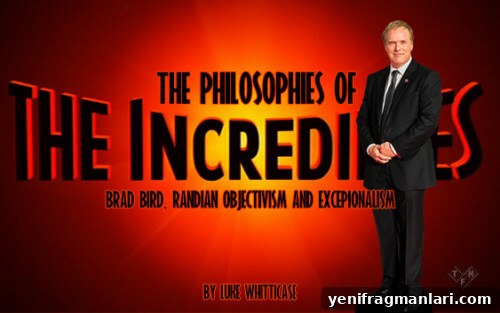
With the release of Incredibles 2 approaching—the long-awaited sequel to Pixar’s 2004 box-office hit—many critics will inevitably discuss how a family-oriented superhero film fits into today’s crowded superhero market. There is, however, another conversation worth having that is more closely tied to the film’s creative lead: writer-director Brad Bird.
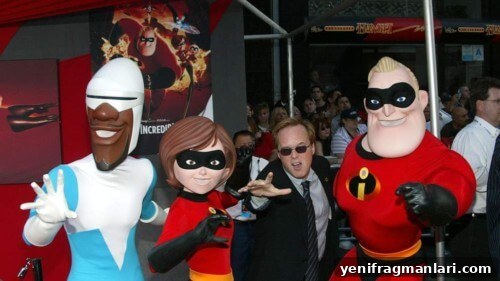
Brad Bird at the premiere for The Incredibles in 2004 | Image: Sky News
Bird has long been celebrated among film enthusiasts for his early work on The Simpsons, his beloved (if under-seen) feature The Iron Giant, and his Pixar films—both The Incredibles entries and Ratatouille. Yet as admirers place Bird on a pedestal, a recurring theme in his films merits closer attention: an ideological strain often linked to Ayn Rand’s Objectivism.
Objectivism, developed by the Russian-American novelist Ayn Rand, rests on several basic tenets: an objective reality independent of consciousness, rational self-interest as a moral aim, and a strong endorsement of laissez-faire capitalism. In Rand’s fiction—most notably The Fountainhead and Atlas Shrugged—characters often function as philosophical symbols, embodiments of her ideas about individuality, creativity, and the moral rights of the exceptional. These themes have echoed through popular culture in many places, including the 2007 video game Bioshock, and occasionally surface in the work of filmmakers attracted to visions of technological progress and heroic individualism.
Brad Bird does not present himself as a political ideologue, and classifying his films purely through the lens of Objectivism would be reductive. Still, certain patterns recur across his work: an affection for Kennedy-era futurism, a fascination with brilliant creators or exceptional individuals, and narratives that celebrate visionary ambition while treating social conformity as an obstacle. Those patterns become more explicit in some of his films than in others.
Take Ratatouille. On a structural level it can be read as a family-friendly retelling of The Fountainhead: an uncompromisingly talented protagonist—here, a rat who cooks—faces a cultural establishment content with mediocrity, while a critic’s influence and the battle for artistic standards drive much of the story. Cooking replaces architecture, but the thematic bones—artistic excellence, the struggle against complacency, and the triumph of talent—are comparable.
Then there is Tomorrowland. Despite its narrative and structural flaws, Tomorrowland is perhaps the clearest expression of Bird’s futurist impulses. Its premise—an idealized enclave built by history’s most imaginative figures—reads as a fantasy of unbridled innovation. The film frames ordinary society as short-sighted or complacent, while the “Plus-Ultras,” a group of visionary thinkers and inventors, attempt to preserve a better future from a distracted public. The result is a story that can read, at times, like a defense of exceptionalism: the idea that certain people or ideas deserve latitude to pursue greatness, even when the broader society resists.
These ideas complicate how we view The Incredibles. Since the original film’s release, critics and scholars have debated whether the film endorses a Randian worldview, or whether its themes are more nuanced. Central to that debate are the film’s primary conflicts.
Bob Parr, a.k.a. Mr. Incredible, chafes against a society that insists on anonymity and mediocrity in the name of safety and conformity. The Super Hero Relocation Program forces “supers” into ordinary lives where their talents are suppressed and their identities hidden. Bob’s frustration stems not only from nostalgia for the past but from a conviction that his family’s abilities make them inherently special and that they should be allowed to express themselves.
Syndrome, the antagonist, further complicates the moral picture. A former fan turned enemy, he becomes a technological mastermind who plans to stage heroic spectacles and then sell his inventions to the public so that “everyone can be super.” His slogan—“when everyone is super, no one will be”—is often read as an odd moral stance: his plan levels excellence by making exceptional power commonplace, and the film treats that equalizing project as villainous. The moral ambivalence here is what fuels debate: is the film defending the privileged rights of the exceptional, warning against enforced mediocrity, or lampooning both extremes?
One useful distinction is between Objectivism and exceptionalism. Objectivism carries a philosophical framework about rational self-interest and the moral primacy of the individual, while exceptionalism is the broader idea that particular people, groups, or nations are inherently special. The Incredibles mixes both ideas: it objects to social systems that stifle individual talent, yet it frames exceptional individuals as deserving special latitude. At the same time, the film resists simple ideological labeling through its character work and emotional stakes.
Ultimately, while Objectivist readings of Bird’s films are provocative and sometimes convincing, they do not fully account for the emotional core that gives The Incredibles its lasting appeal. The film balances big ideas with grounded characters—the Parrs’ family dynamics, their fears, and their love are central. Visually, the film blends classical monumentality with optimistic, retro-futuristic design, mirroring the tension between heroic grandiosity and warm domesticity.
Where Incredibles 2 takes these ideas and the family’s story will reveal how Bird and Pixar choose to expand or complicate those themes. Whether the sequel doubles down on the politics of exceptionality or deepens the characters’ human struggles, audiences will decide how the legacy of the original stands in a changed cultural landscape.
Written by Luke Whitticase
You can support Luke at the following links:
Twitter – @WhittyStuff
Letterboxd – whittystuff