
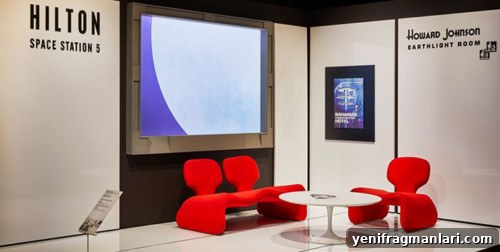
Say the name Stanley Kubrick to almost any film fan and you will get an immediate reaction: respect, curiosity, or even a little unease. Kubrick’s reputation for pushing boundaries and obsessing over craft made him one of cinema’s most formidable figures. The director of landmark films such as A Clockwork Orange, The Shining and 2001: A Space Odyssey—who died in 1999 shortly before the release of Eyes Wide Shut—left a lasting influence on generations of filmmakers, from Christopher Nolan to Steven Spielberg. This summer, London’s striking Design Museum hosts an extensive retrospective that fills the ground floor with memorabilia, manuscripts and meticulously researched material, offering an illuminating look at Kubrick’s working life and creative process.
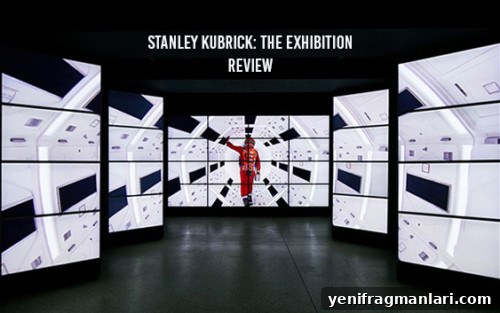
Stanley Kubrick: The Exhibition, on view until 17th September, does more than catalogue a career: it stages an experience. As you enter, images from Kubrick’s films play across screens of varying sizes, evoking the sensory thrill of 2001: A Space Odyssey’s bold visual world. The exhibition blends archival display with cinematic atmosphere, immediately engaging visitors and setting the tone for a visit that balances scholarship with sensory immersion.

Image by Ed Reeve (source).
One of the clearest messages of the exhibition is Kubrick’s relentless attention to detail and the force of his exacting standards. Display cases present notebooks, shot lists, annotated scripts and correspondence that reveal years of preparation for each project. Some cases hold Kubrick’s actual working books; others contain faithful recreations that convey the scale of his research. These objects underline the director’s insistence on total control—from staging and cinematography to the look of posters and promotional materials.
Unlike many directors who leave marketing to studios or outside agencies, Kubrick treated promotional design as part of his storytelling. Posters and marketing proofs dotted throughout the show include his handwritten notes specifying font choices, sizes and printing techniques, evidence of a creator who saw every aspect of a film’s presentation as an extension of the work itself. For The Shining, for example, even the smallest typographic detail could be a matter of artistic intent.
Recommended for you: Kubrick & Kids – The Work of a Dictatorial Director & His Child Stars
Kubrick’s appetite for control extended beyond image and copy: he took an interest in translations and international versions of his films, striving to preserve intended meanings across languages. Yet despite his meticulous control, Kubrick resisted the idea that his films should be read as moral prescriptions. He rejected claims that works of art were responsible for social harm, arguing instead that art should be judged as art.
“The point I want to make is that the film has been accepted as a work of art, and no work of art has ever done social harm, though a great deal of social harm has been done by those who have sought to protect society against works of art they regarded as dangerous.”
The show also highlights how Kubrick’s films sometimes provoked political response. A Clockwork Orange, released in 1971, became a flashpoint for controversy in the UK and was used by some politicians as an example to stoke public concern. Paths of Glory, a 1957 anti-war film, encountered bans and censorship in countries where its critique of military leadership proved contentious. The exhibition places these controversies in context, showing how reaction to a film often reveals as much about the culture receiving it as it does about the film itself.
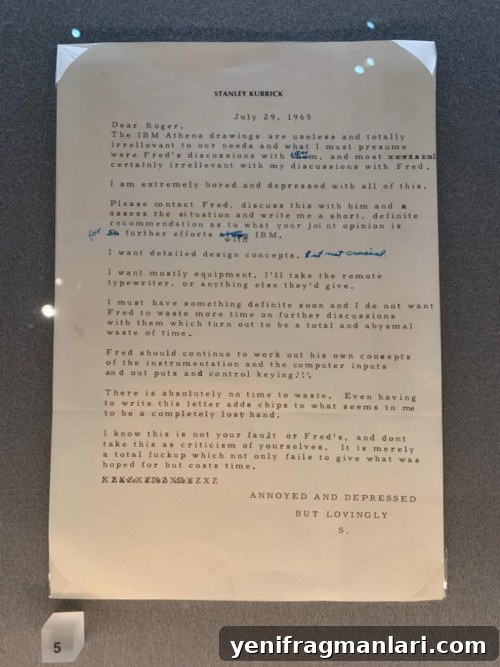
Image: Jason Lithgo (Source)
Letters exchanged with producers, actors and designers reveal Kubrick’s solitary approach to research and filmmaking. Notes from collaborators sometimes express frustration, impatience or distance—testimony to the director’s singular focus. At the same time, these documents are moving evidence of a life devoted to cinema: a creator whose primary allegiance was to the medium he loved and whose work ethic drove him to reshape it.
That determination is central to the exhibition’s appeal. Kubrick was not simply born a filmmaker; he taught himself, studied films obsessively and asked a simple question: can I make this better? That curiosity and discipline produced films that continue to be studied, debated and celebrated. The exhibition honours both his craft and the hard work behind every frame.
Whether you are a lifelong Kubrick fan or a newcomer eager to learn more about filmmaking, Stanley Kubrick: The Exhibition offers insights, surprises and inspiration. Curated with care and displayed with cinematic flair, it is an essential experience for anyone interested in the history and mechanics of great cinema.