
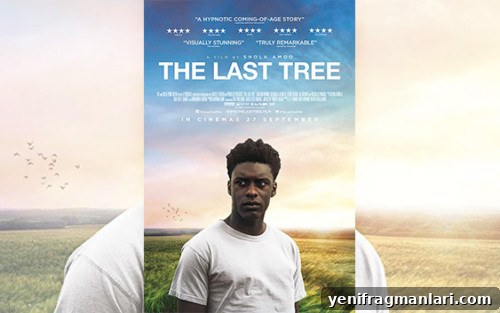
The Last Tree (2019)
Director: Shola Amoo
Screenwriter: Shola Amoo
Starring: Sam Adewunmi, Denise Black, Gbemisola Ikumelo, Nicholas Pinnock
Shola Amoo, who drew praise for his debut feature A Moving Image (2016), returns with The Last Tree, a thoughtful British drama that follows a young Black man growing up amid poverty, class tension and racial politics in London. The film is carefully constructed, well written, and anchored by compelling performances—most notably Sam Adewunmi as the lead—making it more than a conventional kitchen-sink portrait of the underclass. It aims for something more lyrical and intimate, and often succeeds in turning personal struggle into cinematic poetry.
The Last Tree is structured in three distinct acts—childhood, adolescence and early adulthood—each tracing a phase of the protagonist Femi’s life. This tripartite approach, including the use of different actors for the younger and older versions of the character, echoes recent coming-of-age dramas and allows Amoo to map emotional shifts across time. Femi’s journey, which includes a period with a foster parent before returning to his birth mother, explores how love, belonging and displacement shape identity.
The film clearly draws visual and thematic inspiration from other contemporary works that examine inner life and memory. Moments of silence and sensory detail—instances where the camera lingers on Femi’s face or where sound design places the audience inside his head—are among the film’s strongest achievements. Those sequences convey inner turmoil and longing in ways that words alone could not. At its best, The Last Tree uses images and sound to make us feel what the character feels, and to suggest larger social forces at play without heavy-handed exposition.
That said, Amoo’s stylistic homage at times borders on imitation. Certain scenes feel indebted to a recent, celebrated American drama, which can distract from the film’s distinctively British textures: the London neighborhoods, schoollife, local speech patterns and the particular forms of youth violence and survival that the story depicts. While the film aims for universal resonance, there are passages where a stronger claim to local specificity would have lent it more originality.
Pacing is another area where the film is uneven. The middle act—arguably the film’s emotional core—unfolds with power and clarity, but the opening and the final act are less consistent. The first act takes its time to establish character and context, which is useful but occasionally sluggish. The finale shifts tone in ways that can feel abrupt, moving from intense seriousness to lighter moments without always reconciling those changes. As a result, the overall narrative momentum stumbles at points, even if individual scenes remain compelling.
Despite these flaws, the central story is emotionally resonant and thought-provoking. Amoo, who previously explored class and wealth in a London-based docu-drama, brings a humane curiosity to questions of gang culture and youth crime. Rather than simply condemning or endorsing behavior, the film examines root causes—family breakdown, economic precarity and the search for identity—allowing viewers to see how circumstances shape choices.
The cast benefits from Amoo’s steady direction. Sam Adewunmi’s portrayal of Femi feels authentic and lived-in; his choices read as organic rather than scripted. The supporting performers—both veterans and newcomers—are guided to nuanced, believable performances, and the film’s economical production design shields less experienced actors while highlighting their strengths. Amoo demonstrates a gift for eliciting naturalism and for assembling a team that serves the story.
Overall, The Last Tree is an ambitious second feature from a director with a clear aesthetic sensibility. It is sometimes too eager to align itself with recent international hits, and its pacing issues keep it from fully realizing its potential. Still, across its roughly 99-minute runtime the film offers a moving character study, provocative social observation and striking moments of cinematic craft. For viewers interested in British cinema that wrestles with identity, class and belonging, this film provides much to think about and feel.
15/24