
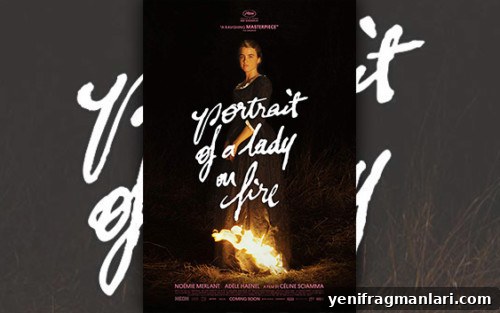

Portrait of a Lady on Fire (2019)
Director: Céline Sciamma
Screenwriter: Céline Sciamma
Starring: Noémie Merlant, Adèle Haenel, Luàna Bajrami
“I’m saying that there’ll be good things too.”
“You’re saying that every now and then I’ll be consoled.”
Céline Sciamma’s Portrait of a Lady on Fire has quietly become one of the defining films of the late 2010s. Winner of the Queer Palm at Cannes and nominated for the Palme d’Or, the film is both a vividly realized period piece and an intimate study of desire, memory, and creative gaze. Sciamma writes and directs with a clarity of purpose: every frame, gesture, and pause matters. The film’s restrained but potent storytelling makes it essential viewing for anyone interested in modern cinema, feminist filmmaking, and the evolution of lesbian romance on screen.
Sciamma stages the story in 18th-century France, where a young painter, Marianne (Noémie Merlant), is hired to paint a portrait of Héloïse (Adèle Haenel), a woman shortly to be married. The job requires secrecy: Marianne must observe Héloïse without her knowledge in order to capture an authentic likeness. From that premise, a slow and quietly electrifying relationship develops. The film’s narrative economy means that small actions—shared glances, a hand held, a phrase repeated—carry enormous emotional weight. Sciamma trusts silence as much as speech, and the result is an immersive, sensory drama.
Visually, the film reads like a sequence of living paintings. The cinematography is rich with color and composed with an artist’s care: light, texture, and negative space are all used to underscore the characters’ inner lives. Sciamma frames the island house, the cliffs, and the sea as both setting and symbol. The ocean functions as a recurring motif—beautiful, vast, and indifferent—suggesting distance, danger, and the border between private intimacy and public life. At the same time, the interiors and portraits insist on attention to detail; the camera asks viewers to look and to consider what looking does to both subject and observer.
Noémie Merlant and Adèle Haenel give performances of rare subtlety and force. Merlant’s Marianne is composed and perceptive, a woman whose professionalism masks a deep hunger for connection. Haenel’s Héloïse is guarded and complex, shaped by family expectations and limited by the social roles available to women of her time. The chemistry between them feels inevitable and newly discovered at once—as if both actors are revealing a shared truth only they can name. Supporting performances, including Luàna Bajrami in a smaller but memorable role, add texture to the film without distracting from its core relationship.
Beyond its immediate love story, Portrait of a Lady on Fire is an exploration of gender, power, and the social constraints that shape women’s lives. Sciamma examines how sexism, religious authority, and notions of propriety confine the characters, making their brief moments of freedom and tenderness all the more poignant. Mental health and social control appear as subtextual pressures, and the film refuses to romanticize its historical context; instead, it uses the period setting to comment on ongoing struggles for autonomy and recognition.
Sound design and music work in tandem with the visuals to deepen the film’s emotional register. Moments of music—when they arrive—feel like revelations, and the quiet ambient sounds of the island amplify the feeling that these events are private, almost sacramental. The film’s pacing allows for contemplation: its deliberate rhythm gives viewers space to register the accumulation of small, meaningful moments.
Portrait of a Lady on Fire is both a love story and a meditation on creative labor. It honors the act of looking—of making and preserving likenesses—while acknowledging the ethical and emotional consequences of that gaze. Sciamma’s direction is assured and compassionate, and her screenplay balances intelligence with feeling. This is a film that rewards repeat viewings: with each return, new details and subtleties become apparent.
Ultimately, the film transcends its period trappings to become a modern classic. It’s a carefully crafted work that combines visual splendor, rigorous storytelling, and profound humanism. For viewers interested in film as an art form, Portrait of a Lady on Fire offers an unforgettable experience.
Score: 24/24