
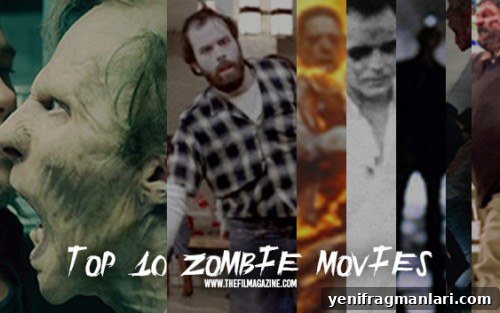
Zombie-Horror, often called zombie cinema, remains one of the most enduring and beloved subgenres of horror. The idea of the dead returning to life continues to fascinate audiences, whether depicted as slow, inevitable hordes or as swift, ferocious predators. Across decades of filmmaking, zombies have been reinvented again and again—each reinterpretation adding new twists to the mythology and influencing the genre as a whole.
Below we rank what we consider the Top 10 Zombie Movies of all time, judging each entry on artistic quality, its approach to the undead, and its lasting impact on horror cinema.
Have an opinion? Leave a comment! And be sure to follow us on Twitter.
Honourable Mentions:
Pride and Prejudice and Zombies (2016) – A playful mash-up set in 19th-century England, led by Lily James and Sam Riley.
Cargo (2017) – A touching Australian take on an outbreak’s effect on family bonds, originally released on Netflix.
Dead Snow (2009) – A darkly comic, gory thriller featuring Nazi zombies in a snowbound setting.
10. I Am Legend (2007)
While some debate whether I Am Legend qualifies as a traditional zombie film, its depiction of reanimated, infected humans places it close enough to earn a spot. Will Smith stars as a lone survivor in an emptied New York, accompanied only by his dog. The film blends emotional isolation with tense encounters against night-stalking creatures born from a global epidemic, bringing both suspense and pathos to the genre.
9. Resident Evil (2002)
Adapted from the popular video game series, Resident Evil introduced mainstream audiences to a slick, high-tech vision of outbreak horror. With Milla Jovovich in the lead, the film mixes sci-fi elements—rogue artificial intelligence, underground labs—with traditional infected-human threats. Stylish action sequences, memorable gore effects, and a strong female protagonist helped the movie become a defining commercial franchise in zombie cinema.
8. Day of the Dead (1985)
George A. Romero’s third major entry in his seminal series leans into claustrophobic survival drama. Day of the Dead confines scientists, civilians, and soldiers to an underground complex as they struggle to study and contain the outbreak. The film escalates the gore and brutality compared with earlier entries, and intensifies tensions between characters—both living and undead—highlighting the genre’s ability to critique human behavior under pressure.
7. Dawn of the Dead (1978)
Romero expanded his vision with Dawn of the Dead, exploring the social fallout of a zombie apocalypse on a wider scale. Set largely within a shopping mall, the film uses the undead as a mirror to consumer culture and social complacency. Its blend of satire, suspenseful sequences, and heightened gore made it a landmark in zombie filmmaking and cemented Romero’s influence on the genre.
6. World War Z (2013)
World War Z translates a global-scale outbreak into blockbuster spectacle. Starring Brad Pitt, the film delivers relentless, high-energy action across several countries, illustrating how an epidemic can overwhelm systems worldwide. Its depiction of fast-moving swarms and citywide collapses refreshed the cinematic vocabulary of the zombie apocalypse and showcased the genre’s potential for large-scale storytelling.
5. Train to Busan (2016)
Yeon Sang-ho’s Train to Busan is a taut, emotionally charged South Korean thriller set largely on a speeding train. As passengers fight to survive a sudden outbreak, the movie examines class divides, selfishness, and the choices people make under duress. Fast-paced and suspenseful, with standout performances from its cast, Train to Busan reintroduced human drama into the heart of zombie horror.
4. Zombieland (2009)
Zombieland Review
Zombieland blends sharp comedy with grisly action to produce a crowd-pleasing take on survival. Anchored by Jesse Eisenberg, Woody Harrelson, Emma Stone, and Abigail Breslin, the film follows four survivors who travel toward a rumored safe haven while following a humorous set of survival rules. The movie’s balance of laughs, violence, and heart—plus memorable cameos—helped it become a modern cult classic.
3. 28 Days Later (2002) / 28 Weeks Later (2007)
Danny Boyle’s 28 Days Later and its sequel redefined the infected as fast, aggressive, and animalistic—departing from Romero’s slow-moving dead. Set primarily in Britain, the series combines visceral thrills with vivid cinematography and a memorable score. The films injected new energy into 21st-century zombie cinema and influenced many subsequent portrayals of outbreak scenarios.
2. Shaun of the Dead (2004)
Shaun of the Dead Review
Edgar Wright’s Shaun of the Dead is a landmark British comedy-horror that fuses clever humor with genuine affection for the genre. Simon Pegg’s everyman Shaun must protect his loved ones as his town is overrun. The film thrives on witty dialogue, inventive kills, and a uniquely British outlook—epitomized by the line about going to the pub and waiting things out—making it both hilarious and heartfelt.
1. Night of the Living Dead (1968)
George A. Romero’s Night of the Living Dead stands as the foundational text of modern zombie cinema. Released in 1968, it popularized the concept of the reanimated dead as slow, relentless consumers of human flesh and established many conventions later filmmakers would reinterpret. Though more restrained by today’s standards, its cultural impact, social commentary, and raw tension make it the essential starting point for anyone exploring the genre.
The History of Zombies in Cinema
That completes our countdown of the greatest zombie films. Which titles did we miss? What’s your personal favorite zombie movie? Share your thoughts in the comments below, and follow us on Facebook and Twitter for more curated lists and film analysis.