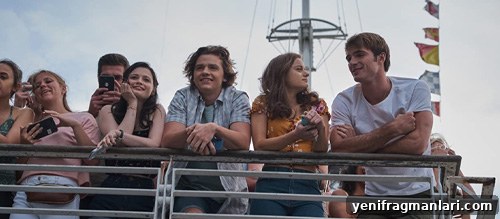

The Kissing Booth 3 (2021)
Director: Vince Marcello
Screenwriters: Vince Marcello, Jay S. Arnold
Starring: Joey King, Joel Courtney, Jacob Elordi, Stephen Jennings, Molly Ringwald
Vince Marcello’s final installment in The Kissing Booth trilogy has arrived on Netflix, closing out a franchise that began as a teenage Wattpad sensation and grew into a global streaming phenomenon. Originating from Beth Reekles’ viral online story, the series successfully translated its bright, youthful energy to screen despite mixed critical reception and an aging cast whose characters increasingly feel out of step with their original teen personas.
The Kissing Booth 3 concludes Elle Evans’s (Joey King) romantic and personal triangle between her best friend Lee Flynn (Joel Courtney) and his older brother Noah Flynn (Jacob Elordi). The film picks up precisely where the last left off: Elle must decide between attending Harvard with Noah or staying in California to go to Berkeley with Lee. The dilemma is presented as a major life choice, yet the movie offers little evidence of Elle’s academic motivations or inner growth. She never seems particularly interested in schoolwork; instead, Elle’s decision-making is driven more by her emotional ties and romantic impulses than by any clear vocational goal.
To spend one last meaningful summer with Lee before college, Elle agrees to complete a nostalgic Beach Bucket List of twenty-two childhood fantasies. The list includes lighthearted set pieces—slushy competitions, a Mario Kart–style go-kart race, a flash mob, cliff diving and sumo wrestling—aimed at recapturing youth and repairing a strained friendship. Meanwhile, Elle balances long shifts at her waitressing job and responsibilities at home, which begins to expose cracks in her relationship with Noah, especially as old flames and personal doubts reappear.
Structurally, the movie leans heavily on montage: a vacation montage, a cleaning montage and a series of beach-activity sequences arrive in quick succession. While these scenes deliver energy, color and spectacle—showcasing lavish houses, sun-soaked locations and upbeat set pieces—the film increasingly feels episodic and unfocused. Marcello appears to oscillate between genres, unsure whether to emphasize friendship, coming-of-age introspection, romantic drama or family dynamics. This scattershot approach dilutes emotional investment and leaves many narrative threads underdeveloped.
Family drama is shoehorned in without much payoff. Elle’s father, previously a minor presence, suddenly introduces a new romantic relationship that garners little meaningful screen time. Veteran actress Molly Ringwald is likewise present on the margins of the story, her role never fully integrated into the main emotional arc. These elements feel perfunctory rather than essential, as if added to enrich the tapestry without real narrative purpose.
Compared to other YA adaptations that explore growth with nuance, such as the To All the Boys series, The Kissing Booth 3 struggles to portray authentic maturation. Where Lara Jean’s journey in that franchise delivers introspection and emotional complexity, Elle’s development remains thin and reactive. A late attempt to give Elle a clearer career direction—an interest in video game design—appears abruptly and without prior setup, undermining its credibility as genuine character growth rather than a last-minute attempt to add depth.
The romantic chemistry between Joey King and Jacob Elordi is another area where the film falters. The relationship lacks the convincing intimacy that would make Elle’s choices feel earned. Elordi’s towering presence and minimal character nuance result in a pairing that rarely convinces. Without authentic sparks or believable emotional stakes, the film’s romantic tension often plays as awkward rather than compelling.
At just under two hours, the movie feels longer than necessary. Wooden dialogue, repetitive beats and recycled high‑school rom‑com tropes dominate the runtime, leaving the finale of the trilogy feeling like a checklist of familiar moments rather than a satisfying resolution. Fans of the series will likely enjoy one last trip to the Flynn beach house and the film’s sunny spectacle, but viewers looking for substantive emotional payoff or surprising growth will be disappointed.
The Kissing Booth 3 functions as a light, nostalgic farewell rather than a meaningful cinematic evolution. It offers bright visuals and a steady supply of teen-movie set pieces, but ultimately it’s an uneven and underwritten conclusion to a franchise that rose from viral origins to mainstream popularity. For those invested in the characters, the film supplies closure; for everyone else, it’s a cheerful but forgettable summer send-off.
5/24