
This article was written exclusively for The Film Magazine by The CineBlog’s Sophie Butcher.
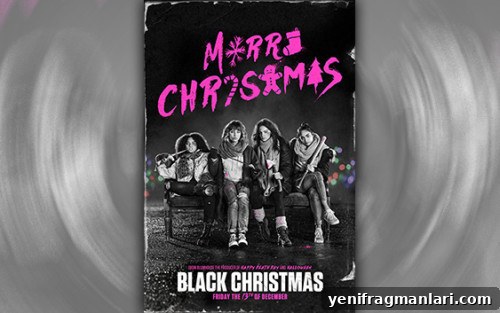
Black Christmas (2019)
Director: Sophia Takal
Screenwriters: Sophia Takal, April Wolfe
Starring: Imogen Poots, Aleyse Shannon, Lily Donoghue, Caleb Eberhardt, Cary Elwes
Black Christmas returns the sorority slasher to campus with a distinctly feminist edge. Directed by Sophia Takal and led by Imogen Poots, this 2019 remake reimagines the familiar holiday-horror template by centering contemporary conversations about gender, power and campus culture. The result is a film that is visually striking and often provocative, but that sometimes struggles to balance its political urgency with effective storytelling.
The story follows Riley (Imogen Poots) and her sorority sisters from MKE as they head into the Christmas break of their final college year. Riley’s friend Kris (Aleyse Shannon) is an outspoken activist who challenges campus tradition: she leads efforts to remove a bust of the college’s founder and questions the male-dominated reading list taught by faculty. The sorority’s activism culminates in a punchy, satirical performance at a frat party — a festive routine staged in Santa outfits that doubles as a sharp critique of campus rape culture.
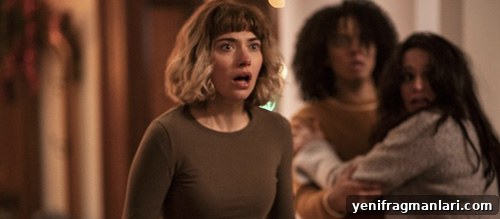
Shortly after, eerie messages begin to arrive, seemingly from the long-dead founder of Hawthorne College, and girls start disappearing. With campus security dismissive — a blunt reminder of institutional indifference — the women are largely left to confront the threat themselves. Takal’s film tries to blend slasher mechanics with a modern, politically aware sensibility, but the screenplay often leans toward didacticism, spelling out its messages in ways that can feel heavy-handed.
Where the script stumbles, the direction and cinematography frequently succeed. Takal and her cinematographer use light and space to compelling effect: strings of Christmas bulbs cast red and green tones across faces, and the sprawling sorority house becomes a memorable set piece filled with doors, hallways and layered compositions. One striking sequence uses a long master shot that gradually illuminates a corridor as doors open in succession, building to an effective jump scare. The opening murder lingers on the image of a victim’s body leaving a snow angel imprint as she’s pulled from frame — a brief, uneasy moment that showcases the film’s visual imagination.
The film’s production choices are notable in part because of its unusual rating history. Initially conceived as an R-rated picture, the filmmakers shifted toward a PG-13 approach to make the movie more accessible to younger viewers. Even so, the deaths are frequently blunt and unsettling: the violence, while less graphic than an R-rated slasher, still lands with a disturbing bluntness. At times the repeated brutal acts against women feel so relentless that the film paradoxically risks feeding into the same cycle of spectacle it intends to critique.
Performance-wise, Imogen Poots is the standout, offering a quiet, layered portrayal of Riley that hints at resilience beneath vulnerability. Poots is given the space to create a fully formed protagonist, and she brings nuance to the film’s more serious moments. Conversely, many supporting characters are reduced to archetypes or to thinly sketched mouthpieces for the movie’s themes; the script’s tendency toward slogan-like dialogue leaves several performers little room to surprise the audience.
That bluntness — the insistence on spelling things out — will likely divide viewers. Some will appreciate the film’s clear political stance and its focus on women fighting back; for others, the tone may feel preachy, diminishing the empowerment moments the movie wants to land. In spite of these flaws, Black Christmas succeeds in offering a fresh, if uneven, angle on the slasher genre: it introduces timely ideas into a familiar framework and provides several visually inventive moments that linger.
Ultimately, Black Christmas is a clumsy but earnest attempt to make a modern horror film for a new generation of female audiences. It may not reward repeated viewings, and its didactic streak undercuts some of the emotional payoff, yet it is likely to hold appeal as a contemporary, conversation-starting entry in holiday horror — perhaps becoming a late-night sleepover favorite for viewers seeking a blend of scares and social commentary.
12/24