
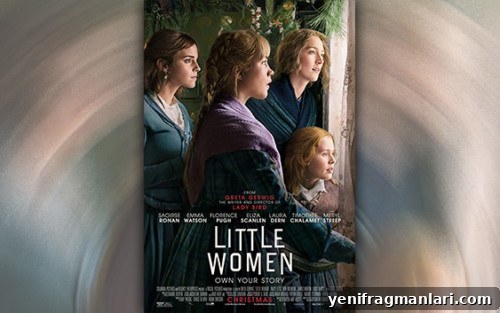
Little Women (2019)
Director: Greta Gerwig
Screenwriter: Greta Gerwig (based on the novel by Louisa May Alcott)
Starring: Saoirse Ronan, Emma Watson, Florence Pugh, Eliza Scanlen, Laura Dern, Timothée Chalamet, James Norton, Louis Garrel, Meryl Streep, Tracy Letts
Greta Gerwig’s 2019 adaptation of Little Women arrives as a fresh, contemporary take on Louisa May Alcott’s enduring novel. At a time when filmgoing can feel like an exercise in cynicism — saturated with remakes, reboots and sequels — Gerwig’s version is both a loving homage and a bold reimagining. She blends modern sensibility with respect for the original text to produce a film that feels intimate, energetic and emotionally honest. This adaptation will likely be the one many viewers remember first, introducing Alcott’s story to a new generation while offering new depth for longtime fans.
Gerwig opens the film in medias res, beginning during the “Good Wives” portion of the book rather than the more familiar opening of Little Women. We meet Jo March (Saoirse Ronan) as a struggling writer in New York, juggling work and ambition while navigating the limits placed on women in her era. The film then moves fluidly between Jo’s present and her past, prompted by an urgent telegram that brings her back to the family home. This flashback-driven structure is not a gimmick; it immerses the viewer in memory and choice, revealing how the sisters change while keeping the core of who they are intact.
That balance between individual growth and familial bond is the film’s greatest strength. Gerwig allows each March sister space to breathe as an independent character: Meg (Emma Watson) as a devoted wife and mother who still longs for beauty and comfort; Amy (Florence Pugh) as an artist in Paris whose apparent vanity masks responsibility and ambition; Beth (Eliza Scanlen) as the quietly loving sister who finds meaning through music; and Jo as the fiercely ambitious, sometimes painfully honest heart of the family. The ensemble chemistry is natural and lived-in; the sisters feel like a real family, complete with bickering, solidarity, rivalry and enduring affection.
Performances anchor the film. Saoirse Ronan’s Jo is headstrong and vulnerable in equal measure, and Florence Pugh’s Amy offers a revelation: she is complex, pragmatic and morally nuanced rather than a one-note antagonist. Emma Watson brings warmth and restraint to Meg, while Eliza Scanlen’s Beth is quietly luminous. The supporting cast — including Laura Dern as Marmee, Timothée Chalamet as Laurie, and Meryl Streep in a brief but pointed role — enhances the emotional texture without stealing focus from the core quartet.
Gerwig’s contemporary sensibility is evident throughout: the dialogue, pacing and thematic emphasis on female desire and autonomy speak to modern audiences while never feeling forced. At times the film flirts with overtly modern phrasing or sentiment, which may feel heavy-handed to some. Yet those moments are balanced by sincere, unsentimental storytelling that reveals why Alcott’s novel endures. The film confronts questions about marriage, economic survival, creative ambition and the social constraints of the 19th century with clarity and compassion.
Much of the film’s power comes from how it reframes traditional tropes. Gerwig resists caricature: gold-digging or social climbing are given context rather than moral shorthand, and sacrifice becomes an act of survival and care rather than mere vanity. Jo’s personal struggle — the desire for independence alongside a yearning for intimate companionship — is portrayed as a realistic and human conflict rather than a binary choice. That ambiguity is one of Gerwig’s most accomplished moves; she refuses to deliver neat answers and instead honors the complexity of women’s lives.
Visually and tonally, the film balances warmth and melancholy. The production design and period details ground the story, while the editing choices — the shifts between past and present — give the narrative a reflective, almost novelistic rhythm. The soundtrack and performances combine to create moments of genuine tenderness and occasional sharp humor. The film also mines surprising comedy from everyday sisterly interactions, making its emotional beats all the more resonant.
Little Women (2019) is not merely a faithful adaptation; it is a reinterpretation that highlights the ongoing relevance of Alcott’s themes. While the fact that many issues Alcott wrote about still resonate today can feel disheartening, Gerwig’s version celebrates resilience, creativity and the power of storytelling. It invites viewers to consider how ambition and love coexist, and how women’s voices deserve space and recognition across generations.
For audiences familiar with the novel, Gerwig’s Little Women offers new insights and emotional rewards. For younger viewers, it serves as an accessible and spirited introduction to a classic text. Though it may not replace every reader’s personal favorite, it is a heartfelt and intelligent film that reaffirms the value of Alcott’s story for contemporary life.
19/24