
Kes (1969)
Director: Ken Loach
Screenwriters: Barry Hines, Ken Loach, Tony Garnett
Starring: David Bradley, Freddie Fletcher, Lynne Perrie, Colin Welland, Brian Glover, Bob Bowes
More than fifty years after its release, Ken Loach’s Kes remains a powerful and painfully relevant portrait of working-class life in Britain. At the heart of the film is Billy Casper, a withdrawn schoolboy who finds brief escape from the hardships of his environment in training a kestrel. Loach’s restrained direction and the naturalistic performances—especially David Bradley as Billy—create an unflinching look at poverty, education, and social hierarchy that still resonates in today’s conversations about class and childhood deprivation.
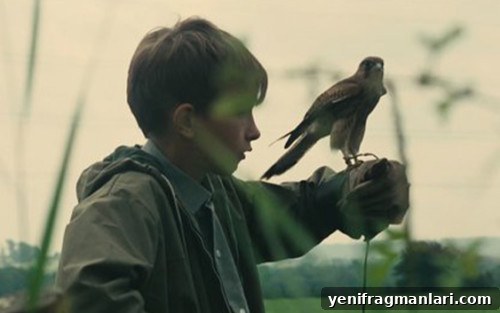
“They say it’s a pet. It int a pet, sir. People come up to me and say ‘int it tame?’ It int tame, sir. They can’t be tamed. They’re manned. They’re wild and fierce and not bothered about anybody. Not bothered about me. That’s what makes it great.”
The relationship between Billy and the kestrel is both tender and paradoxical. To Billy, the bird symbolizes freedom, dignity and a kind of quiet courage—qualities denied to him by his surroundings. Yet Billy captures the young kestrel and trains it to perform for food, a process that involves manipulating and controlling a wild creature until it becomes dependent on him. This mirrored captivity—Billy trapped by poverty and social expectation, the kestrel tamed by necessity—forms the film’s central emotional and political axis.
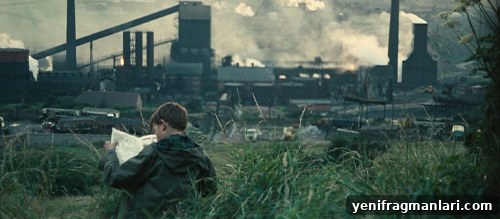
Billy’s life is shaped by the rigid structures around him. He lives in a council estate in an industrial town, attends a school that enforces conformity, and exists within a family pushed to the margins of economic security. His older brother, Judd, embodies a harsher product of the same conditions: aggressive, resentful and quick to dominate. Freddie Fletcher’s Judd is neither a one-dimensional bully nor a mere villain; Loach gives enough context to suggest that his cruelty is itself a symptom of social injustice. The film locates responsibility not only in individuals but in an entrenched system that limits choices and rewards force.
Loach’s use of parallels extends beyond the human-bird relationship. Several scenes stage institutional power and humiliation in vivid terms—most notably a school football lesson in which the teacher twists rules to assert authority, and a later assembly where corporal punishment is administered indiscriminately. These episodes dramatize the everyday mechanisms by which social hierarchies are taught and maintained. A fleeting victory on the football pitch—joyful for some, bitter for Billy—underscores how even small moments of triumph are unevenly distributed.
By contrast, a compassionate teacher offers Billy a rare moment of validation. Invited to speak about his “hawk,” Billy is given time in front of the class to describe his bird. Loach lingers on his face as he speaks, capturing a mixture of pride and longing. That classroom scene is one of the film’s most poignant: for a brief instant Billy is visible, listened to, and admired. Yet the camera and the narrative remind us this is an exception rather than a promise; social forces quickly reassert themselves.
Stylistically, Kes is notable for its understated realism. Loach, working with screenwriter Barry Hines and a largely non-professional cast, crafts moments that feel lived-in rather than staged. The film’s economy of gesture and dialogue allows the underlying social critique to emerge without melodrama. Scenes that might have been sentimental in lesser hands remain restrained and quietly devastating.
More than half a century after its debut, Kes endures as a touchstone of British social cinema. It is not merely a portrait of hardship; it is an indictment of the structures that perpetuate inequality and crush potential. The film’s empathy for its characters, combined with its moral clarity, keeps it urgent: audiences continue to recognize in Billy’s story echoes of contemporary debates about childhood poverty, education, and social mobility.
Kes (1969) stands as one of the great achievements of British filmmaking—a compassionate, critical, and beautifully crafted work from a director who has consistently foregrounded the lives of ordinary people.
24/24