
As The Cabinet of Dr. Caligari passes its hundredth anniversary, it is worth reconsidering why this film still matters and how it continues to shape the language of cinema.
Although it was not the first horror film and rarely appears on mainstream “greatest films” lists, Caligari has been the subject of intense scholarly attention, which has framed much of how viewers and critics understand it. Modern audiences may find some elements quaint — the plot twists feel familiar and the deliberately artificial sets can look obviously stagey — but those surface impressions miss the film’s deeper contribution: its radical visual approach and its role as the touchstone of German Expressionist cinema.
Why keep watching The Cabinet of Dr. Caligari? Because it helped redefine visual storytelling. It established how design, composition and theatricality could communicate psychological states and subjective experience. The film remains a vital example of how cinema can embody inner life through mise-en-scène, set design and stylized performance.
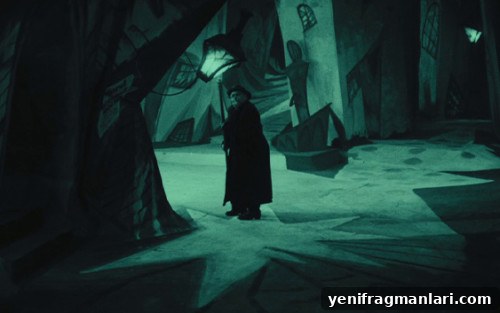
Expressionism began as a reaction against the strictures of realism in painting. Artists distorted form, color and perspective to convey an emotional reality rather than an objective likeness. In Germany, movements such as Die Brücke and Der Blaue Reiter emphasized exaggerated shapes, stark contrasts and symbolic color to break with traditional representation. In film, Expressionism translated into visual strategies that externalize inner states: warped sets, dramatic shadowing, unnaturally angled compositions and exaggerated scale that make the environment reflect a character’s emotions or perception. Unlike Impressionist approaches that rely on camera movement and editing to suggest subjectivity, Expressionist cinema often alters the physical world itself to communicate psychological truth.
Historical context also shaped how the film was made and received. Produced in the aftermath of World War I, when German cinema was largely isolated by wartime bans and import restrictions, Caligari emerged from an industry working inwardly and experimenting boldly. Screenwriter Hans Janowitz served in the war; co-writer Carl Mayer’s relationship to military service has been debated. Whether their wartime experiences consciously informed the film or only filtered through subconsciously is contested, but these biographies informed later readings — most famously Sigfried Kracauer’s assertion that the film reflects anxieties about authority and conformity in Weimar Germany.
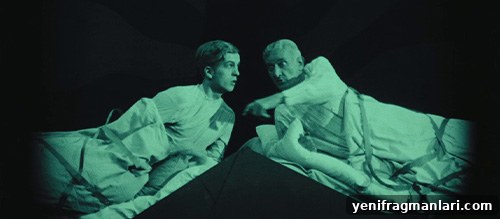
The story itself is straightforward on the surface but carefully structured to unsettle. The film begins with a framed narrative: an older Francis recounts a baffling series of murders in his hometown, Holstenwall. A carnival conjures the enigmatic Dr. Caligari and his somnambulist, Cesare, who predicts the death of Francis’s friend Alan. When Alan is indeed found dead, Francis becomes consumed with discovering the truth. He discovers Caligari posing as a physician who idolizes an 18th-century figure named Caligari; eventually the doctor is detained. The final twist returns to the frame: Francis is revealed to be an inmate in an asylum, and the story we watched is filtered through his disturbed perspective. The doctor, recognizing the patient’s delusion, vows to cure him.
Kracauer’s critique centers on that frame device and its political implications. As he wrote, director Robert Wiene altered the original scenario to place the entire narrative inside Francis’s mind, turning the account into a delusion. For Kracauer, this change undermined an anti-authoritarian reading, leaving instead a film that ends with authority reasserted — the madman cured by institutional power.
“[Director Robert Wiene] suggested… an essential change to the original story, a change against which the two authors violently protested. But no one heeded them. Wiene’s version transforms that account into a chimera concocted and narrated by the mentally deranged Francis.”
That argument depends on privileging an imagined original intention over the finished film. But Expressionism resists fixed readings: it thrives on ambiguity and polyvalence. Once freed from the notion that authorial intent must dominate interpretation, Caligari opens to multiple valid approaches. Some viewers see the film as a reflection on authoritarianism and the manipulation of the masses; others read it as a conflict between modern reason and mythic forces, a cautionary tale about obsession, or a demonstration of cinema’s power to make language and image collide.
The frame story also teaches us to read the film as inherently subjective. From the bench where Francis begins his recounting to the exaggerated trees and gravel path that lead us to Jane — who appears almost luminous in Francis’s eyes — the picture world bends to the narrator’s feelings. When the narrative loops back, those same locations often lose their stark contours, and the asylum scenes are presented with softened shapes and steadier lighting, suggesting a move toward a more ordinary reality. The film’s visual vocabulary constantly signals whether we are inside a character’s perception or seeing something closer to “real” space.

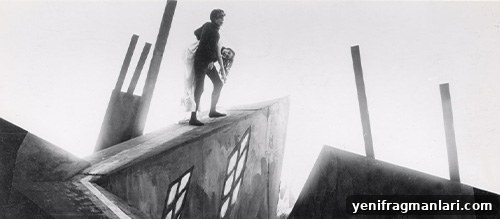
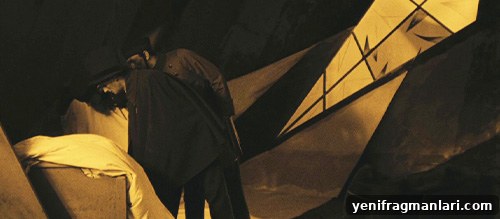
The second half of the film remains striking. Cesare’s flight with Jane across the sharply angled rooftops is a memorable sequence: the Expressionist design permits movements and compositions that would feel impossible in a naturalistic setting, allowing character and environment to merge visually. Intercut moments — Caligari confronted by the corpse of Cesare, or by haunting floating text that proclaims “You must become Caligari” — suggest how Francis’s mind projects dread and desire onto the world around him. These projections highlight cinema’s ability to make the mental tangible.
Viewers should also be aware that many versions of Caligari circulate: restorations and transfers vary in intertitles, coloration, running time and musical score. Some digital copies omit the stylized intertitles and color filters, or pair the film with modernized scores that can undercut its atmosphere; other restorations return intertitles, tints and carefully curated music that better approximates early screenings. Choosing a well-restored presentation will make the film’s visual and rhythmic intentions clearer.
The importance of The Cabinet of Dr. Caligari lies less in a single definitive message than in its demonstration that cinema can be an expressive, subjective medium. It helped establish an aesthetic vocabulary that filmmakers still draw from today. In an era when mainstream films often favor realism, plausible politics and strict narrative logic, Caligari remains a crucial reminder of the power of stylization, imagination and psychological intensity. Its century-long presence in the cinematic conversation encourages filmmakers and critics to keep pushing for art that expands what cinema can show and feel.