
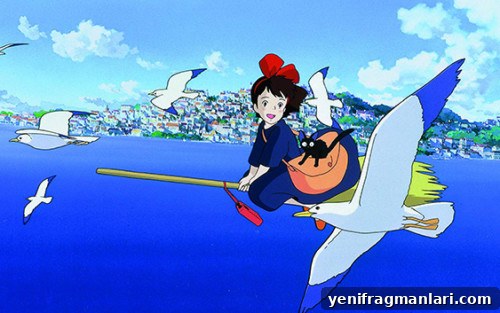
Kiki’s Delivery Service (1989)
Director: Hayao Miyazaki
Screenwriter: Hayao Miyazaki
Starring: Minami Takayama, Rei Sakuma, Kappei Yamaguchi, Keiko Toda, Mieko Nobusawa
Kiki’s Delivery Service is a warm, quietly affecting film that feels like a comforting embrace. Rather than driving toward sweeping drama or epic conflict, Hayao Miyazaki gives us a gentle coming-of-age story that centers on everyday struggles, small victories, and the steady accumulation of confidence.
Miyazaki often divides his work into two tonal families: films that provoke deep reflection and moral inquiry, and films that soothe and restore. Kiki’s Delivery Service firmly belongs to the latter group. Its pleasures come from attentive observation, modest stakes, and the quiet poetry of ordinary life seen through the eyes of a young witch finding her place in the world.
The narrative is intentionally simple. Kiki, a teenage trainee witch voiced by Minami Takayama, moves to a coastal town to spend a year living independently as tradition requires. She supports herself by offering a delivery service, flying on her broom to carry packages and perform small, helpful tasks for the townspeople. The plot resists high drama; for most of the film, Kiki’s challenges are mundane and relatable—finding customers, handling loneliness, coping with exhaustion—and the most dramatic moment early on is a bad head cold contracted after flying through a storm.
Visually, the film reflects Miyazaki’s longstanding fascination with Europe. Although Eiko Kadono’s original book is Japanese, the animated town’s architecture and harbor are inspired by places like Stockholm and other northern European towns. The result is a luminous seaside setting with Scandinavian-influenced rooftops, winding streets, and bright azure waters—an inviting backdrop that enhances the film’s pastoral calm.
The portrayal of witches in Kiki’s Delivery Service echoes a modern, pragmatic idea of witchcraft: witches as workers and neighbors, not sinister outsiders. Kiki’s mother, who trained as a witch herself, practices potion-making and home remedies; she’s competent but human, not mythic. Kiki also meets other witches on her journey—some confident, some flawed—emphasizing community rather than isolation.
Miyazaki has used witches elsewhere in his films with very different emphases. Spirited Away features the domineering Yubaba, a larger-than-life antagonist, while Howl’s Moving Castle includes the Witch of the Wastes, a character who undergoes transformation and decline. Studio Ponoc’s Mary and the Witch’s Flower revisits the theme with a more impulsive heroine. By contrast, Kiki’s charm lies in her steady, everyday heroism: she struggles, she doubts, and she gradually rebuilds her self-belief.
Magic in Miyazaki’s films is rarely a shortcut to happiness; it’s a tool that exposes character and obligation. Kiki makes mistakes and experiences failure, but those setbacks teach her resilience. The most powerful moments in the film are quiet: scenes of Kiki working in the bakery, bonding with the artistic Ursula, or forging a friendship with the enthusiastic Tombo. These interactions build a portrait of maturation that feels honest and emotionally accessible.
At its core, Kiki’s Delivery Service is about confidence and the slow process of reclaiming it. The film recognizes how easy it is for passion to fade under fatigue or failure, and it honors the small acts that restore purpose. For anyone who has felt the strain of trying to find their place—especially young people learning to live independently—the film’s gentle message is consoling: skill, kindness, and perseverance matter, and identity is shaped by daily care as much as by grand gestures.
The animation is gorgeous throughout—Miyazaki and Studio Ghibli craft each seaside scene with meticulous detail, from bustling market stalls to the hush of evening skies. The performances, led by Minami Takayama and supported by a warm ensemble, enhance the film’s intimate tone. Its appeal helped the movie reach international audiences: it was the first Studio Ghibli film to receive a Disney English-language release in 1997, introducing many viewers in the West to Miyazaki’s work.
Kiki’s Delivery Service may not carry the philosophical depth of some of Miyazaki’s grander epics, but it achieves something equally valuable: a tender, reliably human story that comforts while it inspires. It’s an accessible, beautifully rendered coming-of-age film that doubles as emotional therapy—reassuring viewers that growth is messy, communal, and ultimately hopeful.
20/24