
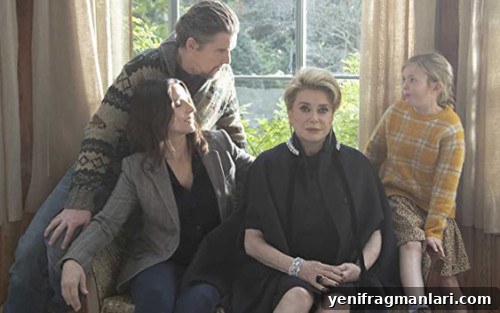
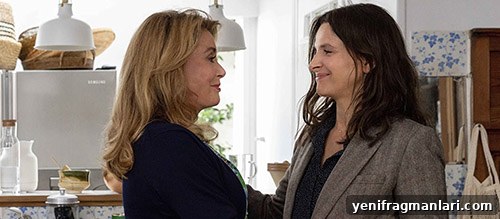
The Truth (2019)
Director: Hirokazu Koreeda
Screenwriter: Hirokazu Koreeda
Starring: Catherine Deneuve, Juliette Binoche, Ethan Hawke, Clémentine Grenier, Alain Libolt, Manon Clavel, Christian Crahay, Roger Van Hool
Hirokazu Koreeda, the acclaimed Japanese filmmaker known for his intimate family dramas, makes a deliberate and affecting departure from his previous work with The Truth, his first film made outside Japan and in a language other than his own. Set in Paris and anchored by luminous performances from Catherine Deneuve and Juliette Binoche, the film explores the complicated bond between a celebrated screen legend and the daughter she raised at arm’s length.
Juliette Binoche plays Lumir, a screenwriter whose family has gathered in Paris to celebrate the publication of her mother Fabienne’s long-awaited memoir. Fabienne, portrayed by Catherine Deneuve, is a glamorous, aging star whose public persona and private life are at odds. When Lumir reads the memoir she finds omissions and distortions that reopen old wounds. The book reshapes public perception of Fabienne’s life—erasing key people and spinning a version of events that disrespects Lumir’s truth.
The central conflict is deceptively simple: a daughter confronts a mother whose career came before family. Fabienne’s refusal to acknowledge the sacrifices of others—most notably Lumir’s surrogate mother figure, Sarah, and Lumir’s own father—sparks a slow burn of resentment. Koreeda uses this rupture to examine memory, legacy, and the way stories are told to reshape reputations. The film does not rely on melodrama; instead, it gradually reveals emotional damages through quiet, precise scenes of two women who share a love of cinema but who have used that passion to avoid each other.
Much of the film’s power comes from the chemistry between Binoche and Deneuve. Their exchanges are sharp and layered: Fabienne offers withering, often passive-aggressive remarks, while Lumir keeps a restrained fury simmering beneath the surface. These performances feel lived-in and truthful, avoiding caricature. When they finally reach a moment of candor, it is not the classic Hollywood reconciliation; instead, they arrive at an uneasy, more realistic acceptance. A small but telling moment comes when Fabienne laments having shown genuine feeling off-camera rather than on it—an admission about the performative nature of her life.
Supporting performances strengthen the film’s emotional core. Ethan Hawke brings warmth and steadiness as Lumir’s partner, while Alain Libolt’s Luc, the longtime assistant, and Roger Van Hool as Lumir’s father add depth to the family constellation. Young Clémentine Grenier catches the eye with a fresh charisma that complements the veteran leads, often providing a quieter perspective on the household tensions.
The Truth also contains a metafilmic strand: Fabienne is working on an art-house science-fiction project in which she plays an older version of a daughter experiencing a reversed aging relationship with her mother. These scenes are meant to mirror and magnify the real-life conflicts between Fabienne and Lumir, but at times the layered self-reflection becomes dense. The glimpses of the filmmaking process bring texture and a thematic echo—how cinema can both heal and distort—but the meta-commentary occasionally piles up and slightly blurs the emotional clarity of the central story.
Still, Koreeda’s direction remains sensitive to nuance. He refuses easy judgments, offering a portrait of a woman who genuinely believes her sacrifices for art were essential, even if those choices wounded the people closest to her. The screenplay gives room for regret and human frailty without turning Fabienne into a villain. The film’s tone is reflective rather than punitive.
While The Truth may not reach the perfection of Koreeda’s finest Japanese work, it is a thoughtful, finely acted drama that succeeds in capturing the painful complexity of family and fame. The movie asks how we reconcile public mythology with private memory, and whether storytelling can ever fully recover what was lost. For viewers drawn to character-driven films and performances that quietly command the screen, The Truth offers a rewarding, emotionally honest experience.
19/24