
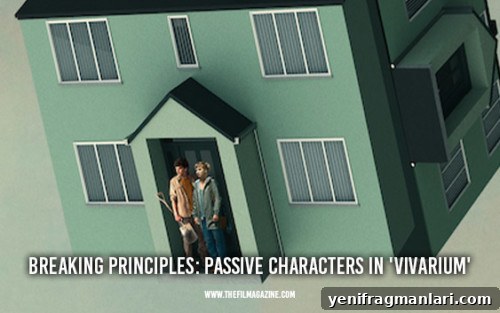
Vivarium: How Passive Characters Frustrate and Reveal the Horror of Suburbia
I saw Vivarium at Abertoir Festival 2019 and left divided about the film’s choices—some viewers complained it was slow and evasive, while others (myself included) appreciated it for exactly those qualities. Now that the film has had an online release, I want to examine the element I found most compelling: the way the film deliberately frustrates the audience by centring on actively passive characters and breaking familiar screenwriting rules.
Spoiler warning: I discuss the film in depth below. Watch it first if you want to avoid plot revelations.

Many critics have read Vivarium as a critique of suburban horror: the coldness of modern life, the sterilisation of individuality, and the unsettling clarity of an ideal made oppressive. That reading is valid—the film’s controlled, clinical atmosphere and its endlessly repeating streets create a disquieting mood. But these themes gain extra force because the film refuses to populate its story with the kind of active characters screenwriting convention usually demands.
In traditional storytelling, protagonists are active: they pursue goals and drive events forward. Think of James Bond racing across the world to stop a bomb, or the romantic lead in a rom-com staging elaborate schemes to win someone over. Active characters make choices, take risks, and through those actions move the narrative along.
By contrast, passive characters let the story happen to them. The action unfolds around them rather than because of them. A familiar film example is when a character’s escape seems to succeed only because circumstance conveniently aligns—the character reacts and survives, rather than creating their own path. Screenwriters often warn against passivity because it can make audiences feel cheated: when a hero never struggles to change their world, the drama can evaporate.
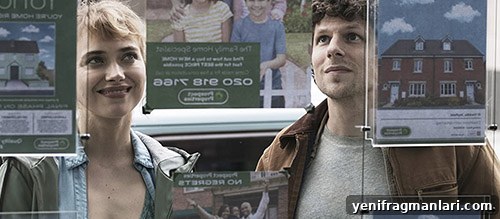
In Vivarium, Tom and Gemma (Jesse Eisenberg and Imogen Poots) repeatedly try to escape a suburban labyrinth, but every effort is stymied. They walk and drive, paint help on a roof, and eventually try to force answers from the strange child they are forced to raise. Tom begins to dig a tunnel; every apparent breakthrough closes. The film keeps cutting back to their daily rituals—brushing teeth, preparing meals—showing them succumbing to a monotonous routine. They exhaust active measures and then settle into compliance.
This repeated failure of agency is deeply frustrating for viewers trained to expect progress. Whenever the story seems about to open up—whenever we think the characters have found a lead—the film shuts the door. A surreal sequence near the end flashes images and impressions without delivering concrete facts; it underscores that something unusual is happening, but it refuses to explain the mechanics. The conclusion, with the couple replaced and the cycle beginning anew, emphasizes repetition rather than revelation.
That refusal to answer core questions—who or what built this suburban trap, how the food is produced, why no one stumbles upon the estate, whether there are external agencies at work—feels maddening at first. But the point is thematic: Vivarium is less interested in resolving its mystery than in interrogating the comfort of a prescribed ideal. The film reads as a parable about aspirational normality—how society presents the tidy house, partner, and child as the default, desirable life. Stepping beyond that narrative, pursuing individuality or unconventional goals, invites pressure to conform.
In that interpretation, the unseen forces that maintain the suburb—be they institutional, cultural, or symbolic—act to neutralise dissent. The film’s structural choice to frustrate an active-protagonist expectation becomes a storytelling device that mirrors real social pressure: every attempt to escape the imposed norm is met with resistance, and eventually surrender feels like the only option.
One unexpected benefit of this approach is that it foregrounds character. With no external monsters, conspiracies, or grand displays to distract us, we spend long stretches with two people in confinement. We watch their small pleasures—dancing in a car’s headlights—and their slow erosion into boredom and resentment. The actors are given space to inhabit the minutiae of domestic life and emotional strain, and as viewers we are compelled to share those intimate moments.
By inverting the conventional principle that protagonists should be active, Vivarium turns passivity into a tool. The film’s restraint and repetition replicate the suffocating predictability it aims to critique, and its emotional impact comes from watching characters do what modern life often asks of us: endure, perform normality, and accept the scripts handed to us. That choice, once you accept it, makes the film both disconcerting and hauntingly convincing.
Article by Kieran Judge
Twitter: @KJudgeMental