
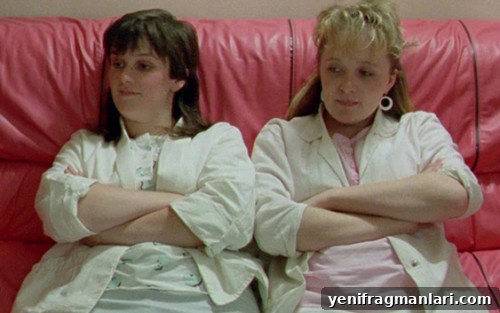
Rita, Sue and Bob Too (1987) — Review
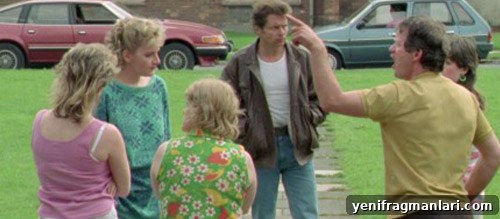
Rita, Sue and Bob Too (1987)
Director: Alan Clarke
Screenwriter: Andrea Dunbar
Starring: Michelle Holmes, Siobhan Finneran, George Costigan, Lesley Sharp
Overview
Branded with the strapline “Thatcher’s Britain with her knickers down,” Rita, Sue and Bob Too could easily be dismissed as an ironic, sensational 1980s drama about working-class sexual looseness. But the film, adapted from Andrea Dunbar’s stage play and directed by Alan Clarke, works from a realist tradition that gives the premise depth. What initially reads as sordid is, in fact, a textured exploration of class, gender, morality and community — delivered with a dark, often uncomfortable humour.
Setting and Visual Approach
The film opens with a striking tracking shot that establishes its world immediately. Clarke follows Sue’s father stumbling home drunk from The Beacon pub and then latches onto Sue herself as she moves through her neighbourhood to visit Rita and later Bob and Michelle. Shot and set in Bradford — including the Buttershaw estate where Dunbar was raised and more middle-class Baildon — the film charts contrasting living conditions: the tight-knit, high-rise flats and council estate blocks give way to detached houses with garages, the visual shorthand for social aspiration in Thatcher-era Britain.
That contrast is reinforced by sound and song. When Rita and Sue enter the couple’s home, Madness’ “House of Fun” plays, its lyric “Welcome to the house of fun, now you’ve come of age” signaling both the relative ease of the household they serve and the uneasy events that will unfold there. These production choices make the film feel consciously arranged to expose tensions in class and culture without resorting to caricature.
Tone, Humour and Realism
Much of the film’s power comes from its humour, which keeps the material from collapsing into pure sordidness. The sexual encounters are intentionally unglamorous: at one point Rita declares, “It’s like a frozen sausage,” and complains of boredom. That blunt, comic realism forces the viewer to confront how this kind of behaviour is normalized in some communities rather than sentimentalised. The comedy often contains a sharp undertow of sadness that haunts the characters and the film as a whole.
The pivotal scene — where neighbours lean from windows to jeer at an intensely private argument, one even calling it “better than ‘Match of the Day’” — is a superbly observed piece of social theatre. It feels painfully authentic: the dialogue rings natural, the performances feel lived-in, and the surrounding laughter heightens the isolation of the characters involved. Clarke and Dunbar employ this blend of humour and bleakness repeatedly, making the film both funny and hard to watch.
Characters and Criticisms
The film is not without its faults. Some of Dunbar’s more testing, ultra-realist impulses are softened, particularly in the characterisations of Rita and Sue. On screen they sometimes read as silly schoolgirls, their conversations reduced largely to when they might next get “a jump” with Bob. The cinematic ending diverges from the original stage play, a change that did not sit well with the Dunbar family and diluted some of the play’s sharper social critique.
The ethical complexities remain uncomfortable. The film treats the affair — between a man presented as 26 in the premise and two 15-year-old schoolgirls — with a troubling casualness. In retrospect, the revelation that George Costigan, who plays Bob, was 40 when the film was released makes the dynamic more troubling, and Clarke and Dunbar do little to obscure or diminish that reality. Still, the girls retain agency; their choices and language feel authentic to their environment even if the framing sometimes feels sentimentalised.
Legacy and Importance
Despite its imperfections, Rita, Sue and Bob Too remains an important British film. It resists becoming “poverty porn” by treating its subjects with humanity and respect, and by anchoring its scenes in genuine lived experience rather than spectacle. It offers a vivid snapshot of a particular time and place in northern England, and it stands out as a hyper-naturalistic working-class northern comedy-drama with a sharp eye for detail and character.
For viewers familiar with Yorkshire-set dramas, the film’s combination of humour, realism and social critique will feel recognisably authentic. For those encountering it for the first time, the film offers both discomfort and insight — a testament to Andrea Dunbar’s voice and Alan Clarke’s ability to translate that voice to the screen.
Score: 22/24