
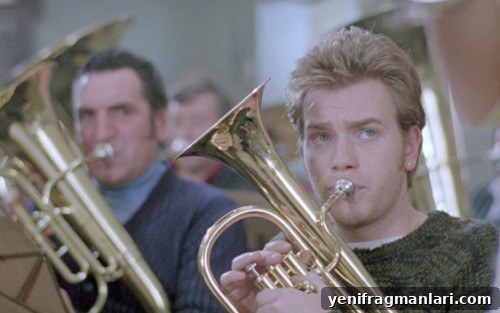
Brassed Off (1996)
Director: Mark Herman
Screenwriter: Mark Herman
Starring: Pete Postlethwaite, Ewan McGregor, Tara Fitzgerald, Stephen Tompkinson, Jim Carter, Philip Jackson, Peter Martin, Sue Johnston, Mary Healey, Melanie Hill
Mark Herman’s Brassed Off (1996) is a British drama that balances social critique and emotional storytelling through the lives of a Yorkshire mining community and its brass band. Set against the backdrop of pit closures in the late 1980s, the film follows a local colliery band as its members confront redundancy, economic hardship and the fight to retain dignity. Herman wrote and directed the film, shaping a work that blends regional authenticity with broader cultural resonance.
The film’s cast anchors its emotional core. Pete Postlethwaite delivers a memorable, grounded performance as the band’s conductor and a man grappling with the erosion of his community’s livelihood. Ewan McGregor, appearing in the wake of his breakout year, brings youthful vitality and empathy to his role. Supporting performances from Tara Fitzgerald, Stephen Tompkinson and Jim Carter help create a vivid ensemble that conveys both the pain and the stubborn resilience of a town under threat.
Brassed Off avoids the predictable beats of a conventional sports-style underdog movie by focusing on character, history and the cultural importance of music. The brass band functions as more than a competitive unit; it becomes a living metaphor for community cohesion and personal identity. Herman’s screenplay draws careful parallels between each musician’s contribution to the ensemble and their place in the wider social fabric, emphasizing how music preserves memory and dignity when economic forces strip away stability.
The film also communicates a clear social critique. It examines the consequences of mine closures on working-class families and communities, exploring themes of unemployment, loss and social neglect. Music in Brassed Off evolves from a reluctant pastime into a rallying force: the band transforms private grief into collective purpose. The soundtrack and performances underline this shift, making every musical moment count as an expression of defiance, hope and shared humanity.
Technically, the film benefits from a straightforward but effective approach to cinematography, production design and sound. Settings and costume details convey the period and setting convincingly, while the musical arrangements underscore the story’s emotional arc. Herman’s direction remains focused on clarity and empathy, prioritizing the lived experience of his characters over melodrama. The result is a film that feels both intimate and socially engaged.
Critically, Brassed Off has been praised for its compassion and authenticity rather than for flashy cinematic tricks. Herman, who drew on his own roots in Yorkshire, crafts scenes that feel honest and specific: family interactions, workplace tensions and rehearsal-room dynamics are depicted with care. The film portrays the miners and their families as complex individuals, resisting simplistic caricature and encouraging viewers to understand the human cost behind political and economic decisions.
While some commentary has simplified the film into a familiar “northern drama” stereotype, Brassed Off consistently rises above such reductive readings. It offers a rich portrait of community life, honoring ordinary acts of courage and solidarity. The balance between social conscience and emotional storytelling makes the film a notable entry in British cinema of the 1990s, appealing to audiences who appreciate character-driven dramas with a clear moral center.
In short, Brassed Off is a compelling and well-crafted film that combines strong performances, sincere direction and meaningful music to tell a story about loss, resilience and the power of collective identity. Its focus on humanity and empathy, supported by a memorable ensemble cast and a thoughtful screenplay, secures its place as an important British drama.
21/24