
This article was written exclusively for The Film Magazine by Eve O’Dea of eveonfilm.com.
Cléo from 5 to 7 (1962)
Director: Agnès Varda
Screenwriter: Agnès Varda
Starring: Corinne Marchand, Antoine Bourseiller, Dominique Davray, Dorothée Blank
Agnès Varda is often cited as the lone prominent female voice of the French New Wave, and her filmography has long been admired for blending visual inventiveness with compassionate storytelling. While her debut feature, La Pointe Courte (1955), already hinted at the movement’s sensibilities—its photographic compositions, observational approach, and thematic focus on ordinary lives—it is Cléo from 5 to 7 (1962) that secured Varda’s reputation as a masterful filmmaker whose work transcends any single cinematic trend.
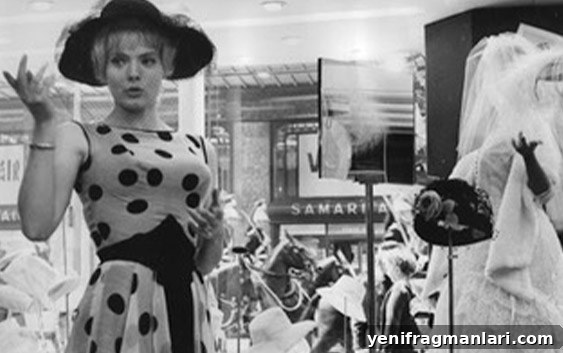
Cléo from 5 to 7 follows a young, rising pop singer, Cléo, as she wanders through Paris over ninety minutes while awaiting the results of a medical test that could confirm stomach cancer. The film tracks her encounters with friends and strangers, and traces the shifting tensions between her public image and private fears. What may read as a simple slice-of-life narrative becomes an intimate portrait of vulnerability, identity, and the ways we seek solace when faced with possible mortality.
On the surface, Varda’s film shares many stylistic traits with the French New Wave: striking editing choices that call attention to form, a Paris that mixes modern life with historic spaces, an avoidance of strict genre boundaries, and a luminous female lead. Yet Cléo from 5 to 7 departs from the movement’s prevailing cynicism. Where contemporaries often embraced irony, detachment, and a brusque, sometimes bleak tone, Varda’s approach is defined by empathy. Her camera registers people with curiosity and warmth rather than disdain. In interviews she emphasized this ethos: “Nothing is banal if you film people with empathy and love,” she said, and added that she preferred to be a friend to her subjects rather than an intrusive observer. That stance informs every moment of this film.
Cléo herself is flawed: vain, melodramatic, occasionally selfish and theatrical. Yet Varda paints her with tenderness, so that viewers come to understand and sympathize rather than judge. Corinne Marchand’s performance is magnetic—she embodies Cléo’s glamour and insecurity in equal measure, making the character both compelling and heartbreakingly human. It’s easy to wonder why Marchand didn’t achieve the long, high-profile career of some of her peers; her work here is quietly unforgettable.
Varda uses editing and imagery to reflect Cléo’s inner turmoil and the alienation of urban life. Mirrors recur throughout the film—fractured, streaked, or multiple—symbolizing Cléo’s fragmented self-image. She rehearses different faces and costumes as if trying to find a safe identity, while crowds and glances from strangers remind her she is constantly looked at. Scenes that place the camera in the midst of passersby, with pedestrians occasionally staring directly into the lens, heighten that sense of exposure.
The film also examines how women’s bodies are observed and evaluated. Cléo’s friends drink from novelty glasses bearing pinups; later, she visits her friend Dorothée posing nude in an artist’s studio. Dorothée’s calm acceptance contrasts sharply with Cléo’s anxiety: “I’d feel so exposed, afraid they’d find a fault,” she admits, while Dorothée replies that those sketching are seeing an idea more than a person. Varda uses these moments to explore how female identity can be reduced to shape or spectacle, and to show how deeply unsettling that experience is for someone like Cléo, whose self-worth is tied to image and appearance.
Beyond the personal, the film gestures toward broader social realities. Released while France was embroiled in the Algerian War, the movie can be read as a quiet commentary on national indifference. Cléo represents a section of society absorbed in itself—image-conscious and insulated—while others face violence and sacrifice. This contrast crystallizes in Cléo’s encounter with Antoine, a young man in uniform. Initially evasive, Cléo gradually allows him into her orbit; their late-afternoon conversation becomes a moment of mutual recognition and emotional honesty. Antoine, poised to depart for Algeria, embodies a world of danger and uncertainty outside Cléo’s concerns. Varda frames their connection not as a traditional romance but as a human alliance of empathy and support—one that restores Cléo’s perspective and, in a bittersweet way, exposes the costs borne by others.
What makes Cléo from 5 to 7 enduring is Varda’s ability to craft scenes rich in small, meaningful details. Her sets are often ordinary streets, cafes, and studios, yet every frame is composed with care; objects and gestures accumulate meaning and reward careful viewing. There is no need for spectacle because the ordinary world she films is already full of texture and feeling. Filmed with a clear affection for people and the city they inhabit, the film invites repeated viewings and continues to reveal new layers.
24/24
Written by Eve O’Dea
You can support Eve O’Dea in the following places:
Website – eveonfilm.com
Twitter – @EveOnFilm