
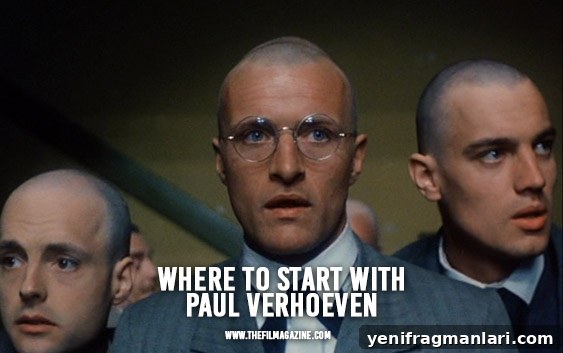
Paul Verhoeven is one of cinema’s most misunderstood and versatile directors. From intimate arthouse work in Europe to brazen, sexually charged studio pictures in Hollywood, and the polarising spectacle that was Showgirls, his career resists easy categorization. Beyond his well-known taste for provocative imagery, Verhoeven has repeatedly returned to political and moral questions, using shock, satire and dark humor to expose uncomfortable truths about human nature and society. Between boundary-pushing European dramas and headline-making Hollywood features, he also left a lasting mark on science fiction cinema by taking commercial genre material and reshaping it in his unmistakable voice.
In the Netherlands, Verhoeven moved quickly from television into bold, socially engaged films that probed national identity and historical memory. Early works such as Turkish Delight (an Academy Award nominee for Best Foreign Language Film), Soldier of Orange and later Black Book are widely regarded among the most important Dutch films, studying collaboration, resistance and moral ambiguity during wartime.
When Hollywood began to court him, Verhoeven spent the late 1980s and 1990s reinventing and interrogating genre. He took what could have been simple B-movie material, or faithful adaptations, and turned each into films that deliberately shifted or amplified the source material’s message. After a period of mainstream success, he returned to Europe in the 2000s to pursue more personal projects.
Verhoeven’s films repeatedly combine explicit sex, graphic violence and satirical intelligence. He uses these elements both to provoke and to clarify—highlighting the darker impulses of society while often relishing cinematic excess. He is an auteur who understands the power of controversy: his films tend to be playful and mischievous even when they are brutally critical. That same irreverent streak extended to accepting criticism in public—he famously attended the Razzie ceremony for Showgirls.
Across fifteen films spanning five decades, where should you begin to explore a provocative filmmaker like Paul Verhoeven? Below are three essential starting points that illustrate his range: from erotic thriller to serious wartime drama to satirical science fiction.
1. Basic Instinct (1992)
Basic Instinct follows a homicide detective (Michael Douglas) investigating a rock star’s murder who becomes both obsessed with and suspicious of the victim’s girlfriend, a successful crime novelist played by Sharon Stone. The film crystallizes many of Verhoeven’s recurring concerns: erotic power, manipulation, and the blurring of performance and reality.
As a hallmark of Verhoeven’s Hollywood era, Basic Instinct is stylish, sleazy and deliberately provocative. It helped define the early 1990s cycle of erotic thrillers—intensely choreographed sex scenes, stylized violence and a central mystery that keeps the audience off balance. While controversial for its explicit content and for the production choices surrounding key scenes, the film is also a propulsive thriller with frequent twists and a performance by Sharon Stone that launched her to international stardom.
More than mere titillation, the movie uses sexual transgression and moral ambiguity to ask uncomfortable questions about why certain images and behaviors are taboo, and how societal norms shape our judgment of desire and danger.
Recommended for you: Where to Start with Terrence Malick
2. Soldier of Orange (1977)
Based on real experiences, Soldier of Orange follows university friends led by Erik Lanshoff (Rutger Hauer) as World War II upends their lives in Nazi-occupied Netherlands. Across its long runtime the film traces how ordinary young men—ambitious, fearful, idealistic—make morally fraught choices under extraordinary pressure.
Many consider this Verhoeven’s finest work. It approaches national history with a clear-eyed and unsentimental gaze, balancing unflinching depictions of cruelty with moments of human warmth and resilience. The film gives each character space to evolve, creating emotional investment that makes each loss, betrayal and act of courage resonate deeply.
Even here Verhoeven’s irreverence surfaces: amid bleak events his characters still display youthful recklessness and occasional defiance, and Verhoeven doesn’t shy away from using visual irony—mocking the pomp of authority—to undercut fascist pretensions. Soldier of Orange is a rigorous, moving exploration of friendship, conscience and survival in wartime.
3. Starship Troopers (1997)
Starship Troopers follows Johnny Rico and his classmates as they enlist in the Mobile Infantry to earn citizenship and fight a terrifying alien insect species known as the Arachnids. On the surface it looks like a high-energy action movie, but Verhoeven turned it into a biting satire of militarism, propaganda and authoritarian culture.
Taking Robert Heinlein’s novel as a starting point, Verhoeven exaggerated its militaristic rhetoric and fascist iconography into a deliberately cartoonish state propaganda machine. The film mocks mindless patriotism and the glorification of violence—its on-screen newsreels and recruitment messages are intentionally chilling in their banality. Many viewers who missed the film’s satirical aim took it at face value, which speaks to how effectively Verhoeven replicated the style of propaganda he was critiquing.
Like much of his work, Starship Troopers blends spectacle with subversion: muscular action, young casts, and frequent nudity sit alongside an unsettling critique of how societies manufacture consent and normalize violence. Its cultural impact endures through quotes, imagery and debates about satire versus sincerity in blockbuster filmmaking.
Together, these three films illustrate Paul Verhoeven’s range: a director who moves between intimate moral drama and loud, controversial entertainment while always interrogating power, desire and ideology. Whether you begin with the erotic tension of Basic Instinct, the moral complexity of Soldier of Orange, or the savage satire of Starship Troopers, you’ll encounter a filmmaker who refuses easy answers and delights in challenging his audience.
Recommended for you: Where to Start with Akira Kurosawa