
Pieces of a Woman (2020)
Director: Kornél Mundruczó
Screenwriter: Kata Wéber
Starring: Vanessa Kirby, Ellen Burstyn, Shia LaBeouf, Iliza Shlesinger, Benny Safdie, Sarah Snook, Molly Parker
Grief is a paradox: deeply personal yet universally recognizable. It can make a person feel as if they are nothing more than the scattered fragments of who they used to be, with a heavy, unfamiliar emptiness filling the spaces between. Kornél Mundruczó’s Pieces of a Woman captures that feeling with acute sensitivity. The film’s achievement is not in dissecting grief clinically, but in forging a connection between the screen and the audience, letting viewers recognize and feel life at its most shattered.
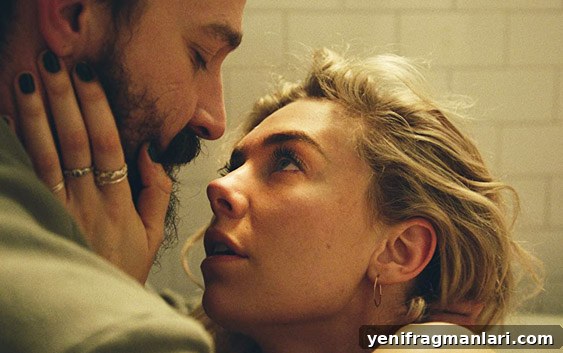
The film begins with Sean (Shia LaBeouf), a blue-collar worker who jokes about his rough edges, and his heavily pregnant partner, Martha (Vanessa Kirby). Early moments set a grounded domestic tone: a gift of a framed ultrasound, a new car prepared by family, and the couple’s decision to have a home birth. Those ordinary details make the film’s later tragedy all the more devastating.
One of the film’s most talked-about sequences is an extended, uninterrupted real-time scene of the labor and delivery. Over roughly twenty-four minutes, the camera remains close to Martha and Sean as their planned home birth takes a dangerous turn. Complications accumulate—an absent midwife, a frantic replacement, an erratic fetal heartbeat—and the scene moves from hopeful to harrowing without a single cut. Mundruczó’s choreography and the actors’ performances create an immersive intimacy: when the sequence ends, viewers have lived the ordeal with the characters and understand the depth of their loss.
What follows is a portrayal of grief that is raw and unprocessed. The film tracks the aftermath—how two people who loved the same child navigate a grief that pulls them in different directions. Time passes in small, ordinary increments: unremarkable dates and empty routines that nevertheless feel like milestones in a life that no longer makes sense. Questions proliferate: how do you name a life that ended before it began? What do you do with the body? Who, if anyone, is responsible? Martha retreats inward, obsessing over small acts that suggest a longing to recreate life, while Sean spirals outward into substance use and self-destruction, undoing years of sobriety. Martha’s mother, Elizabeth (Ellen Burstyn), channels her own trauma and insists on legal action, bringing in cousin Suzanne (Sarah Snook) to pursue a negligence case. These tensions—between avoidance and confrontation, private grief and public blame—drive the film’s emotional core.
The performances are the movie’s backbone. Vanessa Kirby gives a searing, controlled performance as Martha, a woman living in a state of muted devastation. She conveys a constant, simmering pain through small gestures and silences, making her character’s internal collapse both believable and heart-rending. Shia LaBeouf brings his characteristic intensity to Sean, creating a volatile, unpredictable presence that feels perpetually on the edge. Some viewers may find certain scenes uncomfortable given public controversies surrounding the actor, but within the film his performance functions as an engine of combustible grief.
Supporting performances add texture and counterpoint. Ellen Burstyn brings a brittle, forceful determination to Elizabeth, channeling decades of emotional weight. Sarah Snook’s Suzanne and Molly Parker’s midwife Eva provide additional layers, expanding the film’s portrayal of how family, friends, and professionals respond to tragedy. Even when the plot threatens to verge into melodrama—an ill-advised affair, courtroom confrontations—the ensemble often pulls the film back to a more honest, lived-in place. Kirby, in particular, anchors the film; much of its impact depends on her ability to embody sorrow without spectacle.
Pieces of a Woman explores the unique contours of motherhood, loss, and recovery. It doesn’t offer tidy answers, nor does it romanticize suffering. Instead, it traces the slow, uneven process of healing: how people gather the broken parts of themselves and, sometimes, begin to put them back together. The film is unflinching and at times brutally difficult to watch, yet it ultimately gestures toward resilience. Its greatest gift is the possibility it suggests—that even after profound loss there is room for reconstruction, however fragile the new shape may be.
20/24