
What We Do in the Shadows and the “Man Alone” in New Zealand Cinema
In New Zealand film, the figure known as the “man alone” traditionally symbolizes humanity’s struggle to assert control over a harsh natural environment. Over time, this figure has evolved alongside urban growth and changing social identities that no longer cling to the colonial past. Taika Waititi and Jemaine Clement’s What We Do in the Shadows reframes that archetype for 21st-century Wellington through vampire cinema and the genre’s rich intertextual tradition.
Andrea Bosshard describes the “man alone” as a distinctly masculine figure who survives by mastering his physical surroundings—someone who can convert a length of number-eight wire into whatever is needed, a shorthand for so-called “Kiwi ingenuity.” Allan Cameron traces the archetype to John Mulgan’s Man Alone (1939), noting that this figure sits between the wild landscape and the domestic sphere. In contemporary Wellington, however, that boundary has blurred: the domestic life often takes place within the urban landscape, residents are globally connected, and survival more commonly means paying rent and bills than battling the elements.
Vampires, creatures suspended between life and death, serve as a modern counterpart to the “man alone.” Their secluded existence—driven by unusual habits, arrested aging, and lethal appetites—makes them vulnerable to discovery and persecution. Seclusion is also central to vampire iconography: Dracula’s remote Transylvanian castle is a recurrent image. What We Do in the Shadows foregrounds this tension while also challenging the stereotype: Viago, the film’s primary interview subject, acknowledges the isolated-castle trope but explains how vampires often band together in cities where survival depends on adapting to modern urban complexities.
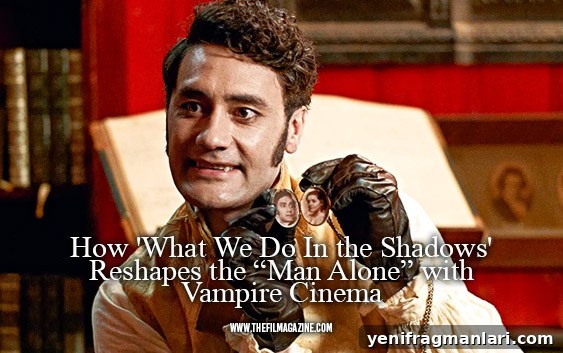
Viago most clearly embodies the updated “man alone.” Transformed into a vampire centuries ago in Germany, he now lives in a shared Wellington house where he functions as a considerate, almost civic-minded leader. Viago is displaced in time and tone—an intertextual parody of the grave, romantic vampires of earlier cinema. He shares traits with those predecessors but remains rooted in the film’s absurd, contemporary world.
Viago’s backstory emphasizes his melancholic distance from his human past. He once followed his lover Katherine to New Zealand with the intention of marrying her, but a shipping mistake left his coffin delayed and Katherine wed to another by the time he arrived. All that remains is a silver locket with their photographs—one he cannot wear because it burns his skin. He resisted killing Katherine’s husband out of love for her happiness, then moved on to live with other outcast vampires: Vladislav, Deacon, Peter, and the newly turned Nick.
The vampire figure blends seduction and violence, embodying predatory impulses and taboo fantasies. Yet Viago’s reluctance to embrace those darker instincts isolates him, even among other vampires. Survival for the house relies on a combination of predatory cunning and mundane domestic management: Vladislav declares, “We are the bait, but we are also the trap,” acknowledging the practical side of feeding, while Viago negotiates the ethical and organizational complications of living together in a modern neighborhood.
The film repeatedly shows Viago practicing a form of ingenuity akin to the classic “man alone” resourcefulness. When a disturbed neighbor or an overly loud victim risks drawing police attention after an incident with a vampire, Viago hypnotizes the officers and orders restraint to avoid escalation—actions that protect the household from further scrutiny. He also insists on basic household upkeep: supplying Petyr with chickens for a steady blood source, running meetings about chores, and preventing the group’s apathy from undermining their collective survival. Where his housemates shrug off cleanliness—“they all end up dying,” as they claim—Viago treats order and foresight as essential to staying hidden in a densely populated city.
Technology is another crucial adaptation. After Nick’s friend Stu helps the vampires set up a computer, Viago uses it to contact his now-aged servant and to search for a lost scarf, demonstrating how information and communication technologies offer new forms of survival and connection. In the 21st century, access to digital tools can be as vital as fire once was to wilderness survival—especially for creatures who must navigate modern social spaces and laws.
These comic scenes are entertaining, but they also underline a deeper point about vampire media: vampires are inherently intertextual. Every new portrayal unavoidably converses with established lore and prior films. Filmmakers respond to long-standing tropes—such as sunlight as a weakness—by reshaping them: from Twilight’s sunlit sparkle to Blade: Trinity’s biologically explained vulnerability. What We Do in the Shadows uses parody to both honor and subvert these conventions while tying the “man alone” motif to a distinctly urban, contemporary context.
Recommended for you: 10 Best Movie Vampires
Viago’s character draws on past cinematic vampires—most notably the hesitant, morally conflicted Louis de Pointe du Lac from Interview with the Vampire. Both are dandyish figures from earlier centuries who struggle with their appetite for blood and care for those around them. They also share the interview-style framing that organizes their stories. But Viago’s comic temperament and present-day dilemmas separate him from Louis’s historical drama. The contrast highlights how a global genre can be reinterpreted for new locales: Viago seems oddly out of place in Louis’s more tragic world, and transplanting him into that universe would likely shift its tone toward the absurdity that defines Waititi and Clement’s film.
Critics like Darren Richman have suggested the film’s primary aim is to amuse, but its inventive reworking of New Zealand identity and vampire tropes demonstrates a broader cultural function. Genres continually recombine prior ideas to say something new about the societies that produce them. What We Do in the Shadows uses parody and intertextual play to update the “man alone” for urban, connected, 21st-century life, offering a fresh perspective on both national cinema and vampire tradition.
Recommended for you: Taika Waititi Films Ranked
Bibliography
Bosshard, Andrea. “New Zealand Moving Beyond a National Cinema.” In Horton, Andrew (ed.), Screenwriting for a Global Market: Selling Your Scripts from Hollywood to Hong Kong. University of California Press, 2004, pp. 97–105.
Cameron, Allan. “The Locals and the Global: Transnational Currents in Contemporary New Zealand Horror.” Studies in Australian Cinema, vol. 4, no. 1 (2010), pp. 55–72.
Richman, Darren. “Movies You Might Have Missed: Taika Waititi and Jemaine Clement’s What We Do in the Shadows.” Independent, 2017.
Worland, Rick. The Horror Film: An Introduction. Blackwell Publishing, 2007.
Weinstock, Jeffrey. The Vampire Film: Undead Cinema. Columbia University Press, 2012.