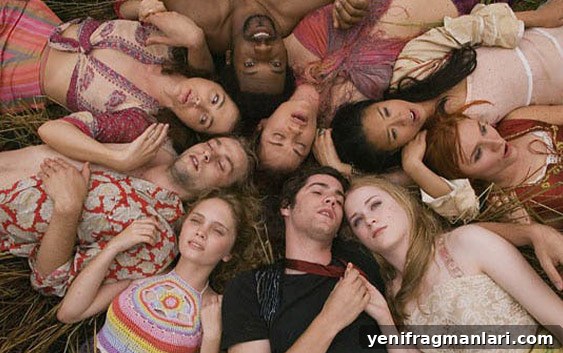

Across the Universe (2007)
Director: Julie Taymor
Screenwriter: Dick Clement, Ian La Frenais
Starring: Evan Rachel Wood, Jim Sturgess, Joe Anderson, Dana Fuchs, T.V. Carpio, Martin Luther McCoy
‘The Beatles are comin’, they’re gonna hold your hand’ – Bob Dylan, “Murder Most Foul” (2020)
Julie Taymor’s Across the Universe is an ambitious, visually striking musical that folds the music of The Beatles into a vividly imagined cinematic fable. Set against the social upheavals of the 1960s, the film traces themes of first love, political awakening and the erosion of innocence. Taymor uses the Beatles’ songbook less as a jukebox and more as a narrative current, letting familiar melodies and lyrics shape characters’ arcs, emotions and the film’s shifting moods.
At the story’s heart are Jude (Jim Sturgess), a young dock worker from Liverpool, and Lucy (Evan Rachel Wood), an idealistic American student. Their relationship becomes a focal point around which the decade’s joys and traumas unfold: the bright optimism of the Summer of Love, the counterculture’s messy internal conflicts, and the escalating violence tied to the Vietnam War and civil unrest. Their personal journey mirrors a larger social disorientation, showing how politics and trauma can test intimate bonds.
Taymor’s production design is unapologetically theatrical and often surreal. The film moves from playful, candy-colored sequences—bowling alleys lit like carnivals, quirky circuses and dreamlike dances—to starkly apocalyptic tableaux where riots and militarized force crash into the frame. This contrast amplifies the music’s dual nature: the Beatles’ songs can be both tender and trenchant, hopeful and wary. Taymor channels that complexity, allowing joyous visual invention to coexist with moments of real, painful gravity.
The casting of relatively unknown actors for the principal roles was a smart choice. Sturgess and Wood bring an unaffected immediacy to their performances; their singing feels lived-in rather than performative, as if they are voicing their characters’ inner lives instead of merely covering classic tracks. Supporting performers—such as Dana Fuchs, T.V. Carpio and Martin Luther McCoy—add texture and emotional weight, each delivering bold, distinctive interpretations that reframe the familiar Beatles catalogue in surprising ways.
Musical arrangements throughout the film are inventive, often recontextualizing songs to serve the story’s needs. Some sequences stand out precisely because they transform the songs into new emotional languages. For example, the film opens with Dana Fuchs’ ferocious take on “Helter Skelter,” undercut by a montage of demonstrations, newspaper headlines and crashing waves that feels like an omen of cultural collapse. “Strawberry Fields” is rendered as a haunting lament on war and loss, its imagery cross-cutting between damaged landscapes and jarringly poetic visuals. “I Want You” resurfaces as a stark recruitment anthem, staged with unsettling imagery of soldiers and patriotism contorted into duty and burdensome symbolism.
One of the film’s most powerful sequences is a gospel-infused performance of “Let It Be,” delivered by Carol Woods and a choir. The scene mourns a young life lost in riot violence and resonates with a hard-earned sorrow that reaches beyond its historical setting. In this way the film feels unexpectedly timely: the grievances and injustices it depicts continue to echo in contemporary headlines, and Taymor’s imagination invites viewers to reckon with how much has changed and how much remains the same.
At its best, Across the Universe is a celebration of music’s capacity to speak across generations. Taymor’s film reminds us that songs can serve as memory, protest and comfort all at once, and that the Beatles’ work—so often associated with youthful optimism—also contains strains of critique, melancholy and moral questioning. The movie’s visual bravado and emotional candor make it as much an artistic experiment as a tribute; it asks audiences to accept reinvention and to embrace the uneasy intersections of beauty and anger.
More than a decade after its release, the film endures as a distinctive entry in the realm of cinematic musicals: a daring hybrid of stagecraft and film grammar that rewards viewers willing to be carried along by its stylistic leaps. It can feel uneven at times, but its ambition, heartfelt performances and memorable set pieces secure its place as a cult favorite. Ultimately, Across the Universe is life-affirming, melancholic and hopeful in uneasy measure—a reminder that art can translate personal feeling into collective reflection.
21/24
Written by Angel Lloyd
You can support Angel Lloyd in the following places:
Screen Queens — Author Profile