
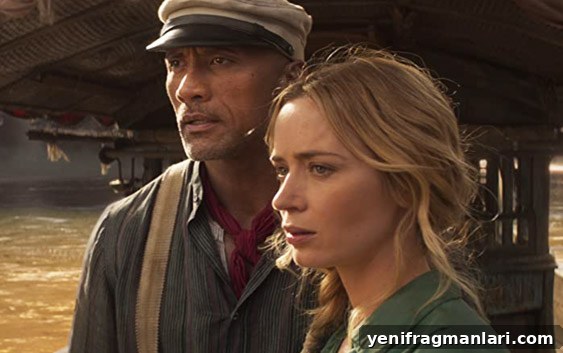
Jungle Cruise (2021)
Director: Jaume Collet-Serra
Screenwriters: Michael Green, Glenn Ficarra, John Requa
Starring: Dwayne “The Rock” Johnson, Emily Blunt, Edgar Ramirez, Jack Whitehall, Jesse Plemons, Paul Giamatti
Disney’s recent slate of theme-park–inspired films has produced a varied catalogue, and Jungle Cruise (2021) joins that roster as a big-budget family adventure built around one of the company’s long-running attractions. Directed by Jaume Collet-Serra, the film aims for energetic fun and clear moral beats but often feels like a hybrid of old-fashioned studio spectacle and modern franchise filmmaking. While it contains bright moments—notably Emily Blunt’s spirited performance—the movie leans toward broad fantasy and predictable plotting, making it feel closer to a children’s matinee than the nuanced PG-13 adventure it sometimes aspires to be.
The story follows Dr. Lily Houghton (Emily Blunt), a determined British scientist searching for the mythical “Tears of the Moon,” a magical plant deep in the Amazon said to cure any illness. Undermined and dismissed by members of the Royal Society, she sets out with her reluctant brother MacGregor (Jack Whitehall) to find the tree and validate her research. They hire Frank Wolff (Dwayne Johnson), a charismatic riverboat skipper with a checkered past, to guide them upriver. Along the way they face multiple threats: a ruthless German antagonist (Jesse Plemons) seeking the plant for military gain, and a band of cursed conquistadors who are literally resurrected and endowed with supernatural abilities.
Emily Blunt is the movie’s clear asset. She brings intelligence, tenacity, and humor to Lily, giving the character more depth than the script always provides. Lily’s fight for recognition within a male-dominated scientific community is a sympathetic throughline: she’s not simply adventurous, she’s trying to prove that her work belongs in the respectable halls of science. The film emphasizes sexism as an obstacle—Frank’s persistent quips about “a lady scientist” are played both for humor and to underline the prejudice Lily faces. Jack Whitehall’s MacGregor offers a quieter, humane counterpoint; his character’s arc includes experiencing social marginalization, a welcome if under-explored nod toward inclusion that modern family films increasingly attempt to acknowledge.
At the same time, the film’s historical framing is uneven. Set in 1916, it depicts the Royal Society almost uniformly hostile to women, a simplification that flattens period nuance. While the filmmakers clearly want to highlight the gender biases of the era and resonate with contemporary conversations about representation and equity, the portrayal sometimes sacrifices historical accuracy for rhetorical clarity. That bluntness runs throughout: antagonists are often presented in broad strokes, and thematic elements are spelled out rather than allowed to develop subtly.
Jungle Cruise also makes tentative efforts to address colonial tropes common to adventure stories set in non-European lands. The film depicts past conquistadors as monstrous figures and briefly acknowledges the damage colonialism inflicted on indigenous peoples. Yet these attempts are inconsistent. Indigenous characters are occasionally reduced to fantasy tropes—granted mystical powers or shown speaking fluent English in ways that strain credibility—while the film preserves some older stereotypes for easy comic beats. Similarly, the choice to make the opposing force German feels like a convenient shorthand for villainy rather than a narratively necessary decision, and it can come across as anachronistic and nationalistic.
Visually, Jungle Cruise oscillates between spectacle and dated CGI. Many sequences aim for the elaborate fantasy of classic Disney adventures, but the special effects sometimes look recycled or overly digital, undermining the sense of wonder the filmmakers intend. There is an argument to be made that the material might have worked even better as animated fare: the broad fantastical elements—talking or highly expressive animals, exaggerated supernatural threats, and elaborate set-pieces—would likely read more convincingly in animation, where visual excess is part of the medium’s appeal.
For all its flaws, Jungle Cruise is not without entertainment value. The chemistry between Johnson and Blunt carries much of the film’s weight, and there are sequences of genuine fun and excitement. The film aims for messages about courage, scientific curiosity, and standing up to prejudice, and it often lands those beats in a way that will appeal to families and younger viewers. However, the film’s two-hour runtime can feel overlong, and its tendency toward simplification means it rarely surprises or challenges the audience.
In summary, Jungle Cruise is a serviceable family adventure with a few strong performances and a handful of enjoyable set pieces. Its attempts at modernizing certain themes—gender equality, inclusion, and a critique of colonialism—are welcome but not fully realized, and its visual approach sometimes betrays the limits of mixing live-action spectacle with heavy fantasy. For viewers seeking light, star-driven escapism, the film offers moments of charm; for those looking for a more sophisticated or original take on the adventure genre, it may feel derivative and undercooked.
13/24