
This article was originally published on SSP Thinks Film by Sam Sewell-Peterson.
Hell or High Water (2016)
Director: David Mackenzie
Screenwriter: Taylor Sheridan
Starring: Jeff Bridges, Chris Pine, Ben Foster, Gil Birmingham, Marin Ireland, Katy Mixon, Dale Dickey, Margaret Bowman
In 2016, Scottish director David Mackenzie (known for Young Adam and Starred Up) teamed with American actor-turned-screenwriter Taylor Sheridan (whose credits include Sicario and Wind River) to deliver Hell or High Water, a contemporary Western that resonated strongly with critics and audiences alike. Sheridan’s screenplay first surfaced on the 2012 Black List, and its sharp, character-driven structure and moral urgency helped ignite a competitive bidding process until Sidney Kimmel Entertainment secured the project.
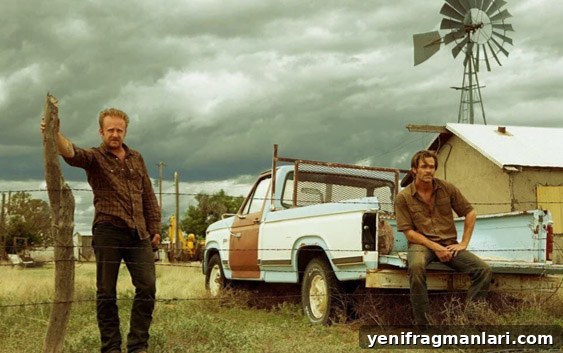
The story follows the Howard brothers, Toby and Tanner (played by Chris Pine and Ben Foster), who embark on a series of bank robberies across Texas. Opposing them is Marcus Hamilton (Jeff Bridges), a weary lawman on the cusp of retirement. At first glance the robberies appear purely financial, but as the plot unfolds it becomes clear that Toby’s motivations are more complicated than a simple cash grab. Tanner embodies volatility and brute force, while Toby, the younger sibling, is the strategist driven by a deeper motive tied to family and survival.
Both Pine and Foster give some of their best screen performances here. Pine balances intelligence and restraint, portraying a man who must constantly manage his explosive brother. Foster, by contrast, is raw and intense — a volatile presence whose temperament fuels much of the film’s tension. Their chemistry captures a real, if at times reluctant, familial affection: they bicker, celebrate small victories and share moments that reveal a bond stronger than the law or public opinion. Jeff Bridges brings a familiar gravitas to Marcus Hamilton, delivering a melancholy portrayal of a cop who must reconcile a career’s worth of duty with the prospect of an idle future. Bridges’ performance is understated yet textured; he conveys a man grappling with loss of purpose as much as the pursuit of justice.
The film’s opening sequence is striking: a long take across an empty parking lot that tracks a bank employee (Dale Dickey) as she walks toward the bank where the brothers lie in wait. The shot immediately establishes a mood of simmering dread and precise control. Mackenzie’s direction — confident and composed — handles both intimate character moments and broader set-pieces with equal care. The director’s earlier work in confined, tense settings like Starred Up is evident here, yet he expands his palette to include the wide-open vistas of the contemporary American West.
Mackenzie and cinematographer Giles Nuttgens use interior spaces for quiet, often ironic touches — a memorable example being Marcus removing his oversized Texan hat in a tiny motel room and accidentally knocking a lampshade loose. But the film’s real menace comes from the exposed, sun-drenched landscapes. The vast Texan terrain, shot in desolate light, becomes almost a character itself; it emphasizes vulnerability and the sense that anyone who travels across it can be stripped of illusion and safety by the glare of the sun.
Sheridan’s script blends noirish wit with deadpan tones and poetic imagery. Dialogue is sharp and economical, and it frequently shifts register in ways that underscore both humor and cruelty. Small details — a diner waitress barking “What don’t ya want?” while taking an order, or a local vigilante threatening “You gotta find the tree” to punish criminals — create moments of tonal complexity that puncture and elevate the drama. These lines reveal Sheridan’s skill at melding vernacular specificity with thematic bite.
Beyond Western conventions — shootouts, patrol cars and barren towns — the film functions as a critique of financial institutions in post-2008 America. Greed and institutional indifference are portrayed as corrosive forces that harm ordinary people and erode communities. The brothers’ actions can read as a form of Robin Hood defiance: the desire to hit the banks that harmed their family and extract a measure of justice. While the exact mechanics of Toby’s long-term plan can feel murky at points, the moral clarity of the film’s anger at predatory finance is unmistakable. That critique gives the story urgency and keeps audiences invested in the brothers’ cause even as the moral consequences complicate straightforward sympathy.
Ultimately, Hell or High Water is a powerful, character-rich film that combines taut performances, assured direction, and a screenplay that sings with regional detail and larger themes about loss, desperation and retribution. It’s a modern Western that feels both timely and timeless — a tense, human drama set against the harsh beauty of the contemporary American landscape.
23/24