
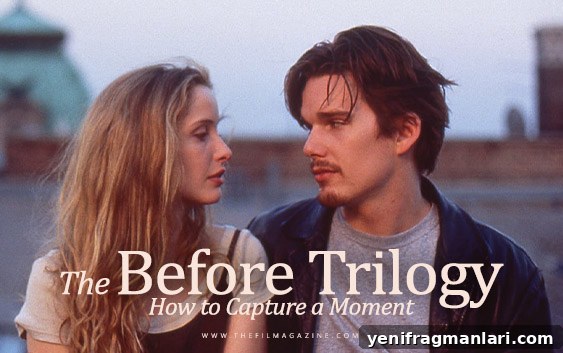
If cinema’s purpose is to capture moments, Richard Linklater’s Before Trilogy stands as one of the clearest demonstrations of that idea. Love, at its core, is made of fleeting instants: the first glance that changes everything, a hand reaching out, the slow ache of loss, the hesitant work of forgiveness. Each film in Linklater’s trilogy concentrates on one of those moments — the instant of falling in love, the rediscovery of a past connection, and the confrontation with what might be irretrievably lost — and together they form a study of how love is lived over time. The Criterion Collection’s description of the trilogy as an exploration of “cinematic time” is apt: each roughly ninety-minute film expands a single night or day into an experience that feels both immediate and expansive, condensing years of feeling into carefully observed scenes. These films show us what it means to exist within moments and, in doing so, reveal what it means to be human.
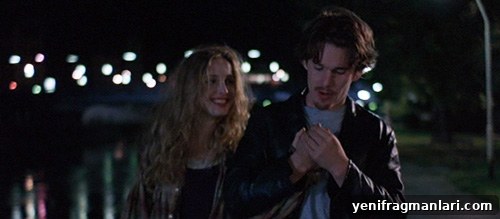
Before Sunrise is, on the surface, a pedestrian film: two strangers walking through Vienna for a single night. But what keeps the film alive is the chemistry and intimacy between its characters. The performances of Julie Delpy and Ethan Hawke — who contributed significantly to the script through rewrites — give the dialogue a natural, improvisatory feel that makes casual conversation seem revelatory. Their banter, small vulnerabilities, and precise physical rhythms create a believable arc: two people cautiously tending toward each other, trying to present their best selves while also revealing surprising truths.
Consider the poem scene, where a street poet offers to write a verse if given a single word. The poem itself speaks plainly of attraction and connection, while the characters’ blocking and behavior underline their restraint. Celine and Jesse stand close enough to touch but do not; they lean on opposite sides of a stone corner, physically marking the distance between them. That small, formal choreography enhances the tension of the scene: they are together but still guarded.
The dialogue throughout that night is playful and intelligent, but the subtext is where the film truly lives. Early love is a mix of performance and honesty — a dance of flirtation and self-protection — and Linklater captures that balance beautifully. The laughter feels like both an invitation and a shield, while the furtive looks and unspoken moments reveal the real tenderness beneath the surface. It’s in those quiet beats that the film transforms casual conversation into a portrait of connection forming in real time.
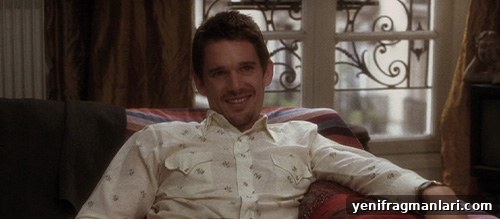
Before Sunset shifts the tone from chance encounter to the pressure of time and consequence. The movie’s central tension — Jesse’s imminent flight — becomes a physical and emotional clock. In the apartment scene near the film’s end, Linklater uses framing and movement to make that choice visible: Jesse lounges on the couch, while Celine paces near the door. From his viewpoint the exit is always in sight, but Celine habitually stands between him and the way out. To choose the door would mean stepping away from her again, a literal leaving that matches the emotional stakes of his decision.
Where the first film thrived on flirtation and possibility, Sunset reveals deeper layers: two people who have been affected by life’s disappointments but who still find comfort in one another’s company. The witty sparring gives way to quieter, more vulnerable conversations. The pacing slows, the jokes loosen their grip, and we watch characters who are genuinely seen by each other — who, for a few small, luminous moments, forget about time. When Jesse admits the coldness in his life and fidgets with a wedding ring, when they share an impromptu laugh at a Nina Simone impression, the audience feels the bittersweet intensity of a connection that might not survive daylight and obligations, but is real for as long as it lasts.
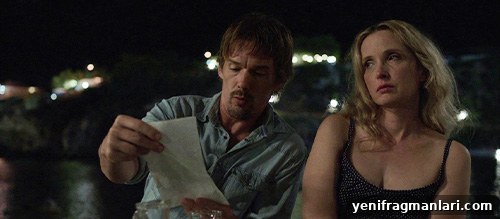
Before Midnight marks a decisive change in tone. The romantic glow of the earlier films gives way to a cooler, more confrontational palette — emotionally and visually. Time has altered these characters: they are older, more defensive, and burdened by the practical consequences of their choices. The film explores two difficult truths at once: the fear that one’s decisions have wasted a life, and the daily labor required to sustain love once the novelty has passed. The result is a raw, sometimes painful portrait of intimacy under strain.
The film’s explosive late-night argument crystallizes this change. Set in a hotel room meant to reignite intimacy, the confrontation becomes a brutal accounting of grievances: parenting, fidelity, identity, and unmet expectations. The physical proximity of the scene — Celine’s exposed vulnerability and Jesse’s avoidance — turns what might have been erotic into something weaponized, a painful reminder of how desire and resentment can intertwine. The dialogue is sharp, barbed, and full of accumulated history; every line carries the weight of years together. Yet the conclusion, when it comes, is quietly hopeful. Jesse offers a small, imaginative story as an olive branch, and in the soft abandon of that exchange the couple find a tentative way back to one another. It’s a reminder that love can be both messy and resilient.
Across all three films, Linklater’s direction reveals the reality of these moments. A furtive glance in a listening booth, a nearly reached hand in a car, the resounding silence after a slammed door — those choices in performance and staging convey the emotional truth of long stretches of life distilled into brief scenes. The trilogy’s power lies not in spectacle but in observation: it compels us to recall moments from our own lives, whether the thrill of falling in love or the sting of having hurt someone we love.
In an era dominated by blockbuster franchises and formulaic storytelling, the Before Trilogy is a vital reminder of cinema’s ability to capture human nuance. These films do not offer moral certainties or tidy conclusions; they depict flawed people making mistakes and trying, imperfectly, to live with the consequences. Shot with care and filmed on celluloid, they preserve the textures of life — its mess, pain, tenderness, and perseverance — and celebrate the small, essential moments that make us who we are.
Written by Jack Fanning