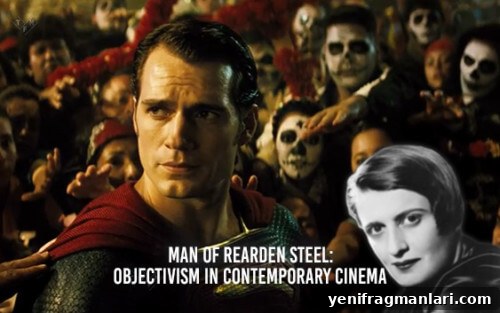
Zack Snyder, Ayn Rand and The Fountainhead: Reading Batman v Superman Through Objectivism
During a conversation with my colleague Katie Doyle I learned something I wish I had known earlier: Zack Snyder’s next project is a remake of Ayn Rand’s novel The Fountainhead. I had previously noted Randian influences in Snyder’s Batman v Superman: Dawn of Justice, but never explored the connection in detail. This article revisits Rand’s ideas and how they illuminate Snyder’s approach to character and theme.
Ayn Rand developed the philosophy known as Objectivism. In broad terms, Objectivism elevates reason as the primary means of understanding reality and promotes rational self-interest as the foundation of moral behavior. Rand’s views were shaped in part by her experience in pre-Soviet Russia and by her opposition to communism. Her writing celebrates private property, individual creativity, and a hierarchical view of society in which productive creators stand opposed to those she casts as parasites. These beliefs have resonated with many on the political right and have influenced cultural discussions about self-reliance, charity, and the role of government.
Objectivism’s strict preference for rationality and self-interest often reads as a corrective reaction to collectivist systems, but critics point out that reducing human choices to pure rational calculation ignores emotion, social obligation, and complexity. Satire and dramatic critiques have shown the limits of Randian reasoning: ritualizing rational action can produce absurd, even harmful, results when it denies ordinary human feelings or ethical nuance.
Rand’s breakthrough novel, The Fountainhead, was adapted for the screen in 1949 by director King Vidor with Rand involved in the screenplay. The story follows the architect Howard Roark, a fiercely independent designer who refuses to compromise his vision. Roark’s uncompromising idealism pits him against critics and colleagues: Ellsworth Toohey, a manipulative critic and ideologue, seeks to destroy Roark’s influence; Peter Keating, a talented but conformist architect, rides the currents of public taste; and Gail Wynand, a powerful publisher, represents the cost of living by public approval. The novel’s dramatic moments — including Roark’s defiant courtroom speech and an act of sabotage intended to punish creative compromise — foreground Rand’s assertion that individual creative integrity is the highest moral good.
Viewed through the lens of Randian fiction, many choices in Snyder’s Batman v Superman begin to align. The film’s presentations of heroism, justice, and public life often prioritize rational self-interest and individual will over empathy and collective responsibility.
Consider Batman. In Snyder’s film Bruce Wayne is driven by anger and a desire for retribution after massive destruction in Metropolis. From a Randian perspective, Batman’s vigilantism could appear as misplaced emotion undermining reason — he acts from hatred rather than principled self-interest. In Rand’s world, a figure consumed by revenge is likely to be seen as failing to live up to the ideal of rational independence.
Lex Luthor maps onto Ellsworth Toohey with striking clarity. In the film Luthor engineers public fear and manipulates institutions to bring Superman down. That strategy mirrors Toohey’s use of media and influence to shape opinion against Roark. Both characters weaponize public sentiment to control or destroy an individual who refuses to conform.
Superman is the most complicated comparison. Snyder’s Superman shares Roark’s impassive exterior and a lone-hero posture: he carries himself like a rational, almost aloof figure who evaluates actions by their consequences to his purpose and identity. At times this Superman seems to measure the value of rescuing others against a broader philosophical judgment about dependency and consequence; his compassion looks restrained by an almost Objectivist calculus. Yet Snyder’s film also layers religious imagery and sacrificial themes onto Superman’s arc, a striking tension because Rand’s Objectivism is explicitly materialist and atheistic. That synthesis — a character who embodies Randian self-assertion while simultaneously bearing Christ-like symbolic weight — creates an uneasy blend of philosophical registers.
The film’s depiction of government and public institutions further aligns with laissez-faire assumptions. Senator Finch and other officials react warily to a being as powerful as Superman and favor limited intervention unless property or clear rights are threatened. This mirrors Rand’s distrust of expansive government power and her belief that the proper role of institutions is to protect individual rights rather than manage collective welfare.
Understanding Snyder’s film through Objectivism clarifies many elements that otherwise feel contradictory or didactic. Characters behave like moral exemplars or foils in a philosophical drama instead of as psychologically complex people driven by ordinary human motives. The result is a movie in which dialogue often reads as editorial or ideological and actions serve symbolic ends more than emotional realism.
Seeing Batman v Superman this way does not mean one must agree with Rand or with Snyder. It does, however, provide a coherent interpretive framework: the film’s moral and aesthetic choices start to make sense when you read them as expressions of a worldview that prizes reason, independence, and the primacy of the individual. If that worldview appeals to you, the characters and conflicts will land one way; if you prioritize empathy, communal responsibility, or sacrificial altruism, you will likely react very differently.
Author’s Note: Before any devoted Objectivists jump to compare me to Ellsworth Toohey, I want to be clear: this piece is my own assessment. I wrote it because I wanted to explore how a particular philosophy shapes a major pop-culture work. I aim to describe and analyze, not to proselytize. My critique is offered as the view of one reader engaging with ideas and art, aware of the limits of both.
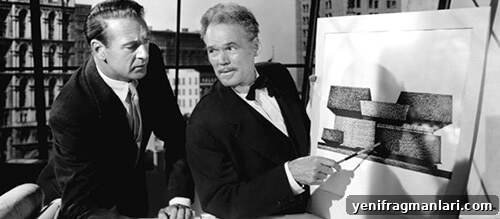
The Fountainhead (1949)