
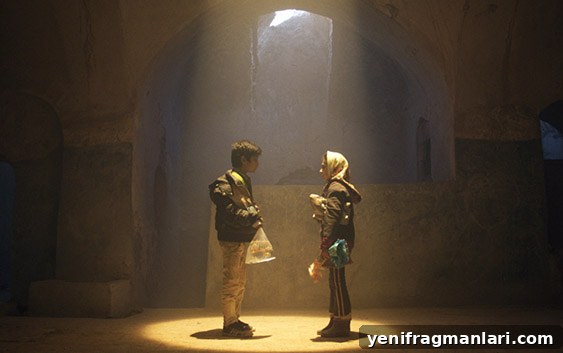

Winners (2022)
Director: Hassan Nazer
Screenwriters: Hassan Nazer, Hamed Emami
Starring: Parsa Maghami, Reza Naji, Hossein Abedini
What would you do if you stumbled upon an Oscar statue on the street? Keep it, try to sell it, or search for the owner? Winners centers on that simple premise: a young waste picker named Yahya (Parsa Maghami) discovers an Oscar and, with the reluctant help of his employer and fellow film enthusiast Naser (Reza Naji), attempts to return the statue to its rightful recipient. The concept invites comparisons to beloved films that celebrate cinema and the lives around it, but while the idea is promising, the execution falls short of its ambitious billing.
Yahya’s affection for movies is presented early on—he often stays up late to watch films despite his mother’s reproaches because the family depends on his income. The film repeatedly emphasizes his love for cinema, yet it rarely translates into a convincing or textured portrait of what film culture means to him or to the wider community. The emotional connection the story promises between characters and the movies they cherish rarely takes hold.
Director Hassan Nazer brings a personal history to the project. Born in Iran, Nazer left at eighteen after experiencing censorship at his university; he later built a life and career abroad and ultimately secured full financing in Scotland for this feature. His dedication to the craft and to telling stories tied to his cultural roots is evident in his commitment to making this film. That passion, however, is not consistently reflected on screen: the film talks about cinema rather than showing why it matters.
The film promotes itself as a loving ode to the history of Iranian cinema, yet references to films and film culture are often shallow and sparse. Aside from a few posters and an on-the-nose nod to works like Cinema Paradiso and The Song of Sparrows (notably featuring Reza Naji), there is little sustained engagement with cinematic history or technique. For a story grounded in a rediscovered Oscar, such minimal treatment of film lore feels like a missed opportunity.
One of the movie’s main weaknesses is its script. The dialogue frequently leans on exposition rather than character-driven moments, and conversations often spell out information the audience could infer. Characters are sketched narrowly: Yahya is the movie-loving young man, Leyla is his friend, and his mother is the practical guardian. These roles are serviceable but rarely expand into fully realized personalities with conflicting motivations and inner lives. The result is a cast that feels more like archetypes than three-dimensional people.

The plot itself sometimes unravels into unnecessary complication. The sequence that places the Oscar within Yahya’s reach is convoluted: a woman transporting the statue exits a taxi briefly, the driver is asked to move on by police, and in the confusion the Oscar ultimately ends up abandoned by the roadside. This chain of events distances the character’s occupation as a waste picker from the moment of discovery, making that aspect of Yahya’s life feel peripheral rather than integral to the story. Throughout the film, details accumulate in ways that don’t always advance character development or thematic clarity.
On a technical level, Nazer’s direction is restrained to the point of bluntness. The film favors straightforward framing and classical editing that largely recede from view, which can be effective when coupled with strong writing and vivid emotional beats. Here, however, the subdued directorial choices underscore the script’s flatness and leave many scenes feeling muted. There are intermittent visual pleasures—cinematographers Arash Seifi and Arash Seyfijamadi capture striking images of Iran’s landscapes and urban textures—but these flourishes do not fully compensate for the story’s structural and tonal shortcomings.
Where the film does succeed is in small human moments: brief interactions that reveal humility, warmth, or irony in everyday life. Reza Naji brings a quietly lived-in presence to Naser, and Parsa Maghami conveys a gentle earnestness as Yahya. Yet those performances are constrained by underwritten scenes and a script that too often tells rather than shows.
Ultimately, Winners struggles to stir the affection it aims to inspire. It aspires to be a sincere tribute to cinema and the people who cherish it, but the treatment feels tentative and incomplete. The movie gestures toward love for film culture without fully committing to the emotional or intellectual work required to make that love palpable. As a result, it leaves the audience admiring certain visuals and individual performances while wishing for a more layered and engaging story.
Score: 6/24