Train to Busan (2016)
Director: Yeon Sang-ho
Screenwriter: Yeon Sang-ho, Park Joo-suk
Starring: Gong Yoo, Jung Yu-mi, Ma Dong-seok, Choi Woo-shik, An So-hee, Kim Su-an,
Kim Eui-sung, Ye Soo-jung, Park Myung-shin, Shim Eun-kyung, Jang Hyuk-jin
Train to Busan stands as a near-perfect example of what a contemporary zombie thriller can achieve: it is tense, emotional and relentlessly propulsive. Yeon Sang-ho’s live-action feature builds its suspense within the tight, claustrophobic environment of a high-speed train and uses that confined setting to explore human behavior under sudden, brutal pressure. The film forgoes extensive worldbuilding in favor of focusing on the immediate experience of an outbreak and the moral choices that follow.
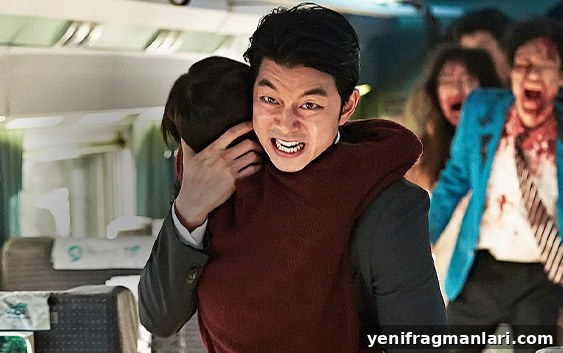
The plot follows Seok-woo (Gong Yoo), a busy fund manager and emotionally distant father, who reluctantly agrees to accompany his young daughter Su-an (Kim Su-an) on a train journey from Seoul to Busan so she can visit her mother. Their ordinary trip quickly turns into a nightmare when an injured passenger brings a violent, fast-spreading infection aboard. Within minutes, calm cabins erupt into chaos as the infected transform and attack with terrifying speed and ferocity.
Unlike slower, shambling undead in some popular franchises, the infected in Train to Busan are alarmingly swift and aggressive. The contagion progresses in moments rather than days, turning bitten victims into threats almost immediately. This rapid transformation heightens the urgency and forces characters into constant, high-stakes decisions where hesitation can be fatal.
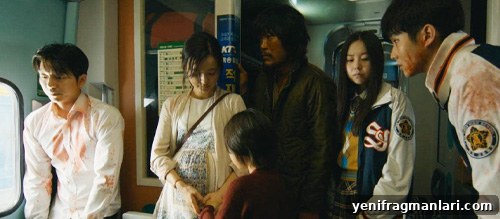
Seok-woo and his daughter quickly cross paths with a diverse group of passengers. Sang-hwa (Ma Dong-seok), a stout-hearted working-class man, travels with his pregnant wife Sung-gyeong (Jung Yu-mi). Their steady courage and instinct to protect others contrast sharply with Seok-woo’s initially self-centered outlook and serve as a catalyst for his personal change. Other passengers—a cheerleader named Jin-Hee (An So-hee), a young man Min Yong-guk (Choi Woo-shik), and the arrogant executive Yon-suk (Kim Eui-sung)—fill out a microcosm of society whose varied reactions to catastrophe illustrate different moral choices and survival strategies.
Beneath its zombie thrills, the film offers a pointed, if subtle, commentary on social hierarchy and selfishness. The crisis exposes how greed, cowardice and selfish ambition can compound danger, while compassion and cooperation increase chances of survival. Yeon Sang-ho, who previously directed socially conscious animated works, brings the same observational eye to this live-action effort, examining human behavior without dispensing easy judgment. The film suggests that actions define people more than labels or status.
Cinematography by Lee Hyung-deok keeps viewers pressed close to the action. Camera work and editing emphasize the train’s claustrophobic corridors and packed cars, crafting action sequences that are both kinetic and emotionally charged. Wide shots of passing landscapes contrast those confined interiors, reinforcing the isolation of the survivors. Yeon’s background in animation informs his handling of large-scale set pieces—crowds of the infected are staged to alarming, almost choreographed effect, creating sequences that are frightening and visually striking.
The film’s emotional core rests on its characters and their shifting relationships. Each passenger undergoes transformation: some grow more selfless and protective, others reveal cowardice or opportunism. Rather than relying solely on spectacle, Train to Busan keeps viewers invested in the human cost of the outbreak—the fear, grief and small acts of sacrifice that accumulate as the journey proceeds. Scenes showing train cars filled with victims underscore the tragedy: these are people robbed of agency, a heartbreaking reminder that the infected were once ordinary lives.
Action in Train to Busan feels earned. The survivors struggle, often paying heavy prices for temporary safety. That imbalance—where even successful escapes come at steep cost—lends emotional weight and realism that many larger, effects-driven zombie films lack. The film avoids cheap solutions or melodrama, instead sustaining tension and moral ambiguity through tight plotting and well-drawn performances.
For viewers who appreciate character-driven horror, the movie stands alongside classics of the modern outbreak subgenre. It shares DNA with earlier works that emphasize human relationships under strain, and yet it brings fresh energy and cultural specificity through its Korean setting and societal observations. Yeon Sang-ho refreshes the genre by blending visceral action with thoughtful examination of human nature under threat.
Score: 22/24
Written by Kae M.
You can support Kae M. on Twitter – @ultraman1312