
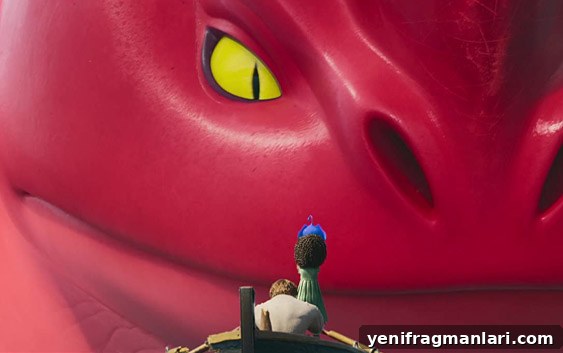

The Sea Beast (2022)
Director: Chris Williams
Screenwriters: Chris Williams, Nell Benjamin
Starring: Karl Urban, Zaris-Angel Hator, Jared Harris, Marianne Jean-Baptiste, Dan Stevens
The Sea Beast has become Netflix’s standout animated feature, earning both critical attention and an Academy Award nomination for Best Animated Feature. Its broad appeal is easy to understand: a lively mix of adventure, humor, a rebellious child protagonist, a reluctant adult hero, a lovable animal companion, and a genuine emotional core that resonates with audiences of all ages.
Chris Williams, who previously co-wrote the blockbuster Moana and directed Big Hero 6, brings his familiarity with heartfelt family storytelling to this film. The echoes of those earlier successes are clear: sweeping sea vistas, imaginative creature design, and a central relationship that anchors the narrative. The movie even includes a memorable oversized crustacean moment that adds a playful touch.
The story opens with the familiar ritual of campfire-style monster tales. In a world where enormous sea beasts roam the oceans and humanity has learned to fear them, young Maisie (Zaris-Angel Hator) grows up in an orphanage for the children of hunters. Proud of her parents’ legacy and determined to follow in their footsteps, she refuses to accept a life of quiet compliance. Her stubborn curiosity and sense of purpose propel her into danger and adventure.
After repeatedly attempting to escape the orphanage, Maisie finally leaps into the wider world and finds her way aboard the hunter ship The Inevitable. The ship’s crew includes the formidable Captain Crow (Jared Harris), the principled first mate Sarah Sharpe (Marianne Jean-Baptiste), and the more compassionate second-in-command Jacob Holland (Karl Urban). The opening action provides an exciting showcase for the film’s creature animation: enormous beasts feel real and threatening while remaining family-friendly, their features softened so they are expressive rather than purely terrifying.
Onboard, Maisie quickly fixates on Jacob, whom she dubs “Captain Someday,” and secretly stows away to join his life at sea. At first the crew tolerates the child as a novelty, and Crow’s gruff approval—tempered by a grudging respect for Maisie’s “hunter blood”—hints at a culture built on tradition and unexamined beliefs. But as the story progresses, Crow’s rigid worldview becomes an obstacle to change. He represents the entrenched mindset that refuses to question long-held narratives about the beasts and the role of hunters in society.

When Maisie and Jacob are thrown together by circumstance, their relationship becomes the emotional center of the film. Jacob serves as the bridge between Maisie’s idealism and the adults who cling to fear and profit-driven myths. Their growing bond is tender and sincere, capturing the kind of warmth audiences remember from films featuring empathetic, nonjudgmental companions.
The narrative shifts tone as Maisie forms an unlikely friendship with a Red Bluster—affectionately called Red—a massive creature initially presented as a monster. The dynamic recalls How to Train Your Dragon: as Maisie learns more about Red, she discovers the complexity behind the beast’s behavior and the often-cruel history humans have written about these animals. Physical scars on Red’s body tell a history of violence inflicted by hunters, and the film uses these details to explore difficult questions about culpability, history, and how stories are shaped by those in power.
The Sea Beast never simplifies its themes into a binary of good versus evil. Both humans and beasts have caused harm, and the film invites viewers to consider how fear, ignorance, and profit motives can perpetuate cycles of violence. It also highlights how children are frequently the victims of adult conflicts and decisions, emphasizing the importance of compassion and understanding for future generations.
Williams also continues his inclusive approach to representation. The world of The Sea Beast is populated by characters of many ages, body types, abilities, and backgrounds. Women appear in leadership roles and as complex individuals, while characters with visible differences are present without their identities being reduced to a single trait. This natural diversity reinforces the film’s broader themes of empathy and shared humanity.
Although The Sea Beast does not necessarily reinvent the animated adventure genre, it succeeds on its own terms: it is funny, thrilling, beautifully animated, and emotionally satisfying. Small touches—such as the pirate-inflected dialogue and the shipboard camaraderie—add flavor without overwhelming the story. Ultimately, the film delivers a hopeful message: change is difficult, but through understanding and courage people can choose a better way forward for both humans and the creatures they fear.
Score: 19/24