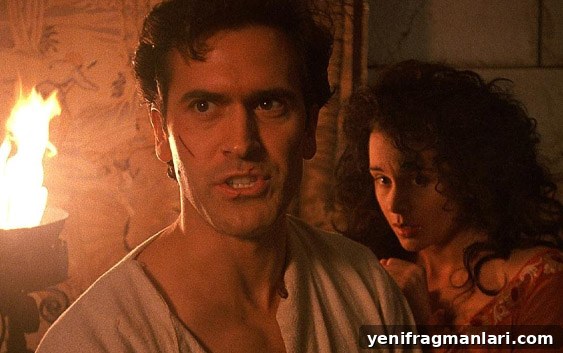
Army of Darkness (1992)
Director: Sam Raimi
Screenwriter: Sam Raimi, Ivan Raimi
Starring: Bruce Campbell, Embeth Davidtz, Marcus Gilbert, Ian Abercrombie, Richard Grove, Bridget Fonda, Ted Raimi
Sam Raimi’s Army of Darkness concludes the original Evil Dead trilogy with an audacious tonal shift and a distinctly comic sensibility. Building on the franchise that began with The Evil Dead (1981) and continued in Evil Dead II (1987), Raimi pushes the series away from pure terror toward broad slapstick and high-energy fantasy. Central to the film’s success is Bruce Campbell’s unforgettable portrayal of Ash Williams — a cocky, over-the-top action hero whose mix of bravado and physical comedy anchors the movie’s wild, often absurd set pieces.
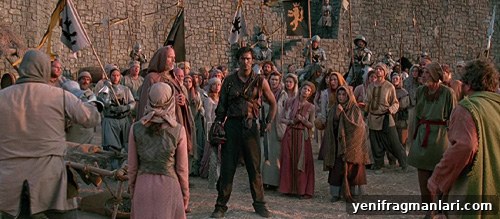
In this third installment, the Necronomicon again upends Ash’s life. The book transports him — and his battered 1973 Oldsmobile Delta — to 1300 AD, in the midst of a medieval conflict between King Arthur and Duke Henry the Red. Mistaken for an enemy spy, Ash is captured and enslaved by the king’s forces. Through a series of trials and unexpected heroics, he is eventually hailed as a prophesied savior and reluctantly agrees to help the kingdom defeat the Deadite menace, provided he can secure a way back to his own time.
Once freed to roam the castle and surrounding countryside, Ash’s improbable competence and spectacularly bad judgment trigger a cascade of comic calamities. The film delights in juxtaposing lowbrow humor with inventive practical effects, from sight gags that echo classic silent-era comedians to purposely exaggerated gore that plays for laughs rather than shock. Raimi’s direction embraces kinetic camera movement — the jittery, dynamic style he’s known for — and combines it with elaborate stunt work and imaginative creature design to generate a continuously surprising tone.
One of the film’s most memorable sequences finds Ash confronting a windmill while cursed illusions of miniature, mischievous versions of himself torment him. The scene relies on physical comedy and precise timing: mini-Ashes perform Chaplin-esque routines, culminating in a gag where one dives into Ash’s mouth, prompting the hero to retaliate in an absurdly literal way. These moments underline Raimi’s ability to blend cartoonish humor with horror motifs, transforming terror into an almost Looney Tunes-style romp.
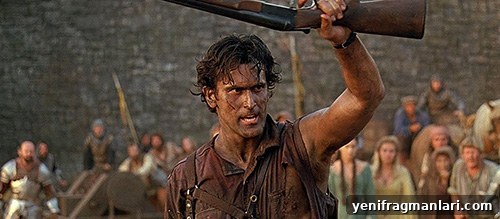
Army of Darkness departs from the darker atmosphere of its predecessors and fully embraces camp. While the film still contains splashes of blood, dismembered Deadites, and intense fight choreography, those elements are deployed in service of comedy rather than sustained horror. The result is closer in spirit to parody and playful pastiche — think madcap medieval adventure — than to conventional supernatural fright. Fans of Monty Python’s absurdist humor will recognize similar impulses in Raimi’s approach: irreverent set pieces, improbable inventions, and a willingness to let the film veer into outright silliness.
That shift in tone initially unsettled some viewers when the film was released. Studio edits significantly shortened Raimi’s intended cut, which altered pacing and undercut parts of the character arc. The theatrical version was pared down from roughly 96 minutes to about 81 minutes, changing the intended balance of humor and consequence and prompting confusion for audiences expecting either straight horror or a direct continuation of Evil Dead II. Over time, however, the director’s cut and restored editions have restored much of Raimi’s original vision and allowed modern audiences to appreciate the film’s full creative scope.
Even where the plot feels episodic and the pacing uneven, Bruce Campbell’s charisma keeps the film buoyant. His comic timing and physical commitment make Ash a convincing, hilarious protagonist — equal parts blowhard and begrudging hero. The chemistry between director and lead is rooted in a long collaboration dating back to their high school filmmaking days, and that rapport is evident on screen: Raimi stages daring camera moves and elaborate compositions, while Campbell delivers line readings and pratfalls with infectious enthusiasm.
Technically adventurous, earnestly silly, and unabashedly entertaining, Army of Darkness stands as a bold conclusion to the original trilogy. It may not satisfy viewers searching for unrelenting horror, but it rewards anyone willing to accept its gleeful absurdity. The film’s blend of practical effects, slapstick, and bravura direction has made it a cult favorite and a lasting example of how horror and comedy can fuse into something uniquely memorable.
Score: 19/24
Recommended reading: 10 Best Sam Raimi Movie Moments
Written by Kae M.
Support the author on Twitter: @ultraman1312