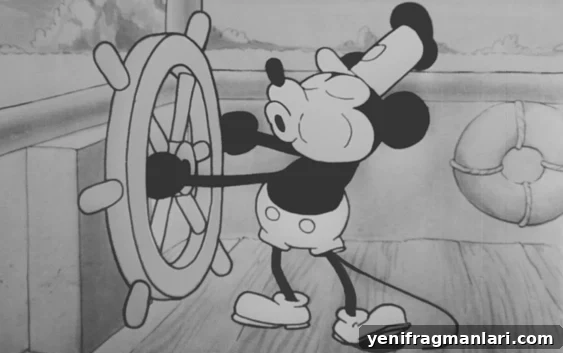
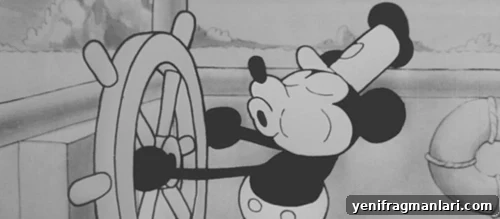
Steamboat Willie (1928)
Directors: Ub Iwerks, Walt Disney
Screenwriters: Walt Disney, Ub Iwerks
Starring: Walt Disney, Charlotte Jamquie
The origins of Disney’s most famous character trace back to another creation: Oswald the Lucky Rabbit. Before Mickey Mouse, Walt Disney and Ub Iwerks developed Oswald, who starred in numerous shorts. However, disputes over ownership and distribution rights led Disney to lose control of the character, prompting the studio to create a new anthropomorphic character over which they retained full creative control. That character was Mickey Mouse, and his first widely released film was the landmark short Steamboat Willie.
In the short, Mickey works aboard a river steamboat under the stern command of Captain Pete. As the steamboat makes its way downriver with livestock on board, Mickey picks up his girlfriend Minnie and improvises a lively musical performance that involves the ship’s animals. The film’s plot is simple, but its charm and timing reflect an evolving art form and a new approach to animated storytelling.
Steamboat Willie is billed in the opening credits as “A Mickey Mouse sound cartoon,” an early example of Disney’s character-driven branding and promotion strategy. While another short, Plane Crazy, was produced around the same time, it did not reach the same wide theatrical release. It was Steamboat Willie that introduced Mickey to a broad audience and helped establish Walt Disney and his studio as a major force in animation.
The late 1920s saw the rapid adoption of synchronized sound in cinema. The success of films with synchronized dialogue and music created an opportunity that Disney seized. Technically inventive for its era, Steamboat Willie coordinates action to a lively soundtrack throughout its roughly eight-minute running time, showcasing both a new level of musical integration and the studio’s commercial savvy. Walt Disney recognized the potential of sound and made decisions that allowed creative staff like Ub Iwerks to drive the technical execution while he focused on the business and expansion of the studio.
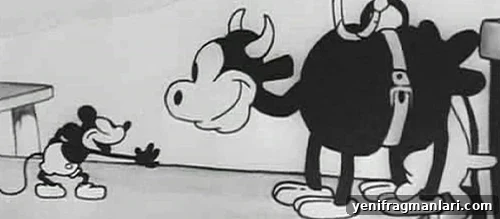
Watching Steamboat Willie today highlights a mix of invention and rough edges. The animation displays the elastic, exaggerated “stretch and squash” technique that defined early cartoon motion, often edging toward surreal and mischievous movement. At the same time, the short reveals its age: economical animation, occasionally uneven drawing quality, and fast-paced, gag-driven staging that relies heavily on musical rhythm rather than character psychology or narrative depth.
Some sequences in the short reflect comedic uses of animal bodies as instruments, from using a goat’s tail as a makeshift gramophone horn to turning a cow’s teeth and a litter of piglets into percussive elements. These gags were intended as playful and inventive at the time, yet modern viewers may find aspects of this physical comedy uncomfortable. The humor in early animation often borrowed from vaudeville and stage entertainments, where exaggerated gestures, visual puns, and physical slapstick were standard practice. It’s useful to consider these elements in historical context while also acknowledging how modern sensibilities have shifted.
The short also reveals cultural influences common in 1920s entertainment. Musical selections and stylistic choices reflect the era’s popular repertoire and performance traditions. Some of these influences carry problematic histories—songs and acts that were once widespread are now understood differently. Recognizing this context is not an attempt to erase the work but to view it with informed perspective.
Despite its imperfections, Steamboat Willie remains a vital piece of cinematic history. It represents an early and successful marriage of synchronized sound with animated image, a clear turning point in how cartoons could be produced and marketed. The short’s ingenuity and energy helped create a template for many subsequent animated works and set the stage for decades of character-driven entertainment.
As a historical artifact, the film is enjoyable and significant even if it is not the most polished entry in Mickey Mouse’s catalog. It is best appreciated as the important first step that allowed Walt Disney’s studio to refine techniques, experiment with musical timing, and build a global brand that continues to influence animation and family entertainment.
Score: 18/24
Rating: ★★★ (3 out of 5)
Recommended reading: Disney Renaissance Movies Ranked (article title reference)