


Taxi Driver (1976)
Director: Martin Scorsese
Screenwriter: Paul Schrader
Starring: Robert De Niro, Jodie Foster, Cybill Shepherd, Albert Brooks, Harvey Keitel
On a humid New York night, a cab slides into frame and the camera fixes on a pair of eyes lit by neon, offering a hallucinatory vision of the city’s restless energy. Emerging from the American New Wave — a period when independent and arthouse approaches reshaped mainstream cinema — Martin Scorsese’s neo-noir crime drama remains one of the era’s most potent films. More than a showcase for Robert De Niro, Taxi Driver blends genre and style from multiple cinematic traditions to present a bleak, unforgettable portrait of 1970s America that continues to resonate.
This was Scorsese’s second major collaboration with De Niro and the film that cemented his reputation as a leading voice among the so-called auteur generation of the 1970s: directors who brought rigorous, personal filmmaking to American screens. By 1976 Scorsese had already directed titles such as Boxcar Bertha and Mean Streets, and had earned critical attention with Alice Doesn’t Live Here Anymore. But Taxi Driver raised his profile globally, winning the Palme d’Or at Cannes and garnering several Academy Award nominations.
Paul Schrader’s script centers on Travis Bickle, a Vietnam veteran who takes up taxi driving to cope with insomnia and isolation. Deprived of meaningful human contact, Travis drifts into obsession and violence, channeling his inner turmoil toward dramatic, dangerous acts. The film traces his descent with a mix of psychological realism and stylized intensity, creating a character study that challenges viewers rather than offering easy sympathy.
Travis is not heroic; he is socially inept, awkward in attempts at intimacy, and increasingly detached from the world around him. Early scenes with Betsy, a campaign worker played by Cybill Shepherd, and casual exchanges with fellow cab driver Wizard reveal his inability to connect. In his search for purpose he meets Iris, a young sex worker played by Jodie Foster, and develops a distorted, paternalistic urgency to “save” her. The interaction between Travis and Iris drives much of the film’s moral ambiguity: his intentions can feel protective yet are inseparable from his volatility and violent impulses. Travis’s private writings, meanwhile, expose disturbing racist and misanthropic views that complicate any effort to excuse his behavior.
De Niro’s performance is a study in controlled intensity. Known for his charm in other roles, he molds himself into Travis’s awkward, brittle presence, using charisma sparingly as a thin veneer over growing rage. His capacity for improvisation adds authenticity — most famously in the mirror scene where his ad-libbed line “You talkin’ to me?” has become legendary. Scorsese’s collaborative approach allows moments like this to breathe, reinforcing the film’s immediacy.
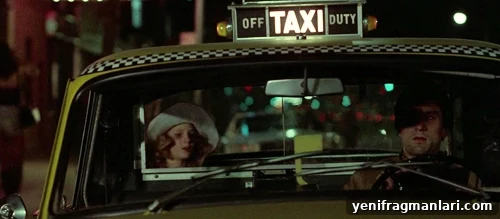
Jodie Foster delivers a remarkably mature and convincing performance as Iris, a role that required careful oversight given her youth at the time. She brings naturalness and surprising levity to scenes that could otherwise feel relentlessly bleak — such as a memorable diner breakfast where teenage mannerisms and incidental humor offset the film’s darkness. Harvey Keitel’s brief but vivid turn as Iris’s pimp adds bruised theatricality; his presence hints at larger underworld dynamics even in limited screen time.
Taxi Driver also functions as a cinematic crossroads: it absorbs influences from classic Hollywood, European art cinema, and exploitation traditions. The film echoes John Ford’s themes of a lone protagonist on a rescue mission, nods to Hitchcock in its visual composition, and borrows Godard-like montage techniques to create symbolic flourishes — for example, a close-up of dissolving alka-seltzer that becomes a metaphor for simmering violence. Its depictions of brutality and injury were more graphic than many American studio films of the time, pushing the boundaries of on-screen violence into more intimate, visceral territory.
Bernard Herrmann’s score — his final work before his death — is integral to the film’s mood. The music’s noir-tinged brass, restless strings, and ominous percussion drive the streetscape sequences and heighten the climactic confrontation. Herrmann’s soundscape blurs the line between dream and reality, reinforcing questions about whether certain events are objective or filtered through Travis’s deteriorating perspective. His posthumous Oscar nomination underscored the score’s power and its contribution to the film’s enduring atmosphere.
Viewed from today’s perspective, Taxi Driver can feel both prescient and disturbing: it exposes the rage of a disenfranchised man shaped by cultural forces that fail to offer healthy outlets or guidance. Scenes and speeches that articulate violent, racist fantasies are hard to watch, yet they serve the film’s unflinching examination of social neglect and masculine desperation. The movie does not propose remedies; instead, it stages a vivid indictment of systems that leave certain men alienated and dangerous.
While Scorsese’s later works such as Goodfellas and Casino may have broader mainstream recognition, Taxi Driver remains essential for understanding both his and De Niro’s careers and for tracing the evolution of American cinema in the 1970s. Its uncompromising themes, stylistic inventiveness, and moral ambiguity secure its place as a landmark film — one that continues to provoke strong reactions and thoughtful debate.
Score: 21/24
Rating: 4 out of 5.