
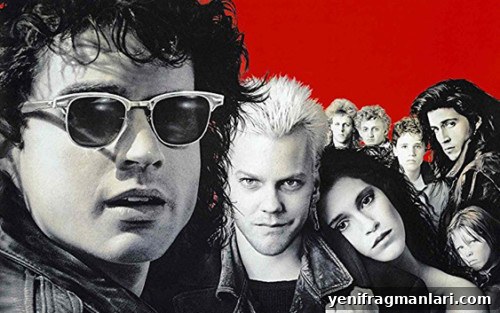
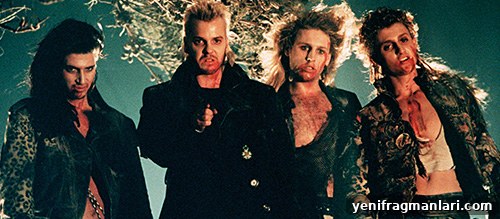
The Lost Boys (1987)
Director: Joel Schumacher
Screenwriters: Jan Fischer, James Jeremias, Jeffrey Boam
Starring: Kiefer Sutherland, Jason Patric, Corey Haim, Corey Feldman, Jami Gertz, Dianne Wiest, Edward Herrmann, Alex Winter, Jamison Newlander
The Lost Boys reintroduced vampire stories to a new, MTV-influenced generation. Released in 1987 and directed by Joel Schumacher, the film mixes horror, comedy and teen drama to create a distinct 1980s vibe that has since earned it a devoted cult following.
The plot centers on Lucy, a newly single mother who moves with her two sons, Sam and Michael, to the coastal town of Santa Carla to live with Lucy’s elderly, eccentric father. The seemingly sleepy seaside community hides a darker secret: it is infested with vampires. Young Sam discovers the truth and quickly realizes his older brother Michael is at risk of being drawn into the undead world.
Sam teams up with a pair of amateur vampire hunters, Edgar and Alan Frog—known colloquially as the Frog Brothers—to track down the head vampire and stop Michael before he fully succumbs. Meanwhile Michael drifts between ordinary teenage life and a seductive nocturnal existence led by David and his charismatic gang. The tension between teenage rebellion and dangerous adulthood is the film’s central emotional engine.
Jason Patric’s portrayal of Michael captures the confusion and anger of adolescence as he tilts toward something darker, while Kiefer Sutherland’s David is the polished, magnetic antagonist who makes vampirism look like the ultimate rite of passage. The dynamic between these characters, combined with energetic supporting turns from Corey Haim and Corey Feldman, gives the film both heart and edge.
Director Joel Schumacher peppers the story with moments of humor, high-energy set pieces and stylish visual touches that lean into 1980s pop culture. The film often reads as a horror-inflected coming-of-age tale: Michael’s gradual transformation doubles as a metaphor for the lure of adult freedoms and the dangers that can accompany them. There is also a persistent subtext of addiction—Michael sleeps through the day and roams at night, distancing himself from family and responsibilities, often hiding behind sunglasses and a defiant posture.
One of the movie’s strengths is how it balances scares with lightness. The Frog Brothers provide comic relief and a DIY heroism that complements the darker, more seductive world of the vampires. Scenes of youthful camaraderie—riding bikes to a punchy soundtrack, staging late-night raids—give the film a nostalgic, almost adolescent adventure quality that offsets the horror. That blend helps explain why many viewers compare The Lost Boys to other coming-of-age stories, even as it stands firmly within the vampire genre.
Stylistically, the movie is unapologetically 1980s: the costumes, the soundtrack and even the small, memorable moments—like an oil-covered saxophone player in leather trousers—anchor it in a particular era. Its music and atmosphere work hand in hand to create a tone that is often playful, sometimes brutal, and always cinematic. The film’s self-awareness and occasional winks to the audience let it lampoon horror tropes while still delivering genuine moments of menace.
Critics were divided on release, but audiences who grew up with the film helped build its lasting reputation. Over time, The Lost Boys has been reassessed as a key entry in late-20th-century vampire cinema—less formal than gothic adaptations, more attuned to youth culture, and influential for how it fused horror with teen sensibilities.
If you approach it expecting a straight horror movie, you might be surprised by how much heart and humor it contains; if you come for the atmosphere and the era-specific style, you’ll find the film richly rewarding. It is at once a vampire movie, a teen drama and an energetic snapshot of 1980s pop culture—an enduring cult favorite that continues to attract new viewers.
18/24