
This piece was written exclusively for The Film Magazine by Sophie Cook of Sophie Beatrice’s Blog.
Since Anthony Minghella’s adaptation of The Talented Mr. Ripley (1999) arrived, critics and audiences have admired its rich cinematic vocabulary and bold stylistic choices. The film follows Tom Ripley, played by Matt Damon, who is sent to Venice to persuade Dickie Greenleaf (Jude Law) to return to America at his father’s request. Tom ingratiates himself into Dickie’s circle under false pretenses—claiming connections to Princeton he never had—and becomes obsessively drawn to Dickie’s life. As the story progresses, Ripley’s imitation of Dickie deepens until he attempts to become him entirely.
The film’s most powerful moment comes in its final sequence. This confined, tense scene crystallizes Tom’s internal conflict—his struggle between remaining himself and adopting another identity—and ultimately marks his decisive abandonment of his original life.
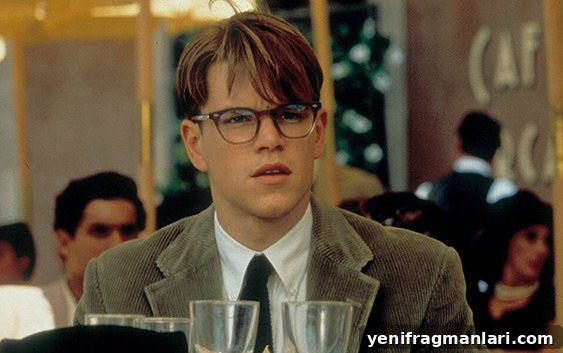
Throughout the film, Damon delivers a chillingly nuanced performance. He captures Ripley’s awkwardness and social reticence through carefully controlled physicality and subtle facial expressions. Damon balances Ripley’s unsettling traits with moments of vulnerability and charm, making him simultaneously watchable and unnerving. That duality heightens the shock when the character’s darker impulses surface. Minghella’s mise-en-scène and the cinematography frequently draw attention to these small gestures, turning Damon’s performance into the film’s emotional fulcrum.
The final sequence unfolds inside a small cabin on a boat, where Tom shares cramped quarters with Peter, played by Jack Davenport. The tight setting and Minghella’s close camera work create a claustrophobic atmosphere that keeps the audience unnervingly close to the action and the characters’ shifting dynamics.
The camera placement in this scene is crucial. Over-the-shoulder shots from Tom’s vantage point dominate the sequence, emphasizing the distance between the men even as the frame keeps them physically close. This technique both foreshadows Tom’s betrayal and positions the viewer to see the world through his predatory perspective. High-angle over-the-shoulder framings subtly establish Tom’s control while contributing to a growing sense of menace.
These choices echo Hitchcockian suspense techniques. Hitchcock often used over-the-shoulder compositions to align viewers with a character’s gaze and build unease; Minghella similarly guides us to identify with Tom, increasing the dread that something violent may occur at any moment.
Recommended for you: Top 10 Alfred Hitchcock Films
Minghella alternates these over-the-shoulder compositions with intimate close-ups that chronicle Tom’s mounting panic and psychological unraveling. The close framing leaves no escape for the viewer; we are forced to observe the flickers of emotion across Damon’s face. A scene that hinges on short shot-reverse-shot edits accelerates the tempo of otherwise stationary dialogue, producing a nervous energy that suggests something irrevocable is about to happen. When Tom laughs at Peter’s naïveté and later begs Peter to say kind things about “Tom Ripley,” the camera lingers on small expressions—gratifying the audience’s knowledge of Tom’s duplicity while denying Peter that insight.
Lighting in the cabin plays a significant narrative role as well. The sequence relies on low-key, interior lighting from lamps within the frame, which casts deep shadows and a subdued palette over the action. This noir-inflected approach creates an oppressive mood and highlights the moral ambiguity at the scene’s heart. The dim, almost naturalistic lighting and the close quarters combine to intensify the viewer’s sense of foreboding.
Color and costume design reinforce the scene’s psychological tone. The palette favors muted browns and greys, reflecting Tom’s emotional dullness and possibly indicating the merging of his real identity with the persona he has stolen. Tom’s darker clothing hints at the threat he poses, while Peter’s greys suggest vulnerability and the fading life he represents—visual cues that underline the widening divide between the men.
The camera’s subtle bobbing mimics the motion of the boat and enhances immersion, making viewers feel physically present in the cabin. This restless movement also mirrors Tom’s internal instability—the visual rhythm stands in stark contrast to the steadier cinematography used elsewhere in the film, underscoring the sequence’s decisive emotional rupture.
The killing itself occurs off-screen, a deliberate editorial choice that amplifies its impact. Rather than depicting the act explicitly, Minghella holds on Tom’s face and intercuts to a long shot of an empty cabin, the symmetry of the spaces accentuating the absence left in the wake of violence. By keeping the violence out of frame and retaining Peter’s voice in a haunting voiceover—pleading and increasingly strained—Minghella forces the audience to imagine the act, which makes it all the more disturbing.
Mirrors function as a recurring motif in this sequence, symbolizing Tom’s fractured identity and his ongoing self-reflection. In the closing image, a door is reflected multiple times, visually suggesting the many versions of Tom and the choices that lead him to seal off his former life. When the door finally closes, it signifies not only the end of a chapter but the permanent entrapment of the real Tom within the persona he has assumed.
That convergence of acting, cinematography, lighting, production design, and editing is why this scene stands as the film’s most memorable and unsettling sequence. Damon’s layered performance, Minghella’s precise camera direction, the noirish lighting, and the minimal but telling production details combine to create a moment that remains haunting and effective on every viewing.
Written by Sophie Cook
You can support Sophie Cook in the following places:
Twitter – @sophbc_
Instagram – @sophbc_
Blog – sophiebeatricesblog