
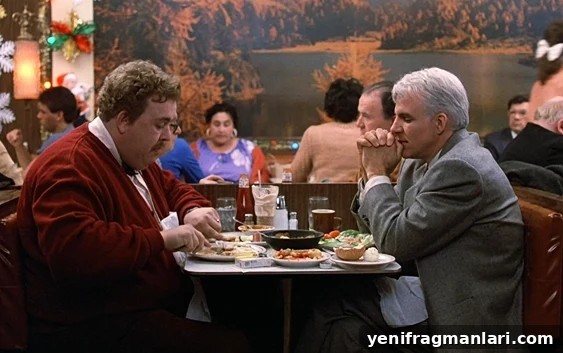

Planes, Trains and Automobiles (1987)
Director: John Hughes
Screenwriter: John Hughes
Starring: Steve Martin, John Candy
Few films are as closely linked to the Thanksgiving season as John Hughes’ 1987 comedy Planes, Trains and Automobiles. For many viewers it has become the definitive post-feast movie: a film that blends broad, screwball humor with unexpected emotional depth. While Hughes wrote other holiday classics that also endure—such as National Lampoon’s Christmas Vacation and Home Alone—this particular film remains his most enduring holiday piece, cherished for both its laughs and its warmth.
At its core the movie is a simple premise executed with precision: two very different men, both desperate to get home for Thanksgiving, are repeatedly thwarted by travel mishaps. Steve Martin plays Neal Page, a tightly wound, impatient advertising executive who values order and solitude. John Candy plays Del Griffith, a relentlessly talkative shower curtain-ring salesman with a generous heart and a tendency to overstay his welcome. The contrast between Neal’s brittle exasperation and Del’s relentless optimism creates a rich ground for comedy—often broad, sometimes quiet, and frequently poignant.
Casting is one of the film’s great strengths. Martin and Candy don’t merely act their parts; they embody them. Their chemistry is immediate and believable, and the film benefits from moments where the actors are clearly making the characters their own, whether by delivering scripted lines or by improvising small, memorable beats. Many scenes have lodged in the popular imagination precisely because the performances feel lived-in and authentic, with lines and bits of business that viewers repeat for years afterward.
John Hughes’ screenplay moves briskly and balances comic set pieces with more intimate character moments. The motel scene, where Neal has a blunt emotional outburst and Del responds with quiet dignity, is often cited as the film’s emotional center. It’s the scene that reveals what the filmmakers have been quietly building toward: beneath the slapstick and the frustrations lies a sincere exploration of human loneliness and connection. Hughes was unafraid to let his actors lean into both the comic and the tender moments, and that trust in performance pays off throughout the film.

Beyond the laughs, the film endures because of the relationship it builds between Neal and Del. They are, ultimately, two lonely men who find in one another a kind of companionship neither expected. That discovery is what gives the movie its staying power: we root for them because they reveal parts of ourselves—our irritations, our yearnings, our capacity for empathy. The film captures the odd, sometimes uncomfortable ways in which strangers can become meaningful to one another when circumstances force proximity and reveal vulnerability.
Viewed today, the movie’s themes feel as relevant as ever. The modern world often encourages distance and anonymity, and many of us are used to brief, transactional interactions with service workers and drivers. Planes, Trains and Automobiles reminds us how quickly an acquaintance can become something more when people slow down and really listen. The film’s gentle insistence on empathy—finding common ground between unlikely companions—remains its most powerful quality.
Technically, the film is economical and focused. Hughes’ direction keeps the pacing lively without sacrificing character development. The combination of sharp comic timing and sincere dramatic beats creates a rare tonal balance: moments that make you laugh out loud, and moments that quietly pull at your feelings. That mixture is why the movie is still watched and recommended year after year, and why it has been embraced as a seasonal favorite rather than merely a period piece from the late 1980s.
Score: 19/24
⭐⭐⭐⭐
Rating: 4 out of 5.
Written by Connell Oberman
You can support Connell Oberman in the following places:
Twitter: @ObermanConnell
Instagram: @connello_22
Substack: ConnellOberman