
Network (1976)
Director: Sidney Lumet
Screenwriters: Paddy Chayefsky
Starring: Faye Dunaway, William Holden, Peter Finch, Robert Duvall, Ned Beatty
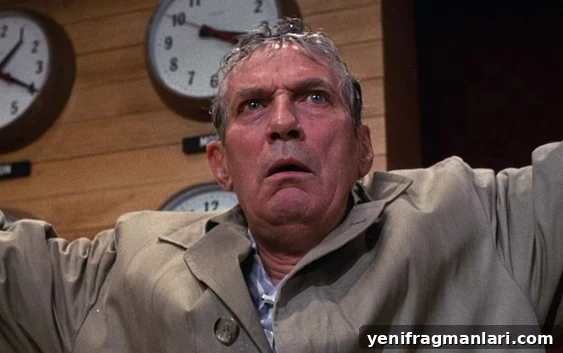
Some lines of dialogue achieve the rare status of feeling prophetic, and few examples are as memorable as the cry from Peter Finch’s Howard Beale in Network. In what became Finch’s final performance—one that earned posthumous acclaim—Beale’s anguished plea, drenched and frantic before the television cameras, captures an undeniable urgency: run to your windows, stick your heads out, and scream, “I’m as mad as hell, and I’m not going to take it anymore!” That moment, which turns a broken news anchor into an unlikely populist figure, forms the core of a satire that is as much about the business of television as it is about the erosion of public truth.
Sidney Lumet’s film tracks how a collapsing network exploits Beale’s breakdown to manufacture ratings. What was once a tragic, unstable figure is repackaged into a spectacle that revives UBS’s fortunes, and the company’s corporate machinery responds by reshaping reality to suit its interests. The film follows executives, producers, and on-air personalities through their internal power struggles, moral compromises, and the gradual displacement of truth by entertainment. The result is a darkly comic, sharp-edged portrait of media, corporatism, and cultural complacency.
Paddy Chayefsky’s screenplay, for which he received the Academy Award for Best Original Screenplay, remains scathing and precise. His writing moves beyond simple partisan critique; it targets any and all institutions that manipulate influence and money for power. The satire skewers left-wing activists who, paradoxically, buy slots and airtime within the very capitalist system they publicly oppose, as brutally as it skewers the corporate executives who manufacture consent and profit. Chayefsky’s script demonstrates a rare even-handedness—taking aim at hypocrisy wherever it appears—and his dialogue carries a prophetic quality about how television would evolve as both mirror and maker of culture.
The film examines corruption not merely as greed, but as a systemic, almost metaphysical force. Ned Beatty’s Arthur Jensen delivers a pivotal monologue in which he characterizes economic power as elemental, primal, and indifferent to democratic ideals. Lumet stages this scene with striking visual economy: Jensen sits at the far end of a long conference table, isolated in the frame, the lighting sculpted to focus attention and underline his remoteness from human concerns. His speech obliterates comforting myths—declaring “There is no America. There is no democracy”—and exposes how modern corporate structures can redefine the very terms of reality.
The film anticipates later theoretical ideas about simulation and hyperreality: when televised representations multiply and detach from any grounding in lived experience, they can come to feel more real than reality itself. Network shows how audiences can accept mediated images as absolute truth, making the television industry a primary architect of public belief. Lumet and Chayefsky present a media environment where entertainment and news are interchangeable, where spectacle substitutes for substance, and where the public’s appetite for sensationalism sustains the cycle.
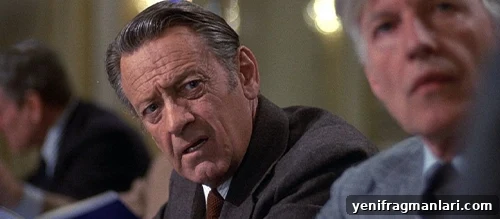
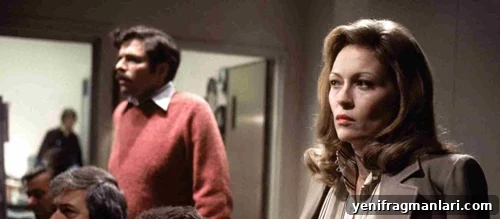
Faye Dunaway’s Diana Christensen embodies this systemic logic. Her performance—awarded an Oscar—portrays a woman who thinks in metrics: ratings, market share, and influence. Diana treats programming like product and people like elements in a broadcast schedule. Her relationship with William Holden’s Max Schumacher, a former UBS executive, reveals the human cost of such a transactional approach. Schumacher, when removed from the newsroom’s machinery, recognizes Diana’s emotional detachment: she is “television incarnate,” he tells her. For her, romance is a scene that can be rewritten or cut if it fails to deliver strong viewer numbers.
Network resists tidy moral closure. When the film reaches its end, it refuses conventional cinematic consolation: wrongdoers are not always punished, and the world does not neatly resolve. The soundtrack recedes, leaving a stark finality that emphasizes how unromantic reality can be. Lumet refuses to cue the audience on how to feel; the film asks viewers instead to confront an uncomfortable truth—television’s ability to anesthetize and distract is sustained only by our willingness to watch.
The closing motif returns to the image of multiple televisions broadcasting different realities. If one channel’s presentation offends you, you can change the channel—an emblem of choice that also masks the deeper problem: all channels may be different versions of the same commercialized, engineered reality. The film’s repeated line—“Television is not the truth. Television is an amusement park.”—captures that paradox. What was emerging in cultural analysis several years later, when theorists pointed to theme parks and media as paradigms of the hyperreal, is present in Network’s urgent critique: when entertainment becomes the main currency of perception, simulated pleasures and narratives risk replacing direct experience and democratic discourse.
Howard Beale’s speech—dismissed as madness by many—functions as the film’s moral catalyst. He momentarily pierces the spell of mediated complacency and calls citizens to a raw, vocal response. Yet the network quickly contains and repackages that voice, demonstrating that visible dissent can be commodified until it no longer threatens the status quo. Ultimately, Network’s insight is not only that corporations disseminate propaganda in the thin guise of news; it is that corporations wield influence only because audiences grant it to them by tuning in. Chayefsky and Lumet’s film remains a powerful, unsettling exploration of media, power, and public responsibility—an artistic statement that still feels remarkably timely.
Score: 22/24
Rating: 4 out of 5.
More Retrospective Reviews