
Dr. Strangelove or: How I Learned to Stop Worrying and Love the Bomb (1964)
Director: Stanley Kubrick
Screenwriters: Stanley Kubrick, Terry Southern, Peter George
Starring: Peter Sellers, George C. Scott, Sterling Hayden, Slim Pickens, Peter Bull, Keenan Wynn, James Earl Jones, Tracy Reed, Jack Creley
Stanley Kubrick originally set out to adapt Peter George’s novel “Red Alert” as a straight thriller, working under titles like “The Edge of Doom” and “The Delicate Balance of Terror.” During development the screenplay shifted into the dark satire we now know as Dr. Strangelove or: How I Learned to Stop Worrying and Love the Bomb, a change that nearly derailed the project but ultimately produced one of Kubrick’s most enduring films.
At the heart of the film’s satire is the idea that human error can undo any supposedly foolproof system. Terry Pratchett once joked from his time working as a publicist for a nuclear plant that no phrase is funnier to insiders than “two completely independent failsafe systems.” Kubrick mines that bitter truth relentlessly. Early on, General Turgidson (George C. Scott) explains in painstaking detail why their layered systems cannot be overridden—ironically exposing the human weaknesses that actually threaten disaster.
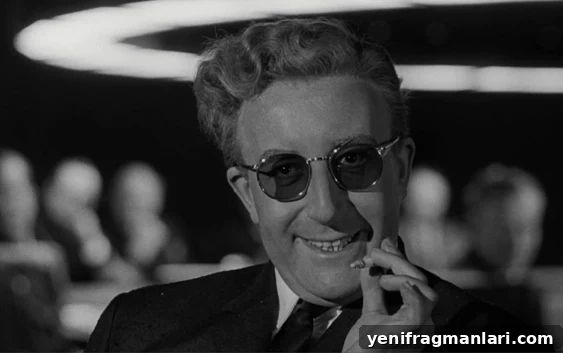
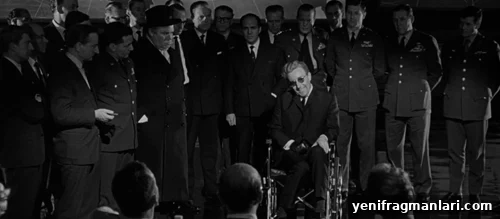
Set in the most dangerous years of the Cold War, the film captures a world living under the constant threat of nuclear annihilation. When the paranoid U.S. Air Force General Jack Ripper (Sterling Hayden) exceeds his authority and orders a nuclear strike on the Soviet Union, the fate of the world falls to three men in the same man’s hands—R.A.F. Captain Mandrake, the ineffectual U.S. President Merkin Muffley, and the unhinged Nazi émigré Dr. Strangelove—three roles all played with extraordinary range by Peter Sellers. Their desperate efforts to prevent global catastrophe drive the film’s tension and its bleak, absurd humor.
The film’s cultural impact has been wide. So ingrained is the image of the “war room” in popular imagination that when Ronald Reagan entered the White House he was surprised to learn there was no real-life room matching the film’s cinematic depiction. Kubrick’s black comedy struck nerves both public and private; studio executives and government figures reacted with shock and anger, a reaction that suggests the film hit on uncomfortable truths about military power and national hubris.
Kubrick’s pacing is relentless and economical: there are almost no extraneous moments. He heightens scenarios to absurd extremes for comedic effect, yet beneath that exaggeration lies a sharp, often bleak intelligence. Terry Southern, one of the screenwriters, later reflected on the film’s stance—whether it was anti-military, anti-American, or some combination—and remembered studio executives insisting that the end of the world was not funny. Kubrick, however, deliberately pushed that uneasy tension between humor and horror.
The movie is rich in absurdist set pieces. Major Kong (Slim Pickens), a bombing wing commander, keeps his cowboy hat stored beside the military launch codes; Captain Mandrake lacks pocket change to call the White House and must reverse charges on his call before resorting to a vending machine; Dr. Strangelove’s supposedly possessed Nazi hand provides chillingly comic business; and one of the film’s most quoted lines, “Gentlemen, you can’t fight in here. This is the war room!” captures the film’s satirical inversion of logic.
Peter Sellers had already shown his ability to play multiple distinct characters in Kubrick’s earlier film Lolita, and here he delivers a trio of unforgettable performances. He withdrew from the role of Major Kong due to a foot injury and dialect difficulties, but his portrayals of Capt. Mandrake, President Muffley, and Dr. Strangelove demonstrate an extraordinary comic and dramatic range. Mandrake’s restrained professionalism, Muffley’s bewildered exasperation, and Strangelove’s grotesque, eccentric energy balance the film’s farce and its menace.
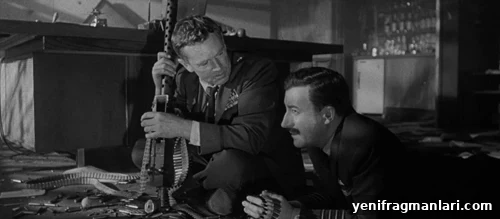
Sellers’ Mandrake convinces by playing the exhausted, polite rationalist trapped inside a mad system; his attempts to placate and reason with General Ripper create quiet, painful comedy. As Strangelove, Sellers heightens every gesture and vocal tic to the edge of grotesque, while President Muffley becomes the world’s most incredulous straight man, his one-sided phone conversations with the unseen Soviet Premier registering like a comic monologue in which the speaker slowly realizes how thoroughly his country has lost control.
The ensemble supporting Sellers is outstanding. Sterling Hayden’s General Ripper—obsessed with the purity of bodily fluids—walks a fine line between believable paranoia and terrifying fanaticism, never becoming caricature. George C. Scott plays General Turgidson as an arrogant, swaggering hawk who embodies the jingoistic impulse Kubrick satirizes. Even when the narrative is confined to an airbase lockdown or the Oval Office-style war room, Hayden and Scott continuously energize scenes with vivid, often reckless performances.
The film’s depiction of gender is dated and problematic: the most visible female character is a secretary in a bikini. Still, the absence of women in other roles is also part of Kubrick’s point—the mad logic of Mutually Assured Destruction was shaped primarily by men in power. Tracy Reed’s Miss Scott has one memorable comic moment as she attempts to relay an urgent coded message to her lover, General Turgidson, who is conveniently distracted in the bathroom next door.
Kubrick deliberately borrows visual and thematic language from classic war films while turning it against itself. The movie’s striking black-and-white cinematography by Gilbert Taylor heightens contrast and drama, while sequences focusing on the air crew—where even camaraderie and improvisation feel doomed—use traditional heroic tropes to emphasize tragic irony. The upbeat music and marching rhythms that accompany the bomber crew’s actions only deepen the film’s satirical sting, underscoring how cinematic conventions can be used to mock real-world militarism.
Although it is a comedy, Dr. Strangelove delivers one of the bleakest endings in cinema. Kubrick seems to suggest that human nature, institutions, and systems leave little hope for avoidance of catastrophe once the mechanisms are in motion. Compared with his earlier anti-war film Paths of Glory, which explored how war corrupts reason and morality, Dr. Strangelove interrogates the modern machinery of destruction with sharper gallows humor and more terrifying implications. The film’s final message is chilling: the same hubris and error that make systems seem infallible are likely to bring about their collapse—perhaps while we laugh at the absurdity of it all.
Score: 23/24
Rating: 5 out of 5.
Recommended for you: Where to Start with Stanley Kubrick