The Front Room (2024)
Director: Max Eggers, Sam Eggers
Screenwriters: Max Eggers, Sam Eggers
Starring: Brandy, Andrew Burnap, Neal Huff, Kathryn Hunter
A24 has become synonymous with a distinct kind of horror filmmaking: mood-driven, often cerebral, and more invested in slow-building dread than in cheap jump scares. That reputation leads audiences to expect a particular blend of atmosphere and thematic ambition. The Front Room is unusual in that, despite its marketing and company association, it feels removed from the identity audiences typically expect from an A24 release. The film attempts to balance psychological unease, familial tension, and supernatural suggestion, but it rarely finds a cohesive voice for the material it adapts.
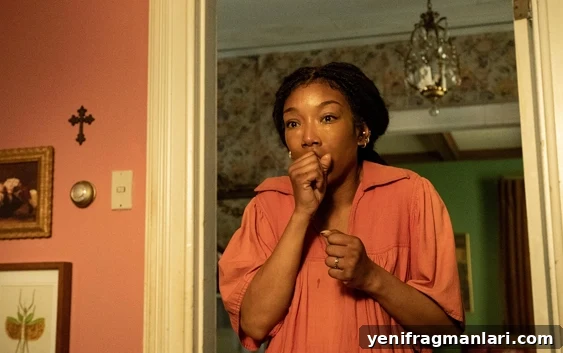
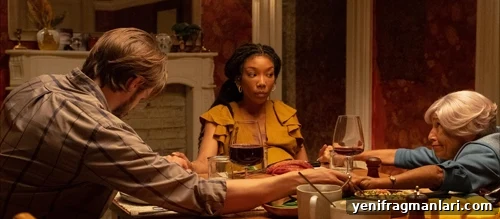
The story centers on Belinda (Brandy) and her partner (Andrew Burnap), a young couple stretched thin financially and emotionally with a baby on the way. Their precarious stability is further compromised when Burnap’s devout and unsettlingly determined mother-in-law, Solange (Kathryn Hunter), moves into their home in exchange for financial support. Solange’s presence disrupts the household: she insinuates herself into daily routines, manipulates relationships and slowly tries to edge Belinda out of the place she occupies within the family. What begins as a tense domestic arrangement gradually slides into something ambiguous and menacing, blurring the lines between real malice and psychological disturbance.
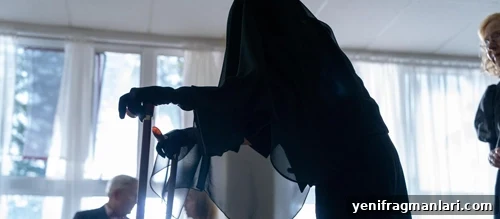
Kathryn Hunter emerges as the film’s most memorable presence. Her performance is anchored in physicality—every movement and use of the character’s crutches feels intentional, serving as an extension of Solange’s personality rather than merely a prop. Hunter’s work offers a bestial, unnerving quality that frequently anchors sequences where the script otherwise skids. She creates a tactile, animal-like menace that sticks with the viewer long after scenes end.
Max and Sam Eggers, the directing duo behind the film, are heirs to a certain filmmaking lineage: they are related to Robert Eggers, whose work is often praised for period detail and psychological intensity. As directors, the Eggers brothers aim to add stylistic flair to an adaptation of a Susan Hill story, but their visual approach can feel overwrought. Repetitive mirror shots, an insistence on odd camera angles, and a tendency toward mannered compositions give the film a look that at times distracts rather than deepens the story. Instead of allowing tension to build organically, the direction frequently telegraphs unease with stylistic devices that call attention to themselves.
That said, the film is not without merits. There are moments when the acting is layered and emotionally truthful, when the script’s quieter beats register and develop subtly. The underlying concept—a young family under siege by an intrusive relative whose motives are unclear—is potent and has strong roots in classic gothic and domestic-horror traditions. The musical score by Marcelo Zavros works hard to manufacture atmosphere, and while it contributes to a sense of dread, it also at times does the heavy lifting that the screenplay and direction should be doing themselves. The result is a tone that feels anxious and insistent but not always earned.
A recurring problem in the film is its refusal to commit to a clear interpretation of the central threat. Is Solange a supernatural force, an embodiment of pure evil, or simply an abusive, manipulative human being whose presence warps the household? The screenplay hovers between possibilities—demonic suggestion and mundane cruelty—without choosing a definitive stance. This indecision undercuts suspense because it prevents the audience from settling into any single mode of fear. If a film cannot decide whether it wants to be a ghost story or a psychological drama, its emotional impact will inevitably be diluted.
By the time the climax arrives, the film’s tonal uncertainty contributes to an anticlimactic finale. Climactic moments that should feel cathartic or terrifying instead land flat because the groundwork for a decisive conclusion has not been fully laid. There is genuine talent on display—solid performances, interesting production design choices, and moments of sustained unease—but these are scattered rather than cumulative. The film therefore struggles to leave a lasting emotional or intellectual impression.
For viewers seeking a classic ghost story steeped in dread and carefully crafted atmosphere, The Front Room may feel like a missed opportunity. For those interested in performances—especially Kathryn Hunter’s nuanced, physical portrayal—there is value to be found. Ultimately, the film is a mixture of promising elements and uneven execution: competent in parts, intriguing in concept, but inconsistent in delivery.
Score: 8/24
Related reads: More 2024 film reviews and critical perspectives on contemporary horror cinema are recommended for readers who want broader context or alternatives in the genre.