
This article was written exclusively for The Film Magazine by Bethen Blackabee of Films at Focal Point.
The Boy in the Striped Pyjamas (2008)
Director: Mark Herman
Screenwriter: Mark Herman
Starring: Asa Butterfield, Vera Farmiga, Cara Horgan, Amber Beattie, David Thewlis, David Hayman, Jack Scanlon, Rupert Friend
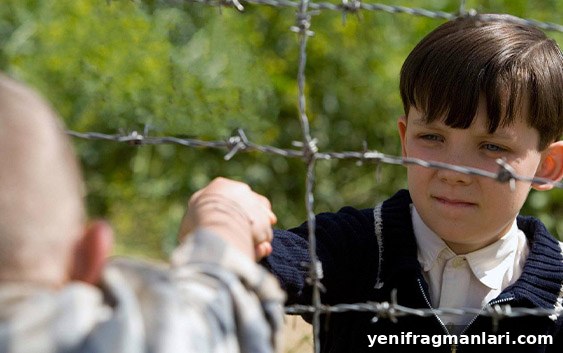
Mark Herman’s 2008 drama The Boy in the Striped Pyjamas crafts a difficult and affecting viewing experience by filtering the horrors of World War II through the eyes of a child. The film follows Bruno, the eight-year-old son of a Nazi officer, who relocates with his family when his father receives a promotion. Innocent and curious, Bruno explores the grounds near his new home and discovers Shmuel, a boy living on the other side of a barbed wire fence. Their unlikely friendship unfolds amid a backdrop of persecution, separation, and the machinery of genocide.
This film stands out for its consistent use of a child’s perspective to shape tone and meaning. Bruno’s point of view governs most scenes, and his naiveté determines how viewers interpret each moment. While Bruno perceives the fenced area as a mysterious “farm,” the visual language and contextual details in the frame continually anchor the story to historical reality. The choice to juxtapose a child’s everyday world with factual references to Jewish discrimination and mass murder forces the audience to confront the contrast between innocence and atrocity.
The cinematography and production design are critical to the film’s emotional force. Simple but powerful props—stacks of dolls, a stark concrete room, rusted barbed wire—become symbols that resonate beyond their immediate appearance. Color palette is used deliberately: richer, darker tones evoke power, security, and privilege, while muted beiges, browns, and washed-out greys mark deprivation and confinement. These visual contrasts underline the gulf between Bruno’s sheltered life and Shmuel’s constrained existence, amplifying the film’s thematic stakes.
Sound design also plays a vital role. The film alternates between diegetic noise and extended silence, using quiet not as absence but as an amplifier for emotion. The restrained soundtrack and carefully chosen moments of hush heighten tension and make the final sequences all the more devastating. When silence is paired with stark imagery and precise framing, the result is a scene that lingers in the viewer’s memory, allowing the emotional impact to take hold without melodrama.
Performance is another of the film’s strengths. Asa Butterfield delivers a convincingly innocent Bruno, while Jack Scanlon’s Shmuel offers a quietly resilient counterpart. Amber Beattie as Gretel and Vera Farmiga as Bruno’s mother bring additional depth: Farmiga in particular portrays a slow, heartbreaking unraveling as her character confronts moral and emotional conflicts within her family. The supporting cast—including David Thewlis, Rupert Friend, and David Hayman—help ground the story in believable human behavior, giving the narrative a realism that can make the fictional elements feel unusually immediate.
Some viewers have remarked that the film feels as though it were drawn from true events, a testament to Herman’s direction and the cast’s commitment. Although the central friendship is fictional and the story takes dramatic liberties, the film repeatedly gestures toward historical facts to keep the viewer aware of the broader context. That tension between invented narrative and historical reference is part of what makes the film both powerful and, for some, controversial.
Overall, The Boy in the Striped Pyjamas is a striking example of how a film can use point of view, visual symbolism, and restrained sound to explore difficult subject matter. It is not an easy watch, but its careful construction—through character development, production design, and performance—creates a memorable, emotionally charged experience. The movie’s closing moments are intentionally wrenching; they leave a lasting impression precisely because the film has earned that impact through subtle, consistent storytelling. For cinephiles interested in wartime drama, child-centered narratives, or studies of cinematography and sound in service of theme, Herman’s film remains a significant and affecting work.
22/24
Written by Bethen Blackabee
You can support Bethen in the following places:
Blog – Films at Focal Point
Instagram – @bethen.film
Twitter – @Bethen1999