
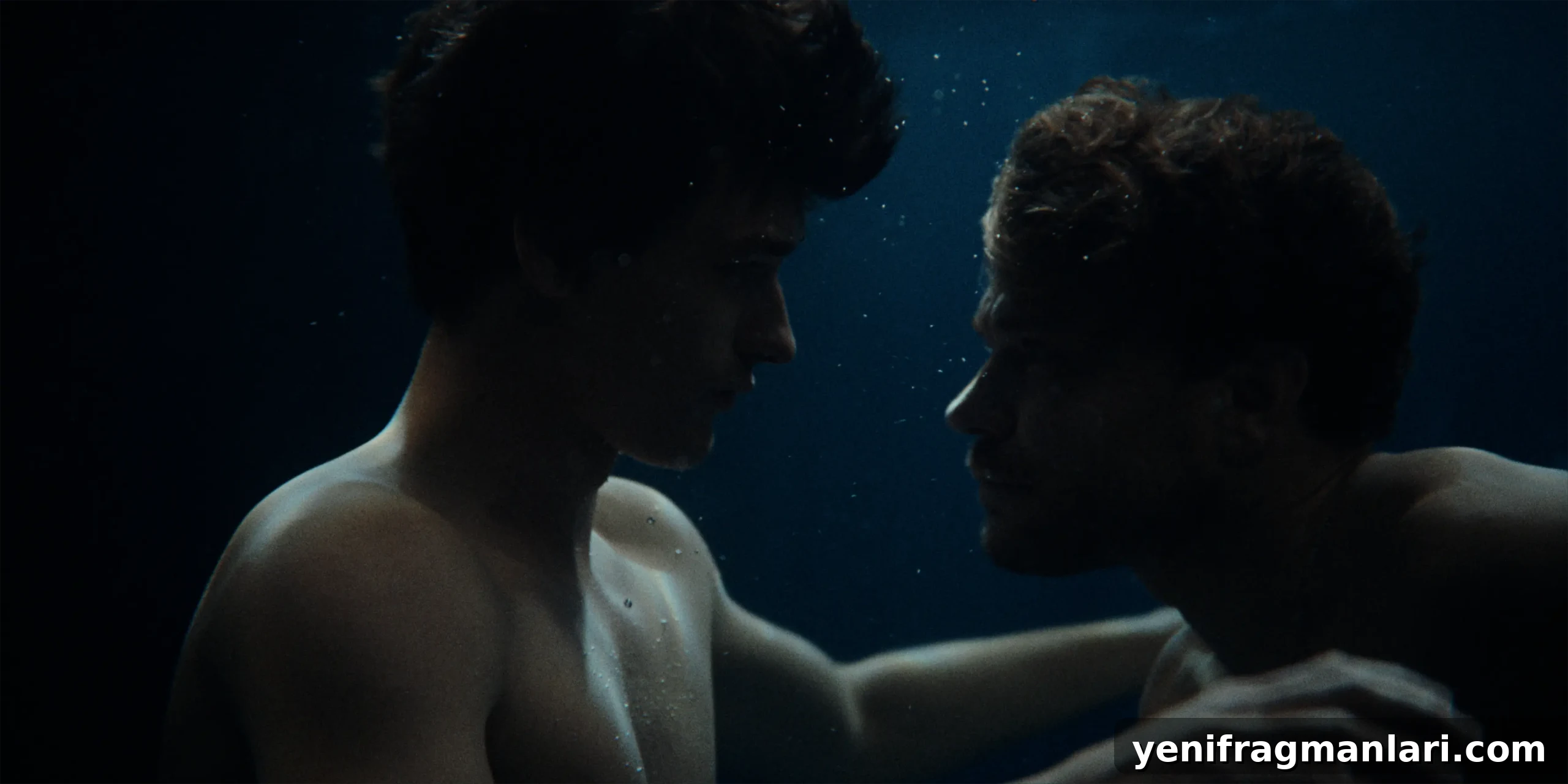
No Rest for the Wicked Film Review | Shame, Desire, and a Life Without Trees
I saw No Rest for the Wicked at the 2026 Fantasia International Film Festival, where it premiered and quickly became one of the festival’s standout titles for me. The film has already earned critical recognition: its director Kasper Kalle won Best Director from the Cheval Noir jury, and Pilou Asbæk received an Outstanding Performance Award for his portrayal of Helge.
Those honors are well deserved, but they do not fully capture what makes No Rest for the Wicked so striking. The film is a tender queer romantic horror piece that uses genre language to amplify intimacy rather than distract from it. The supernatural elements—vampiric suggestion, folk-horror textures, and surreal transformations—do not eclipse the emotional core. Instead, they give Baldur’s shame, longing, anger, and desire tangible expression.
Finding this balance is difficult, and the film succeeds because Kalle treats the horror as an extension of the characters’ inner lives. Rather than letting mythology become the main attraction, the film lets genre imagery grow organically from the relationship at its center. The terror and the tenderness are intertwined: the horror is what the characters’ lives become when repression can no longer hold.
What is No Rest for the Wicked About?
Set in the Faroe Islands in 1862, the film follows Baldur, a young fisherman constrained by family, church, and a tightly policed island community. His life begins to shift when Helge, an older whaler, arrives. Their attraction opens a possibility of another kind of life, but in a society governed by rigid ideas about sexuality, masculinity, and faith, their relationship must remain secret.
After a tragedy, their bond crosses the boundaries of life and death, and the suppressed feelings Baldur has carried all his life start to manifest in uncanny, escalating ways. The movie is adapted from the 1884 short story “Manor” by Karl Heinrich Ulrichs, an early and candid work of queer literature. Kalle honors that lineage while updating the material so it speaks to contemporary emotional experience rather than feeling locked in the past.
The period setting sharpens the stakes without limiting the film’s concerns. At its heart the story asks familiar, urgent questions: what happens to someone who lacks the language to name their desire, who sees no reflections of themselves in the people around them, or who has no safe way to be seen?
Living in Darkness and Learning to Be Seen
Long before Baldur speaks about his desires, his body reveals them. Egor Venned’s performance uses subtle physical choices—downcast eyes, a tendency to make himself small, the habit of avoiding sustained gaze—to communicate a shame that precedes any explicit explanation. This posture is not merely a character tic; it is the outward imprint of a lifetime of concealment.
Helge’s arrival changes that dynamic. Baldur starts to lift his head more, to hold another person’s gaze, and to recognize someone who sees and accepts parts of him he has been forced to hide. In turn, Baldur learns to see Helge as a person with depth, rather than an abstract source of longing. That bidirectional recognition forms the emotional foundation of the film.
Jacob Møller’s cinematography extends these themes visually. Much of the film is dimly lit, with candlelight carving intimate pockets of visibility amid broader darkness. The effect is never dull; instead, the lighting keeps beauty and danger in uneasy proximity. Handheld camera work adds a subtle, persistent instability: the world feels unsettled because Baldur’s life is unsettled.
The film’s visual restraint—enough movement to imply insecurity but not so much that it distracts—supports the performances and keeps the viewer focused on the characters’ interior shifts.
Egor Venned, Pilou Asbæk, and Two Sides of Desire
Venned, making his acting debut after a modelling career, brings an instinctive understanding of how face and body register within the frame. That awareness never reads as self-conscious posing; it becomes a precise tool for expressing a character who cannot always speak his truth. Small shifts in glance, posture, and breathing carry complex emotional information—desire and fear coexist on his face in the same instant.
Pilou Asbæk’s Helge provides a complementary energy: he is older, more assured, and more at ease occupying space. Yet the film resists simplifying them into a confident-savior and a timid recipient. Instead, their relationship functions as a duality—two facets of longing and identity. Helge represents a possible freedom, but he is not invulnerable; Baldur holds a vulnerability that complicates any tidy notion of rescue.
The chemistry between the actors lets the romance breathe without constant exposition. Much of their connection is conveyed in silence, and those quiet moments are rich with mutual recognition rather than empty withholding.
Trees, Driftwood, and an Incomplete Life
One of the film’s most resonant metaphors is rooted in the Faroe Islands’ lack of trees. Baldur has never touched a tree; when he asks Helge what a tree feels like, Helge struggles to answer, ultimately likening it to touching a man’s face. The comparison is straightforward but powerful: Baldur’s sensory and emotional life is incomplete because certain experiences simply do not exist in his world.
The island’s striking landscape is both beautiful and limiting. Its beauty does not erase Baldur’s isolation, nor does his isolation negate the landscape’s splendor. In a place without native trees, wood arrives as driftwood—objects and materials that have traveled from elsewhere. Helge functions like driftwood: an arrival from beyond the island’s boundaries, bringing traces of a life Baldur has never known.
Helge does not “fix” Baldur. Rather, his presence reveals the gaps that were already there, and after Baldur feels something beyond his prescribed world, returning to ignorance is no longer possible.
When Queer Romance Meets Folk Horror
The film’s first act is deliberately patient. Kalle resists immediate spectacle, letting desire accumulate through quiet scenes and restrained interaction. That restraint mirrors Baldur’s own guardedness; the film watches and waits until the characters are ready to move forward.
When the narrative loosens its hold, the transition is jolting in an effective way. Dreams bleed into waking life, quietness erupts into sudden physical intensity, and the controlled stillness gives way to startling images. Those shocks work because they grow from the emotional terrain already established: the horror is not an external imposition but an internal eruption made visible.
Kalle has explained his interest in pairing queer love with horror because the genre can articulate loneliness, shame, and the dread of exposure. In this film, supernaturalism becomes the language for what Baldur cannot safely name. The pacing shifts between silence and fury, calm and outburst, and these states feel like facets of the same emotional truth rather than clashing tones.
Even as the story embraces vampiric and folk-horror elements, it never abandons the romance. The horror ultimately clarifies what the romance contains—hunger, transformation, fear, and a desire that refuses to remain buried.
No Rest for the Wicked and Love Beyond the Physical Body
As the film progresses, Kalle makes a deliberate choice to let identity and feeling travel beyond the familiar physical forms of Baldur and Helge. Their essences continue even when physical appearance shifts or dissolves into other shapes. In a less confident picture, such choices could read as arbitrary surrealism, but here they grow logically from the film’s central idea: desire cannot be confined by social, religious, or even bodily limits.
The characters’ bodies remain meaningful, but they stop being the absolute containment of identity. Desire becomes almost elemental—able to move through darkness, cross borders, and survive attempts to suppress it—without turning abstract or emotionally distant.
Is No Rest for the Wicked Worth a Watch?
Yes. No Rest for the Wicked is a compelling, emotionally rich film that confidently blends a delicate queer romance with folk horror. Egor Venned delivers a nuanced debut, using micro-expressions and measured physicality to convey longing and shame. Pilou Asbæk supplies the steady presence necessary to make Helge feel lived-in rather than symbolic. Kasper Kalle’s direction recognizes that beauty and darkness, confidence and timidity, silence and anger can coexist within the same person and the same landscape.
The film locates horror in the attempt to separate parts of the self and finds tenderness in allowing those parts to be seen together. It is a haunting, humane work that lingers after the credits roll.