
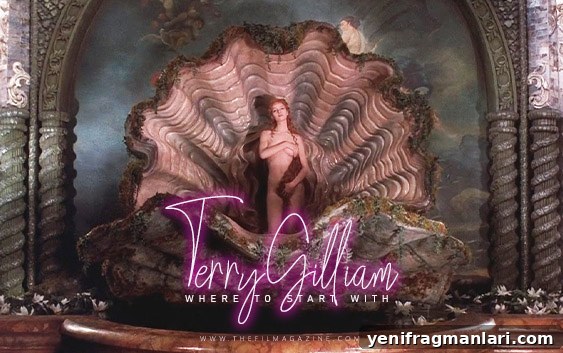
Before he became a cult-favourite director renowned for steampunk aesthetics, surreal imagery and tonal dissonance, Minnesota-born Terry Gilliam (later naturalised British) was best known as one sixth of the Monty Python comedy troupe. Although he rarely wrote sketches, he appeared as memorable grotesque characters such as Cardinal Fang in “The Spanish Inquisition” and the jailer in Life of Brian. He also designed and animated the distinctive cartoons that punctuated and linked sketches in the TV series Monty Python’s Flying Circus.
After a string of short-screen animation jobs, Gilliam began directing feature films alongside Terry Jones on 1975’s Monty Python and the Holy Grail, where his visual sensibility helped give the film a cinematic atmosphere. As one of his fellow Pythons put it, Gilliam’s contribution was central to “making it look like a real movie.”
Over four decades Gilliam has developed a highly distinctive aesthetic: retrofuturist touches in his science fiction, classical art references in his fantasies, and phantasmagoric detours in everything else. His tone typically skews toward dark comedy and his recurring themes revolve around anti-authoritarianism. Gilliam’s ambitious imagination often packs more ideas into a single film than a conventional narrative can comfortably hold, which is why his work remains fascinating even when some titles struggle to fully cohere.
Many of Gilliam’s productions were troubled behind the scenes—from the fraught making of The Adventures of Baron Munchausen, which caused stress and injuries to cast and crew, to the tragic death of Heath Ledger during The Imaginarium of Doctor Parnassus, to the three-decade journey to complete The Man Who Killed Don Quixote. Despite such challenges, his body of work rewards viewers with bold visuals and uncompromising imagination.
Of his thirteen feature films to date, where should you begin? Below is a recommended route into Gilliam’s singular cinematic world—an introduction to his recurring obsessions, visual flair and tonal range. Expect dark humour, striking design, and a strong anti-authoritarian streak. This is Where to Start with Terry Gilliam.
1. Brazil (1985)

Brazil begins with an advertisement—“I want to talk to you about ducts”—which immediately sets the film’s tone: absurd, bureaucratic, and unsettling. Gilliam divides his work between surreal comedy and bleak dystopia; Brazil, alongside films like 12 Monkeys and The Zero Theorem, firmly belongs to the latter category.
The story follows Sam Lowry (Jonathan Pryce), a low-level civil servant trapped in a nightmarish, hyper-bureaucratic state. When Sam is reassigned to the Information Retrieval Department, he becomes entangled with shadowy agents while obsessively searching for a woman he sees in his dreams. From the opening sequence—Sam soaring above clouds like a Bowie-esque angel—the film blurs the line between fantasy and reality, leaving viewers to ask how much of the narrative is objective and how much is Sam’s psychological escape from an oppressive system.
Gilliam’s influences—Fritz Lang’s Metropolis and Orwellian dystopia—are evident, yet Brazil sets itself apart by treating escape through dreams as a form of resistance rather than focusing solely on overthrowing tyranny. The film’s dark, often morbid humour satirises an inhuman system where a misfiled document can mean death and families must bear the cost of interrogations. Robert De Niro’s enigmatic Harry Tuttle embodies the film’s ambiguous spark of rebellion: charismatic, possibly real, possibly imagined.
Gilliam even makes Michael Palin—famously the gentlest Python—menacing as a genial torturer. Visually rich and bleak in equal measure, Brazil is essential Gilliam: audacious, deeply satirical and visually unforgettable.
2. The Adventures of Baron Munchausen (1988)

The Adventures of Baron Munchausen finds Gilliam at his most extravagant and delirious. Sharing DNA with Time Bandits, it strings together episodic fantasy vignettes led by a charismatic ensemble (including Eric Idle, Oliver Reed and Robin Williams). John Neville’s Baron narrates his improbably grand tales on a crumbling stage, and reality seems to bend and rewind around his stories.
The film operates on dream logic: scenes follow associative leaps rather than strict cause-and-effect, producing a vivid, hallucinatory experience. Spectacles include a Méliès-inspired lunar voyage to a disembodied king (Robin Williams), visits to Vulcan and Venus, and a sweeping battle sequence that served as the film’s costly, schedule-stretching finale.
Production troubles are visible at times—the episodic structure shows seams, and the performers reportedly endured pressure—but the film remains a visual feast. Dante Ferretti’s Oscar-nominated production design, lavish practical effects and Gilliam’s baroque world-building make every frame a remarkable object to behold. It’s messy, ambitious and beautiful—classic Gilliam.
3. The Fisher King (1991)

The Fisher King is arguably Gilliam’s most emotionally mature and thematically layered film—a modern, urban take on Arthurian motifs that blends gritty drama with magical realism. Jeff Bridges plays Jack Lucas, a hard-edged former late-night DJ whose life changes after a chance encounter with Parry (Robin Williams), a homeless man on a quixotic quest shaped by trauma and fantasy.
For much of the opening the film is grounded in raw, real-world detail, but with the arrival of Robin Williams’s Parry the director’s characteristic imaginative flourishes seep in. Gilliam substitutes Cervantes’ knight-errant with an ordinary man whose delusions are also deeply human—an exploration of grief, mental illness and redemption rather than a comic caper.
Scenes such as a flaming red knight charging through a city park and the romantically choreographed waltz around Grand Central Station—filmed in a single night—capture the film’s blend of the numinous and the everyday. The result is moving, funny and visually inventive: a film that balances Gilliam’s theatrical instincts with genuine emotional truth.
Recommended further viewing: Explore more of Gilliam’s adventurous and idiosyncratic filmography if these titles intrigue you; his work rewards curiosity with striking visuals and provocative themes.
From his early days as a Python animator to his later career as a fiercely individual filmmaker, Terry Gilliam has produced a catalogue of films that are often flawed but always unforgettable. If you start with Brazil, The Adventures of Baron Munchausen and The Fisher King, you’ll gain a solid sense of his recurring themes—rebellion against authority, the porous boundary between fantasy and reality, and a determinedly theatrical visual style. These works offer an excellent introduction to a director whose ambition and imagination continue to inspire and provoke.