
Director: Michael Radford
Screenwriter: Michael Radford
Starring: John Hurt, Richard Burton, Suzanna Hamilton, Gregor Fisher, Cyril Cusack
Plot: A film adaptation of George Orwell’s chilling vision of a totalitarian future, where even the act of falling in love is outlawed.
When George Orwell’s novel surged to the top of bestseller lists after a major political event in January, publishers responded with large reprints to meet renewed demand. That resurgence underlined how enduring and relevant Nineteen Eighty-Four remains. The novel has been woven into popular culture for decades: phrases like “Big Brother,” “Newspeak,” and “Thoughtcrime” have entered common parlance, and derivative shows and concepts—though often diluted—still trace their origins back to Orwell’s warnings. The story continues to resonate because it captures deep-seated fears about surveillance, propaganda, and the erosion of personal freedom.
Nineteen Eighty-Four affected me profoundly when I first read it. The book’s ending left me emotionally raw, lingering on my mind for weeks and prompting a search for film adaptations that might offer a fresh perspective. Michael Radford’s 1984 is one such adaptation, and its emotional impact stayed with me long after viewing. The film is a faithful, intense rendering of Orwell’s bleak vision and is difficult to watch without feeling unsettled.
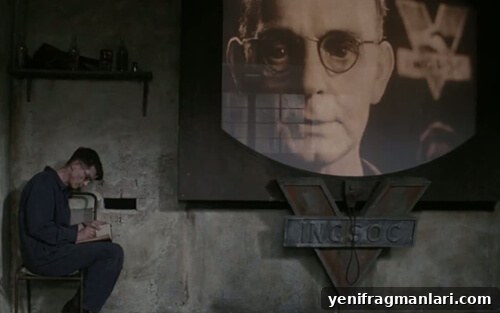
The story follows Winston Smith (John Hurt), an ordinary man trapped under the Party’s oppressive rule in Oceania. The Party, led by the omnipresent symbol Big Brother, maintains control through constant surveillance, public rituals, and a system that rewrites history to eliminate inconvenient truths. Winston works at the Ministry of Truth, altering historical records to match the Party’s shifting narrative. He grows increasingly disillusioned and begins to entertain the dangerous idea of resistance. That small spark of rebellion becomes more tangible when he meets Julia (Suzanna Hamilton) and they begin an illicit love affair. Their relationship offers a brief, fragile glimpse of humanity, but their hope is fragile. O’Brien (Richard Burton), an enigmatic inner-party figure, seems to hint at a resistance movement, drawing Winston deeper into a perilous web. The consequences of defiance are brutal and absolute.
Adapting a novel rich in internal monologue and philosophical reflection to a feature film is a formidable challenge. The movie necessarily trims some of the book’s more cerebral passages to fit a near two-hour runtime. As a result, certain conceptual elements feel compressed; ideas such as Newspeak and Thoughtcrime appear on screen, but without the novel’s detailed internal exposition they can sometimes feel abstract. Small but important moments of revelation tied to Winston’s work at the Ministry of Truth can be easy to miss without the book’s narrative clarity. Similarly, the intellectual force of O’Brien’s interrogations, intense on the page, can come across as oblique in purely cinematic form.
Where the film succeeds brilliantly is in its visceral, sensory world-building and emotional power. The constant drone of telescreens broadcasting Party slogans and fabricated triumphs creates a suffocating soundscape that mirrors Winston’s psychological state. Visual contrasts amplify the sense of dissonance: proclamations of prosperity are juxtaposed with crumbling infrastructure, poor living conditions, and the gaunt faces of citizens. Cinematography and editing heighten this disorienting effect, making truth itself feel slippery. In one memorable shot, a beautiful young woman’s face briefly dissolves into that of an aged, toothless figure—an unsettling reveal that captures Winston’s mixture of desire, disgust, and self-loathing.
The emotional heart of the film is the affair between Winston and Julia. Their secret moments—especially the discovery of Julia’s simple note, “I LOVE YOU”—are both exhilarating and heartbreaking, effectively conveying the human need for connection under a regime that seeks to extinguish it. The pastoral scenes where Julia and Winston briefly experience tenderness and freedom are rendered with lush detail, making their subsequent capture and humiliation all the more devastating. When they are arrested and exposed, the audience shares their vulnerability and shame. The real horror of the story is not only physical torture but the systematic destruction of inner life, empathy, and memory—what the Party destroys most effectively is hope itself.
John Hurt delivers a towering performance as Winston Smith, bringing vulnerability and quiet defiance to the role. His portrayal gives the film its emotional anchor; his suffering and gradual breakdown are deeply affecting. Suzanna Hamilton brings a sense of raw honesty to Julia, making their bond believable. Richard Burton’s turn as O’Brien—his final film performance—mixes warmth with menace and adds chilling gravitas to the interrogations that conclude the film.
One of the film’s strengths is its refusal to tie Orwell’s warning to any single historical regime. Michael Radford deliberately avoided direct parallels to specific governments, allowing viewers from different contexts to interpret the story through their own experiences and fears. That neutrality preserves the novel’s universality: the mechanisms of control, propaganda, and dehumanization can arise anywhere. Whether viewers see echoes of Cold War anxieties, contemporary political manipulation, or the dehumanizing effects of unchecked power, the core message is the same: unchecked hatred and the craving for absolute authority erode freedom and humanity.
“If you want a vision of the future, Winston, imagine a boot stamping on a human face forever.”
The film remains a stark reminder of the dangers of allowing fear and division to empower those who would dominate others. Michael Radford’s 1984 is a powerful, unsettling adaptation that compels viewers to consider the value of truth, memory, and the courage to love in the face of oppression.
Score: 17/24
Recommended for you: More Movie Reviews from The Film Magazine