
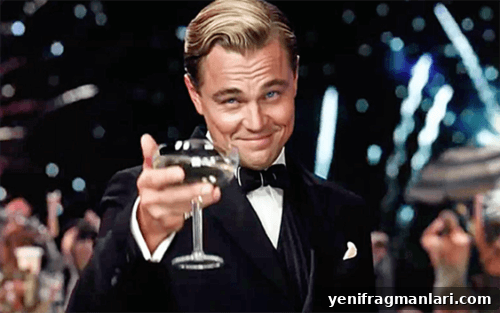
The Great Gatsby (2013)
Director: Baz Luhrmann
Cast: Leonardo DiCaprio, Tobey Maguire, Carey Mulligan, Emily Blunt, Joel Edgerton, Elizabeth Debicki, Isla Fisher
Plot: In the Roaring Twenties, the glittering and mysterious life of millionaire Jay Gatsby and the ideal of a hopeful future as a writer draw the young and naive Nick Carraway into a tangled family drama. When Gatsby reunites with his lost love, Daisy Buchanan—who also happens to be Nick’s cousin—old passions and new conflicts collide in a story of longing, illusion, and social decay.
The film opens by introducing Nick Carraway (Tobey Maguire) as a storyteller, recounting the events surrounding Jay Gatsby to a medical professional. From the first scenes, Baz Luhrmann’s adaptation establishes the dissolute atmosphere of 1920s America, especially the excesses of New York high society. We learn that Nick moved to the city to work on Wall Street, having set aside his ambition to become a writer. This background sets up the film’s central tension between aspiration and compromise.
Early on, the film presents Daisy Buchanan (Carey Mulligan) and her husband Tom (Joel Edgerton), a domineering former college football star and serial philanderer. Nick, as Daisy’s cousin, visits their home for dinner and the film uses light and visual contrast to introduce Daisy as an alluring, almost ethereal figure—white clothing and bright lighting make her seem otherworldly and unreachable. Yet this angelic presentation is quickly complicated by hints of moral corruption beneath the surface. The cinematography’s deliberate use of light performs an effective piece of foreshadowing about Daisy’s dual nature.
A long dinner party sequence that follows functions as a microcosm of the film’s critique of wealth and superficiality. Luhrmann stages the scene with rotating camera movements and focused close-ups that emphasize faces and expressions over meaningful dialogue, conveying how the characters prioritize spectacle and pleasure over substance. Even when a serious discussion—such as one about racial equality—begins, it’s interrupted and discarded, underscoring the shallowness of the social circle depicted. The film frequently returns to contrasts between lavish parties and the emotional emptiness beneath them.
Structurally, the movie relies on Nick’s voice and the framing device of him writing a novel about Gatsby. Luhrmann alternates between Nick’s present-day reflections and his flashbacks, often showing on-screen text drawn from the manuscript to signal shifts between memory and narration. This interplay of past and present creates a layered, sometimes contradictory account that mirrors how memory reshapes events and feelings with hindsight.
Gatsby himself appears relatively late—nearly half an hour into the film—a pacing choice that builds anticipation and pays off when he finally emerges. After Gatsby’s introduction, the narrative accelerates: parties grow more extravagant, emotions become more fraught, and the novel’s melancholic tone becomes increasingly evident. The film nods to F. Scott Fitzgerald’s famous novel while converting its interior melancholy into a lush, cinematic spectacle.
A notable artistic choice is the presentation of the flashback to Daisy and Gatsby’s first meeting through the perspective of Jordan Baker. By filtering that crucial moment through another character’s view, the film creates distance and yet allows the audience to feel the charged chemistry through controlled performances and visual nuance. Carey Mulligan’s Daisy benefits from this approach: she conveys both a fragile, angelic exterior and a self-centered, conflicted interior with precision.
Mulligan’s Daisy reads as emotionally compromised by status and habit; she appears incapable of true, sustained attachment, a condition mirrored in her marriage to Tom. Gatsby’s sentimental honesty contrasts sharply with the Buchanans’ cynical entitlement, and the film frames Tom and Daisy as social figures who manipulate others for amusement rather than empathy. This reading of Daisy’s character has prompted debate about whether the portrayal veers toward misogyny, since her indecision and cruelty drive much of Gatsby’s tragedy.
Tobey Maguire’s Nick and Leonardo DiCaprio’s Gatsby drew mixed impressions. Maguire’s narration is central but often distant: his delivery can feel removed rather than engaged, making it harder to emotionally invest in his role as observer and moral witness. DiCaprio delivers a charismatic and haunted Gatsby, though some viewers may find moments of melodrama that make Gatsby’s intensity seem staged rather than organic. Still, DiCaprio elicits sympathy for Gatsby’s yearning and vulnerability even as the character displays possessive tendencies toward Daisy.
On a technical level, the film shines in its production design and cinematography. Period costumes, set design, and Luhrmann’s vivid visual language create a hypnotic representation of the Jazz Age. At the same time, the use of CGI and modern special effects, along with an anachronistic soundtrack that blends contemporary songs with classical motifs, divides opinion: for some viewers the hybrid choices enhance the story’s emotional immediacy, while for others they disrupt the period atmosphere. The soundtrack’s modern-pop inclusions—used against 1920s visuals—sometimes pull the viewer out of the world the film seeks to evoke.
Overall, The Great Gatsby (2013) is a visually arresting but uneven adaptation. Its strengths lie in production design, cinematography, and certain performances—most notably Carey Mulligan’s nuanced Daisy—while its weaknesses include tonal inconsistency, moments of overwrought acting, and choices that may alienate purists of Fitzgerald’s novel. The film remains an ambitious, polarizing reimagining of the classic story that will appeal to viewers who appreciate spectacle and stylized interpretation, even as it frustrates those who seek strict fidelity to the source material.
Score: 10/24
Recommended for you: Baz Luhrmann Movies Ranked