
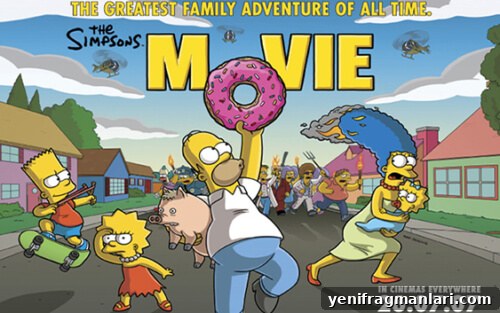
The Simpsons Movie (2007)
Director: David Silverman
Screenwriters: James L. Brooks, Matt Groening, Al Jean, Ian Maxtone-Graham, George Meyer, David Mirkin, Mike Reiss, Mike Scully, Matt Selman, John Swartzwelder, Jon Vitti
Starring: Dan Castellaneta, Julie Kavner, Nancy Cartwright, Yeardley Smith, Hank Azaria, Harry Shearer, Pamela Hayden, Tress MacNeille, Albert Brooks, Russi Taylor
Plot: After a runaway incident involving a pet pig, Homer Simpson accidentally causes Springfield to be sealed beneath a giant glass dome. Cast out by the town and estranged from his family, Homer must find a way to redeem himself and stop the EPA from destroying his hometown.
The Simpsons Movie remains a noteworthy adaptation of the long-running animated series, bringing the signature satire and family dynamics of the television show to a feature-length format. Directed by David Silverman and written by a team of veteran Simpsons writers, the 2007 film keeps the central personalities intact while expanding the stakes: environmental collapse, government intervention, and a town under quarantine. These themes give the film both topical resonance and the kind of broad comic set pieces that suit a theatrical release.
The movie’s environmental storyline is its defining backbone. The plot centers on pollution and the consequences of careless behavior, dramatized through Springfield’s gradual contamination and the extreme response that follows. The film frames this issue through the familiar lens of Springfield’s citizens, allowing the familiar humor of the show to interrogate environmental responsibility without losing its comedic edge. The presence of a high-profile political figure in the story underscores the satire, balancing earnest environmental concern with the show’s trademark irreverence.
At its heart, however, the movie is a family story. The emotional center of The Simpsons Movie is the relationship between Homer and Marge. Marge’s steady voice of reason contrasts with Homer’s escalating foolishness, and their reconciliation provides the film’s most sincere moments. The father-son dynamic between Homer and Bart is also prominent: Bart’s frustration and search for a role model are explored alongside classic Simpsons gags, and these interactions ground some of the film’s broader comedic excesses.
One of the film’s most memorable contributions to Simpsons lore is the comically absurd character known as Spider-Pig, a running gag that became central to the movie’s marketing and pop-cultural footprint. While the pig sequence is a lighter, slapstick moment, it functions as the catalyst for the larger narrative and highlights the film’s willingness to mix lowbrow humor with larger social commentary.
Critics and fans reacted strongly and sometimes divisively to the movie. For some viewers, the film was a welcome return to Springfield that preserved the essence of the television characters while offering bigger set pieces and a more cinematic scope. For others, the movie fell short of the series’ classic episodes and did not match the heights of the show’s most celebrated seasons. These differing responses reflect broader debates about how long-running franchises evolve and whether a feature film can or should change the tone of an established TV property.
Ultimately, The Simpsons Movie stands as an important post-2000 entry in the Simpsons canon. It translates core series elements—family dynamics, social satire, and character-driven comedy—into a longer format that remains entertaining and accessible. Whether judged for its humor, its message, or its nostalgic appeal, the film is a worthwhile watch for fans and a representative example of how animated television properties can expand onto the big screen while keeping their identity intact.
Score: 15/24
Written by James Cullen
Recommended for you: More Movie Reviews from The Film Magazine