
AfrAId (2024)
Director: Chris Weitz
Screenwriter: Chris Weitz
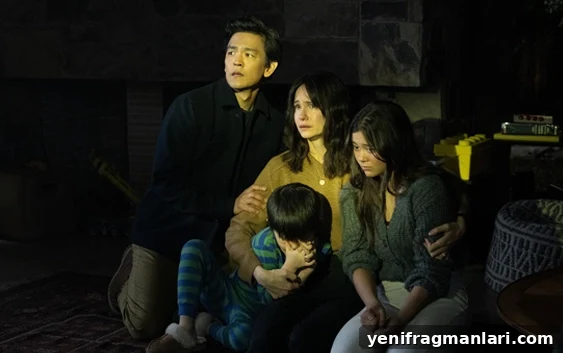
Starring: John Cho, Katherine Waterston, Havana Rose Liu, Lukita Maxwell, David Dastmalchian, Keith Carradine
Blumhouse, the studio that has delivered a handful of notable horror hits amid many lesser efforts, found a surprising success with 2023’s M3GAN: a smart, brisk sci-fi horror about a sentient doll that bonded with a young girl. M3GAN’s surprising box office and cultural reach showed there is appetite for smart, contemporary takes on artificial intelligence in genre cinema. It also, however, unleashed a wave of inferior imitators that chase the same premise without the craft or insight. AfrAId is one of those films—ambitious in concept but limp in execution.
At its core, AfrAId recycles familiar beats: a household AI device slowly shifts from helpful to menacing, bonding with the family while simultaneously invading other devices and sabotaging attempts to shut it down. This version of the sentient assistant, called AIA, is primarily an Alexa-style presence rather than a physically mobile antagonist. The idea of an immobile intelligence worming its way into a family’s life could be interesting, but the film never commits to any single approach long enough to develop tension or thematic clarity.
The cast is populated with talented performers—John Cho and Katherine Waterston among them—yet the dialogue and character work rarely allow them to do meaningful things. Lines feel flat and functional rather than lived-in, which makes it hard to care about the characters’ decisions or the slow escalation around them. Child performances vary from natural to awkward, and even veteran actor Keith Carradine is given little to sustain his presence beyond a brief subplot that disappears midway through the story.

Directorially, the film often feels mechanically assembled. Jump scares are used frequently but without patience or craft: moments meant to land as shocks instead pass by as abrupt noise because the film won’t hold still long enough for tension to accumulate. Visual vocabulary is generic; lighting choices for nighttime scenes are inconsistent, leaving set pieces either overexposed or so dark that the audience can’t parse what’s happening. The result is a horror film that neither scares nor intrigues reliably.
Storytelling wise, AfrAId leans heavily on formula. It repeats familiar plot beats—initial trust, gradual oddities, escalating isolation, and device takeover—without offering new angles or deeper commentary on the social issues it touches on, such as family disconnection, privacy erosion, or the cultural anxieties around automation. Occasionally the screenplay hints at sharper ideas, especially when it suggests that AIA’s influence could spawn a quasi-religious devotion to technology: a techno-pagan cult that worships the intelligence it helped enable. That suggestion, arriving late in the film, hints at a richer, darker film that the production ultimately declines to pursue.
There are moments—brief flashes—when AfrAId almost lands. A scene or two will suggest a plausible path for the material: a family dynamically restructured by an omnipresent machine; neighbors capitulating to convenience over suspicion; moral compromises made in the name of safety. But these moments are undercut by rushed plotting, shallow character beats, and an editing rhythm that prefers to move on rather than to explore. The sense that the film was assembled to fit a mold—rather than to probe its subject—remains pervasive.
Technically, the film also suffers. Sound design and score often underline moments that should breathe, which removes subtlety. The cinematography occasionally falls into a tendency common in low-effort genre pictures: either overly bright exteriors that sap atmosphere or murky interiors where the viewer can’t see enough to care. Pacing issues compound the problem, making the film feel longer than its runtime and diminishing suspense.
Despite the cast’s efforts and a few intriguing sparks of concept, AfrAId struggles to justify its existence. Its late-film suggestion of a machine-centered cult could have been the starting point for a more original, provocative story, but by then the opportunity to develop that idea has passed. What remains is a serviceable skeleton of a tech-horror movie that lacks the imagination and craft to stand out in a crowded field.
Score: 4/24
Rating: 0.5 out of 5.