Flux Gourmet (2022)
Director: Peter Strickland
Screenwriter: Peter Strickland
Starring: Asa Butterfield, Gwendoline Christie, Ariane Labed, Fatma Mohamed, Makis Papadimitriou
Peter Strickland, the director known for his distinct and often unsettling cinematic voice, returns with Flux Gourmet, a film that blends dark comedy, satire, and the aesthetics of giallo. Following the visual bravura of his previous work, this film again demonstrates Strickland’s eye for composition, color, and atmosphere, while offering a polarising take on contemporary art and performance.
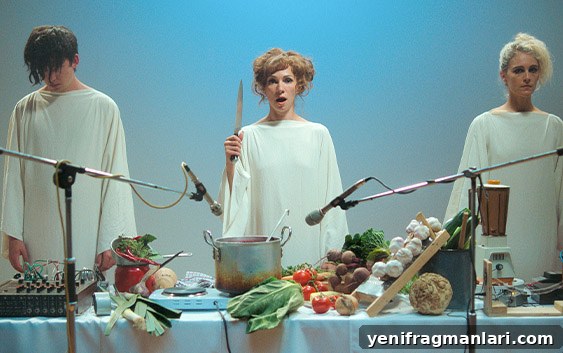
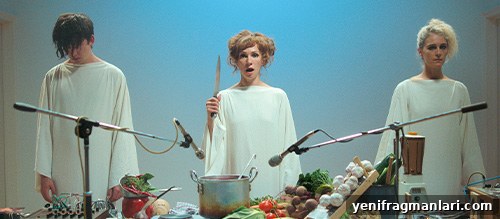
Flux Gourmet centers on a collective of experimental performance artists who practice “sonic catering,” an eccentric method of extracting and amplifying provocative sounds from food and bodily processes. The group accepts a residency at a remote artistic institution, and their daily routine is documented by a journalist with chronic flatulence, who intends to write about the residency after his stay. The film charts the residency over three weeks, each week presented as a structural unit in the screenplay.
Visually, the film is exemplary. Strickland’s cinematography revels in intense primary colors, meticulously staged interiors, and richly textured lighting. Each frame is carefully composed; locations and set design are used to heighten both comedy and unease. Those who appreciate a director who prioritizes mood and image will find much to admire in how the movie looks and feels.
Despite its visual strengths, Flux Gourmet struggles dramatically. The screenplay is organized into three acts—week one, week two, week three—and the repetitive rhythm becomes the film’s main structural weakness. Each week follows an almost identical pattern: interviews with a band member, a communal meal, critical feedback from the collective’s director, a performance, and increasingly chaotic social moments. That repetition, presented without significant development or variation, makes the film feel long and inert at times.
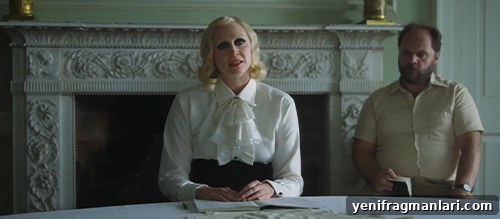
The narrative could have used the tripartite structure to deepen character studies, but the focus is uneven. The film spends considerable time on Elle di Elle (played by Fatma Mohamed) and the leader Jan Stevens (Gwendoline Christie), while other members such as Lamina Propria (Ariane Labed) receive comparatively little attention. Makis Papadimitriou’s journalist, who serves as the film’s narrator, remains present throughout, yet his presence does not fully compensate for the missed opportunities to expand on supporting characters or to explore promising subplots.
Characterization is a major hurdle. Many characters are deliberately exaggerated—pretentious, volatile, or insufferable—but the satire often tips into cruelty rather than wit. Elle di Elle, in particular, is portrayed as a hot-headed, self-assured artist who rejects criticism outright; the performance aims for comic excess but can read as grating for long stretches. The film intends to lampoon contemporary art’s self-importance, yet it often sacrifices nuance for caricature.
The satire itself is blunt. Flux Gourmet targets the world of noise music and avant-garde performance, amplifying the pretensions and rituals of that scene to absurd levels. Moments of staged performance are deliberately over-the-top, and much of the humor comes from the audience’s recognition of art-world affectations. When satire relies on exaggeration, its success depends on balance; here, the needle frequently swings toward parody without the counterweight of insight or emotional depth.
In contrast to the film’s highbrow targets, Strickland incorporates lowbrow comedy—most notably the journalist’s flatulence—both visually and through voice-over narration. The repeated focus on bodily functions aims to bridge the gap between the lofty and the vulgar, suggesting that the two are intertwined. While that concept can be provocative, in practice the film often lands on the crass side of the spectrum, undercutting its own attempts at cultural critique.
The voice-over narration, delivered in the journalist’s native language at moments, is intended to provide reflective commentary and comedic contrast, but it sometimes reads as an affectation rather than a meaningful storytelling device. The film’s attempt to juxtapose high-art satire with base humor produces moments that feel mismatched: the aesthetic refinement of the visuals clashes with the broadness of comedic beats.
Overall, Flux Gourmet is a visually assured film with ambitions to skewered contemporary art culture, but it is hindered by an overreliance on repetition, uneven character work, and humor that too often defaults to the crude. Fans of Strickland’s style may appreciate the film’s craftsmanship and boldness, yet viewers looking for sharper satire or stronger narrative momentum may find it frustrating. With strong performances and striking imagery, the film remains worth watching for its sensory experience, even if its thematic payoff is limited.
Score: 5/24