
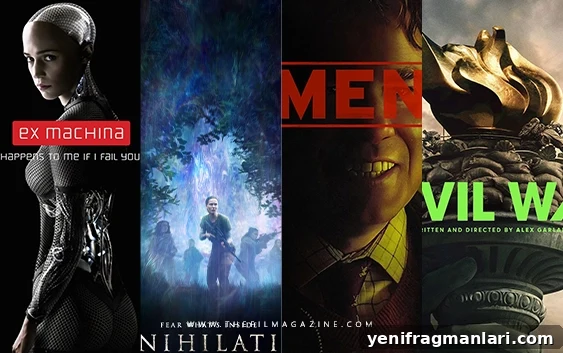
Alex Garland began his career as a novelist and moved into screenwriting, contributing to notable films by directors such as Danny Boyle, including 28 Days Later and Sunshine. Early in his career he did uncredited work on the troubled comic-book adaptation Dredd, absorbing lessons from the filmmakers he collaborated with. Garland made his formal directorial debut in 2014 and has since become known for films that are intellectually ambitious, visually striking, and technically meticulous.
Garland’s work tends to sit at the intersection of cerebral science fiction and psychological horror, persistently probing large questions about identity, consciousness, and what it means to be human. His films are often deliberately challenging and ambiguous, which can limit their mainstream commercial reach even as they attract notable actors and critical attention.
Recent reports indicate that Garland’s fourth feature as director, Civil War, might be his last, reflecting his growing frustration with the film industry. Whether or not he continues directing, his body of work over the past decade deserves close attention. Below are all four of Alex Garland’s films, rank-ordered by critical reception and the distinctiveness of their central ideas.
4. Men (2022)

Men is modest in scale but immense in emotional impact, steeped in the traditions of folk horror and the folklore of the British Isles. From the outset it was always likely to divide viewers. The story follows Harper, played by Jessie Buckley, who escapes an abusive relationship and retreats to a remote countryside rental to recover. Instead of finding solace, she encounters a village populated by men who all resemble the same face, portrayed by Rory Kinnear.
Garland borrows from the unsettling atmospheres of directors like Ken Russell and David Lynch, populating his film with disturbing imagery and a confrontational approach to toxic masculinity. Casting a single actor to embody a range of male behaviours—menacing, pathetic, predatory—is a bold and striking choice. The variations among the men are communicated through changes in hair, makeup, and occasional visual effects; these techniques sometimes hit their mark and at other times feel uneven.
The film builds slowly, letting a creeping sense of oppression settle in, and softly introduces a supernatural element connected to the mythic Green Man. From that steady groundwork the narrative escalates into an increasingly surreal and violent climax. The final act abandons subtlety for a kind of surrealist body horror that beats its themes into the audience, forcing a re-evaluation of what has come before.
Expect controversy: some viewers will respond with reflexive defenses such as “not all men.” The film’s perspective is explicitly through Harper’s traumatized, gaslit point of view; her experiences stand in for countless real-world narratives of women who feel dismissed and disbelieved. Men will resonate strongly with some viewers and alienate others, but it is designed to provoke reflection on why certain viewers react so defensively.
3. Civil War (2024)
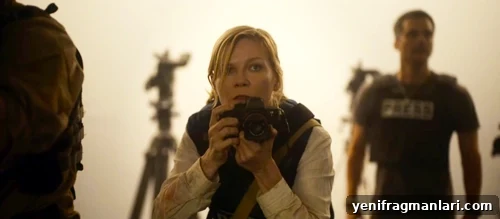
Civil War grew out of a concept Garland developed during the first Biden-versus-Trump election cycle. Delays from the pandemic and other commitments meant the film arrived in cinemas in the lead-up to the next major political moment. The premise imagines a chillingly plausible near future in which a president evolves into a dictator and the United States fractures into open conflict.
Kirsten Dunst plays Lee Smith, a photojournalist who embarks with her colleagues on a perilous journey to document the truth amid chaos. The film interrogates questions around media, truth, and the fragmentation of public reality. It offers no neat solutions but delivers potent, unforgettable images and sequences that dissect extremism, misinformation, and the volatility of perceived truth.
Garland’s work has grown steadily bolder and more uncompromising, and Civil War is no exception. It’s a tense, fastidious deconstruction of contemporary political and media dynamics that lands particularly hard for American audiences called to reassess the institutions and information channels shaping their views.
2. Annihilation (2018)

Garland’s Annihilation diverges from Jeff VanderMeer’s novel in tone and structure. Garland famously chose not to reread the book before adapting it, instead working from a “dream” of its themes, which gives the film a feverish, hallucinatory quality. The story follows biologist Lena, portrayed by Natalie Portman, who joins an all-female scientific expedition into a quarantined wilderness known as the Shimmer, an otherworldly zone that mutates and refracts reality.
Within the Shimmer, the crew’s inner traumas manifest as physical and psychological transformations. The environment itself warps life forms into uncanny hybrids—animals with impossible anatomies, plants that behave like animals—and induces a psychic distancing between characters that amplifies themes of isolation and identity. Garland uses visual motifs of mirrors and refraction to reinforce the film’s ideas about perception and change.
While Garland offers more interpretive closure than the novel, the film still invites prolonged discussion. The climactic sequence—Lena confronting a luminous doppelgänger of herself—is haunting and unforgettable, forcing viewers to reassess everything that has come before. Its blend of beauty and dread makes Annihilation a rare science-fiction experience that is both intellectually stimulating and viscerally affecting.
1. Ex Machina (2014)
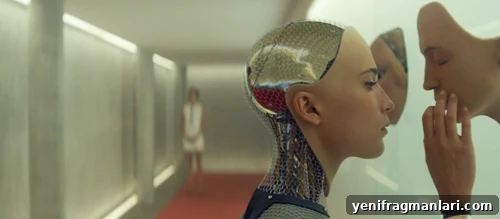
Alex Garland’s debut feature as a director, Ex Machina, remains his most accomplished film. Its meditation on artificial intelligence, power, and human hubris synthesizes concerns present in his earlier screenplays—28 Days Later and Sunshine—and in his later work, including the limited series Devs. The film is an elegant, contained exploration of observation, manipulation, and the ethics of creation.
The plot places Caleb, a junior employee at a tech corporation, in the isolated estate of the company’s enigmatic founder, Nathan. Caleb is invited to help evaluate Nathan’s latest creation, an artificial intelligence named Ava. The narrative unfolds as a three-way chamber piece in which watching and being watched determine power; each character constantly tests and recalibrates the others.
Alicia Vikander’s Ava is a striking, unnervingly human presence, achieved through precise acting and subtle visual effects. The film’s tension is constructed with care, and its twists feel earned rather than gratuitous. Ex Machina proves that inventive, idea-driven science fiction can thrive on modest budgets: the film’s moral and philosophical questions have only become more relevant as artificial intelligence moves further into everyday life and into the hands of the world’s wealthiest and most influential people.
Do you hope Alex Garland will continue directing, or would you prefer to see his writing inform other filmmakers’ projects? Which of his four films resonates most with you? Share your thoughts with other readers and follow discussions on film-focused social channels for further commentary and analysis.