
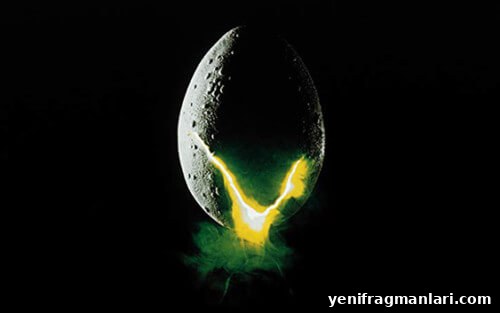
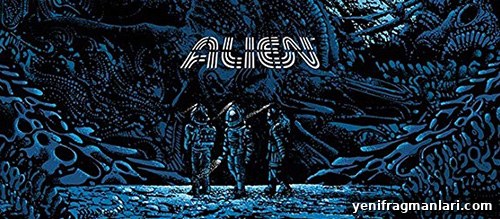
Alien (1979)
Director: Ridley Scott
Screenwriter: Dan O’Bannon
Starring: Sigourney Weaver, Tom Skerritt, Harry Dean Stanton, Veronica Cartwright, John Hurt, Ian Holm, Yaphet Kotto, Bolaji Badejo
Ridley Scott’s Alien announced the arrival of a director with an extraordinary visual sensibility and an exacting work ethic. Long before he became a dependable filmmaker on big studio projects, Scott delivered a horror film that still lingers in the imagination: atmospheric, meticulously designed and ruthlessly efficient. His ability to translate design and texture into palpable dread makes Alien feel less like a conventional monster movie and more like an immersive, anatomical study of fear.
The film’s power rests in its tactile production design and the way every detail serves mood and narrative. From the opening minutes, the Nostromo feels alive: lighting, sound and the smallest physical props turn the ship into a functioning, breathing environment. Rather than simply using setting as backdrop, Scott treats the Nostromo as a complex organism, with corridors, ducts and machinery functioning like veins and organs. The effect is claustrophobic and convincingly industrial, expanding the sense of space while trapping the viewer alongside the crew.
Restorations have only sharpened those qualities. Seeing the film on the big screen again reveals how much of the horror is built into texture: condensation on bulkheads, sagging wires, and the everyday grime of a working vessel. Quiet, intimate moments—Harry Dean Stanton’s character taking an offbeat shower in a cargo bay, for instance—become unexpectedly eerie once the film’s textures are magnified. These small, specific details help root the supernatural threat in a believable world.
Collaborations with H.R. Giger and art director Ian Whittaker gave the film an aesthetic unlike anything else at the time. The alien creature, its life stages, and the ship’s interiors feel both biological and mechanical—an unnerving hybrid that turns body horror into industrial design. The film’s imagery frequently merges food, sex and consumption into a single disturbing logic: vents open like orifices, nests resemble grotesque wombs, and the alien’s life cycle reads as a perverse commentary on reproduction and violation. The result is an atmosphere of replacement and disposability, where human life seems increasingly expendable in favor of cold, evolving machinery.
One of the film’s most effective shocks is not the creature itself but an internal betrayal: the revelation that Ash (Ian Holm) is an android. Holm’s uncanny performance makes the reveal viscerally unsettling—his smooth, clinical behavior reframes earlier scenes and undercuts any assumption of human solidarity aboard the Nostromo. When Ripley discovers the milky fluid from his damaged head, that drip of nonhuman “blood” is more terrifying than any alien attack, since it proves the threat has been embedded among them all along.
Alien also toys with ideas about artificial intelligence. The ship’s computer, dubbed “Mother,” is presented in a subdued, text-based manner, but its decisions shape the crew’s fate with the impersonal logic of bureaucratic machines. This echoes the era’s anxieties about technology and control—computers that are not overtly malevolent but are indifferent to human life nonetheless. Ripley’s confrontation with these systems, and her eventual survival, underscores human resilience in the face of institutionalized coldness.
The film does show its 1970s heritage in moments that feel dated to modern eyes. A well-known example is a scene in which Sigourney Weaver’s Ripley appears in minimal attire; defenders argue it is meant to convey vulnerability before the final confrontation, but it remains difficult to separate that shot from broader industry habits of treating women’s bodies as spectacle. Still, Weaver’s performance transcends any single costume choice—her Ripley emerges as a durable, resourceful protagonist whose power owes more to intelligence and will than to visual titillation.
What makes Alien enduring is its balance of immediate horror and open-ended mystery. Unlike later franchise entries that sought to explain the creature’s origins, the first film preserves its enigma. That restraint maintains a sense of cosmic dread: the alien feels like an intrusion from an unknowable elsewhere rather than a puzzle to be solved. Scott’s film is as much a nightmare of containment and invasion as it is a classic sci-fi horror, and it remains one of the director’s most compelling achievements.
Score: 22/24
Recommended for you: Alien Movie Franchise Ranked
Written by Lucas Hill-Paul
You can support Lucas Hill-Paul at the following accounts:
Personal Twitter – @lucashpaul
Film Daily News – @FilmDailyNews