
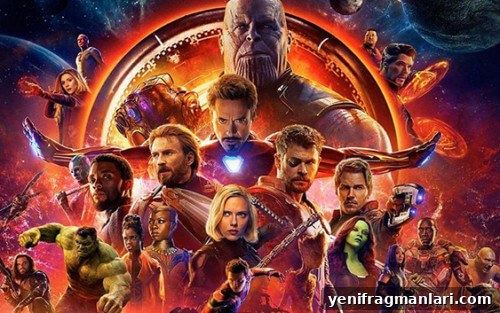

Avengers: Infinity War (2018)
Directors: Anthony Russo, Joe Russo
Screenwriters: Christopher Markus, Stephen McFeely
Starring: Robert Downey, Jr., Chris Evans, Josh Brolin, Chris Pratt, Chris Hemsworth, Tom Hiddleston, Chadwick Boseman, Scarlett Johansson, Tom Holland, Elizabeth Olsen, Karen Gillan, Carrie Coon, Pom Klementieff, Sebastian Stan, Zoe Saldana, Dave Bautista, Benedict Cumberbatch, Idris Elba, Letitia Wright, Vin Diesel, Danai Gurira, Paul Bettany, Bradley Cooper, Gwyneth Paltrow, Mark Ruffalo, Anthony Mackie, Benedict Wong
Avengers: Infinity War delivers a bold, unprecedented chapter in the Marvel Cinematic Universe—an event film that demands to be seen on the biggest screen possible. Ten years and eighteen prior films culminate here, and the Russos have constructed a high-stakes spectacle that rewards longstanding fans while pushing the franchise into darker, more consequential territory.
What sets Infinity War apart is its commitment to making Thanos a fully realized antagonist. Marvel Studios, under Kevin Feige, addressed past criticism about one-dimensional villains by giving the Mad Titan clear motivations and a surprising emotional logic. The film invests time in building his character, turning him from a vague cosmic threat into a believable, terrifying presence whose ambitions drive every major beat of the story. This careful development transforms Thanos into one of the MCU’s most compelling villains—less caricature, more tragic force of nature.
At the same time, the filmmakers balance an enormous ensemble with grace. The movie splits its heroes across multiple fronts—Earth, space, and distant worlds—yet never feels chaotic. Thor, Hulk, Iron Man, Star-Lord, Captain America and others each receive meaningful moments that contribute to the overarching narrative. These sequences deliver the fan-pleasing interactions viewers expect while also advancing character arcs and emotional stakes. Given the sheer number of stars, no single performance dominates, but key actors—Robert Downey Jr., Chris Evans and Chris Pratt—shine when the film calls for their emotional or comedic notes. Josh Brolin’s motion-capture portrayal of Thanos is notably effective, conveying weight and conviction even beneath the visual effects.
The Russos’ direction is tightly focused on story. Despite frequent shifts in location and tone, the film’s narrative through-line remains coherent: the impending, planetary-scale threat posed by the search for the Infinity Stones. Action set pieces are crafted around character objectives rather than spectacle alone, so big moments feel earned. The CGI and production design are polished and often spectacular, but they never overshadow the storytelling. This discipline gives Infinity War a pace that keeps the runtime lean and the stakes consistently urgent.
That said, Infinity War is built for viewers with some familiarity with the MCU. Newcomers may find certain beats puzzling because the film assumes knowledge of relationships and prior events from earlier installments. However, this approach serves the movie’s momentum: by minimizing exposition, it preserves energy and allows scenes to play out without interruption. For longtime fans, the payoff is immense; for casual viewers, it remains an exciting action film that may inspire catching up on the franchise.
In many ways, Infinity War is more than just a blockbuster—it’s a defining entry in modern franchise filmmaking. It manages the near-impossible task of fitting dozens of characters into a single, coherent story while delivering emotional consequences that resonate beyond one movie. Where earlier MCU entries sometimes treated villains as mere obstacles, this film demonstrates how a blockbuster can give its antagonist credible weight and moral clarity. The result is thrilling, somber and often surprising.
There are inevitable compromises: with so many characters, not every hero receives equal depth, and award-season recognition for individual performances seems unlikely. Still, the collective achievement—direction, visual effects, editing and ensemble acting—creates a cinematic experience that feels historically significant for the genre. It sits comfortably alongside other landmark franchise moments that reshaped audience expectations for blockbuster storytelling.
If you have the opportunity, see Avengers: Infinity War in a theater. It’s an event-level film that rewards the communal experience and delivers emotional and narrative payoffs you’ll be talking about long after the credits roll. For fans of the MCU and admirers of ambitious blockbuster filmmaking, this is a near-perfect comic-book epic.
Score: 22/24
Recommended for you: MCU Marvel Cinematic Universe Movies Ranked