
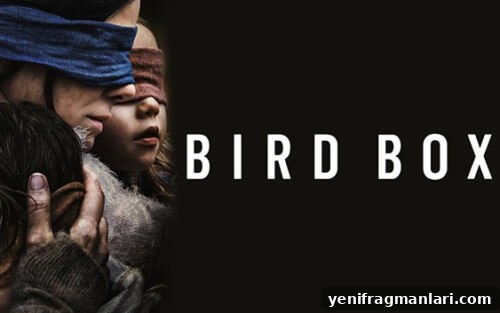
Bird Box (2018)
Director: Susanne Bier
Screenwriter: Eric Heisserer
Starring: Sandra Bullock, Trevante Rhodes, John Malkovich, Sarah Paulson, Jacki Weaver, Rosa Salazar, Danielle Macdonald, Lil Rel Howery, Tom Hollander, Machine Gun Kelly, BD Wong
What are the monsters in Bird Box? Could the apocalyptic threat be a metaphor for the private demons people carry? Susanne Bier’s Bird Box imagines a world where seeing itself becomes lethal, and survivors navigate a landscape where vision is as dangerous as it is vital. Netflix’s adaptation has generated intense discussion precisely because its central conceit—surviving with eyes shut—forces audiences to confront both literal and figurative blindness.
The film’s premise is simple and unsettling: a mysterious, unseen force drives people to suicide if they look at it, so communities survive by blindfolding themselves. Sandra Bullock’s character, Malorie, must shepherd two children—named Boy and Girl—on a perilous river journey toward the rumored safety of a sanctuary. The narrative alternates between scenes from Malorie’s past, showing how the catastrophe unfolded, and the present, charting the river voyage and the group’s fragile attempts to build a life in confinement.
The originality of the setup is one of the film’s strengths. The rules around vision and exposure create immediate tension and inventive sequences, and several plot turns are unexpected enough to sustain suspense. At the same time, the storytelling choices weaken the emotional center at times. The back-and-forth structure scatters focus: by oscillating between before and after, the movie sometimes sacrifices deeper character development in favor of maintaining mystery.
Malorie’s relationship with the two children is the emotional core, and the film thrives when it lingers on the improvised family dynamics—how fear, responsibility and attachment evolve when the normal markers of safety and adulthood collapse. Yet the movie often foregrounds questions of “what” and “why” over giving us more intimate moments that would make those relationships fully convincing. A tighter focus on the trio’s daily rhythms and small human exchanges would have amplified the stakes of their journey.
Several viewers have compared Bird Box to A Quiet Place, and the comparison is instructive. Both films limit a sense-oriented human faculty to heighten peril and explore survival strategies, but they take different narrative risks. A Quiet Place commits to ambiguity about the origin of its threat and lets atmosphere and character guide the experience. Bird Box offers more explanation and broader set pieces, which occasionally undermines rather than enhances its mystery. At times Malorie’s navigational skills and other feats stretch plausibility, yet those moments are balanced by scenes that produce genuine dread and empathy.
Where Bird Box is most compelling is in its metaphorical possibilities. The unseen force works as an allegory for mental health crises and societal denial. The film repeatedly returns to images and lines that suggest how communities choose to look away from uncomfortable realities. Before the catastrophe, Malorie lives a reclusive life and dismisses distant reports of chaos; that gradual collapse of distance into personal tragedy mirrors how mental illness and suicide often pervade lives quietly until they can no longer be ignored.
The apocalypse in this story functions as a blunt instrument to examine stigma. Those who once lived behind locked doors—patients in institutions or people treated as fragile or unstable—are, in some sequences, the ones who react with aggression or fear in their attempts to reclaim normality. Survivors who take refuge inside houses are effectively blind to what they have shut out, while those labeled as mentally broken are sometimes the only ones who seem to sense a different reality. Bier has crafted a vision where conventional community lines are redrawn, exposing how easy it is for society to marginalize and misunderstand suffering.
Symbolism is woven throughout: the blindfolds are both protection and self-imposed isolation; the birds in their cramped container represent hope tested by confinement; the river journey becomes a rite of passage in which trust and courage are measured by small acts of care. The film repeatedly asks: when will we open the box, lift the blindfolds and face what we have refused to see—both as individuals and as a society?
These ambitions make Bird Box worth watching even where the plotting falters. It is not simply a supernatural thriller; it is an attempt to make literal the ways people hide from painful truths and to dramatize the human cost of that avoidance. While the movie can be heavy-handed in its message, and some scenes strain credibility, its emotional center—Malorie’s evolving bond with the two children and her struggle to protect them—remains powerful.
In the end, Bird Box is a film with a strong concept and uneven execution. It asks uncomfortable questions about visibility, responsibility and the limits of compassion. Depression and suicidal behavior are not horror genres to be exploited for scares, but the film insists they are realities too often overlooked. That discomfort is its point: to compel audiences to stop turning away.
17/24