
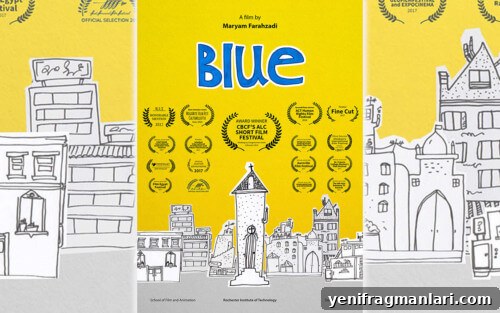
Blue (2017)
Director: Maryam Farahzadi
Screenwriter: Maryam Farahzadi
Maryam Farahzadi’s 2D animated short, Blue, is a compact and affecting exploration of exclusion, identity, and the search for acceptance. At just four minutes long, the film uses a minimalist, paper-storybook visual language to tell a largely wordless tale in which the protagonist’s vivid blue color stands in stark contrast to an otherwise monochrome world. That visual choice becomes the film’s central metaphor: an individual marked as different in a uniform society.
The animation style is deliberately simple, recalling children’s picture books with flat planes, clear silhouettes, and restrained movement. This simplicity works to the film’s advantage by making emotions immediately legible: sadness, loneliness, anxiety, and small acts of kindness are all easy to read without dialogue. The film’s brevity is another strength—its concise structure focuses the viewer’s attention on a small series of encounters that cumulatively build a larger emotional resonance.
On a thematic level, Blue functions as a universal parable about being othered. While the film does not name specific systems of oppression, it invites readings that include racism, sexism, discrimination against illness or disability, and the stigma surrounding mental health. Because the storytelling is visual and largely symbolic, the film can connect with varied audiences who recognize the experience of standing out and seeking connection in a world that often prefers sameness.
However, the short is not without flaws. Some of the editing choices—quick shifts from wide shots to close-ups and sudden tonal pivots—create moments that feel unintentionally comic or melodramatic. Those abrupt cuts can undercut the serious social commentary at the film’s heart, opening certain scenes to alternate interpretations that dilute their emotional weight. In a piece so brief, every beat matters, and a handful of jarring transitions prevent a few moments from landing as strongly as they otherwise might.
Despite these occasional tonal inconsistencies, the film’s emotional core remains persuasive. Farahzadi’s direction demonstrates a clear empathy for the protagonist, and the short’s universality is one of its greatest assets: viewers can project their own experiences of exclusion onto the film and find their reading affirmed. The narrative arc moves from isolation toward a tentative hope, which makes the short’s final moments feel genuinely uplifting rather than pat.
Saman Motamed’s piano score plays an essential role in shaping the film’s mood. The sparse, intelligently arranged music amplifies the narrative without overwhelming it, guiding the audience through the protagonist’s inner life. The combination of pared-down animation and a sensitive musical backdrop helps the film achieve a quietly persuasive form of emotional storytelling.
In terms of impact, Blue performs admirably for a work of its length. It offers a clear, empathetic message about acceptance that lingers after the viewing finishes. While a few technical or editorial slips reduce the force of some scenes, the short remains a heartfelt and relevant artistic statement. It brings a personal perspective to longstanding social issues, giving viewers a moment to consider how difference is perceived and handled in everyday life.
For viewers interested in short-form animation that addresses social themes in an accessible way, Blue is worth watching. Its book-like visuals, universal emotional language, and hopeful conclusion make it a small but meaningful piece of filmmaking that invites reflection and conversation.
16/24