
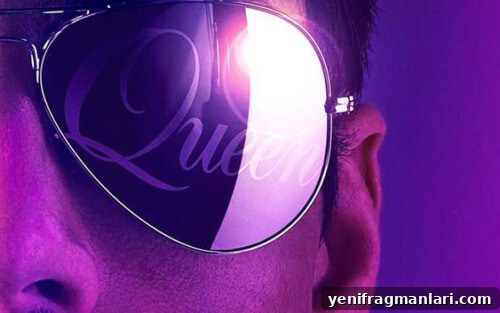

Bohemian Rhapsody (2018)
Director: Bryan Singer (credited), Dexter Fletcher (completed film)
Screenwriter: Anthony McCarten
Starring: Rami Malek, Lucy Boynton, Gwilym Lee, Ben Hardy, Joe Mazzello, Aidan Gillen, Tom Hollander, Allen Leech, Mike Myers
Bohemian Rhapsody, the biopic centered on Freddie Mercury and the story of Queen, arrived after a long, troubled production history. The project lingered for more than a decade under 20th Century Fox, cycling through writers and filmmakers while the surviving members of Queen and their management closely controlled the film’s direction. That careful oversight was intended to preserve Mercury’s legacy, but it also constrained the filmmakers’ ability to probe deeper into the complexities of the man behind the legend.
Production turmoil intensified when director Bryan Singer was dismissed partway through principal photography and Dexter Fletcher stepped in to finish the movie. That highly publicized change contributed to a sense of unevenness throughout the finished film. The end product is a loud, crowd-pleasing musical biopic that often prioritizes spectacle over psychological insight, shaping Freddie Mercury and his bandmates into near-mythic figures rather than fully three-dimensional people.
From a narrative standpoint, the film moves briskly from milestone to milestone. Scenes are assembled to hit key events and tour dates, and many sequences function as tidy checkboxes rather than revealing moments that deepen our understanding of Mercury’s inner life. For viewers already familiar with Freddie’s charisma, sexuality, and hedonistic tendencies, the film rarely offers fresh revelations. Even his most significant personal relationship, with Mary Austin (Lucy Boynton), plays out at a distance; the film never quite captures the intimacy and nuance of that bond.
Rami Malek delivers a physically accurate and charismatic portrayal on stage, and his resemblance to Mercury is striking. But the performance often feels like part of the film’s broader mythmaking. The heavy reliance on lip-syncing and carefully staged concert recreations turns the movie into a series of theatrical set pieces rather than a deep character study. When the script does gesture toward Mercury’s interior struggles, the moments are fleeting and insufficiently explored, leaving an emotional hollow at the center of the drama.
Aesthetically, the film is inconsistent. Some sequences capture the energy and ambition of Queen’s studio process, offering enjoyable glimpses of their collaborative craftsmanship. Yet on the whole the visual approach lacks a cohesive identity. Montage and montage-driven coverage are used heavily to gloss over transitions and compress complex events. Even large set pieces such as the Live Aid recreation—intended to be the film’s triumphant climax—can feel like a polished karaoke tribute rather than an urgent cinematic reinvention of that iconic performance.
Still, the film is not without merit. It acknowledges the band’s musical inventiveness in places, and scenes devoted to songwriting and studio experiments are genuinely entertaining. Gwilym Lee captures Brian May’s mannerisms and musical authority with impressive fidelity. Ben Hardy brings energy to the role of Roger Taylor, though some supporting players, like Joe Mazzello as John Deacon, receive limited material to make an impact. The hair, makeup, and costume departments deserve credit: the film nails the period glam and stage personas that defined Queen’s visual identity.
Ultimately, Bohemian Rhapsody 2018 functions best as a greatest-hits cinematic experience. It celebrates the music, and for many viewers that will be enough—the songs do what they’ve always done: they move people. But as a biographical film about Freddie Mercury, it chooses safety over risk, opting for reverent depiction rather than probing interrogation. The result is a crowd-pleasing, occasionally thrilling movie that falls short of offering new insight into its complex subject.
Given the film’s stop-and-start production and creative compromises, it feels as if two different approaches were stitched together: a glossy concert film and a conventional biopic. Editing choices emphasize major narrative beats and musical highlights while discarding subtler connective tissue. The audience is left to supply much of the emotional heft, singing along during the highs and filling in the blanks during quieter moments.
8/24
By Luke Whitticase
You can support Luke at the following:
Twitter – @WhittyStuff
Letterboxd – whittystuff